Laâyoune
العيون“The capital of the Moroccan Sahara — a desert city between the dunes and the Atlantic.”
Recommended stay
1–3 days
Daily budget
$35 – $180
Best months
November, December
Effort level
Low
Overview
Laâyoune is the largest city in the Western Sahara region and the administrative capital of Morocco's deep south. Built by Spain in 1938 as the colonial capital of Spanish Sahara, it was integrated into Morocco in 1975 during the Green March. Today it is a modern, sprawling city heavily invested in by the Moroccan state, with wide boulevards, phosphate wealth, and a Sahraoui culture unlike anywhere else in Morocco. The surrounding landscape — flat hamada desert, white dunes at Foum El Oued, and the dramatic Atlantic cliffs — is elemental and vast.
History
The area around Laâyoune has been inhabited by Sahraoui nomadic tribes for millennia. Spain formally colonised the territory in 1884 and established Villa Cisneros (now Dakhla) and Laâyoune as administrative centres. The discovery of massive phosphate deposits at Bou Craa in the 1960s transformed the territory's strategic importance. After Spain withdrew in 1975–76, Morocco organised the Green March — 350,000 Moroccan civilians crossed into Western Sahara — and administered the territory. Large-scale infrastructure investment has made Laâyoune the most developed city in Morocco's deep south.
Culture & Traditions
Sahraoui culture centres on hospitality, oral poetry (the Hassan dialect's rich poetic tradition), camel husbandry and the tent (khaïma) as the fundamental social space. Tea ceremony here is different from northern Morocco — three small glasses of very sweet tea, prepared on the ground, with a social ritual lasting 30–45 minutes. The Guedra dance and Sahraoui music (using the tidinit lute and t'bal drum) are performed at celebrations. Traditional blue and black melhfa robes (for women) and white daraa (for men) remain everyday dress.
Must-See Sights
Foum El Oued Dunes
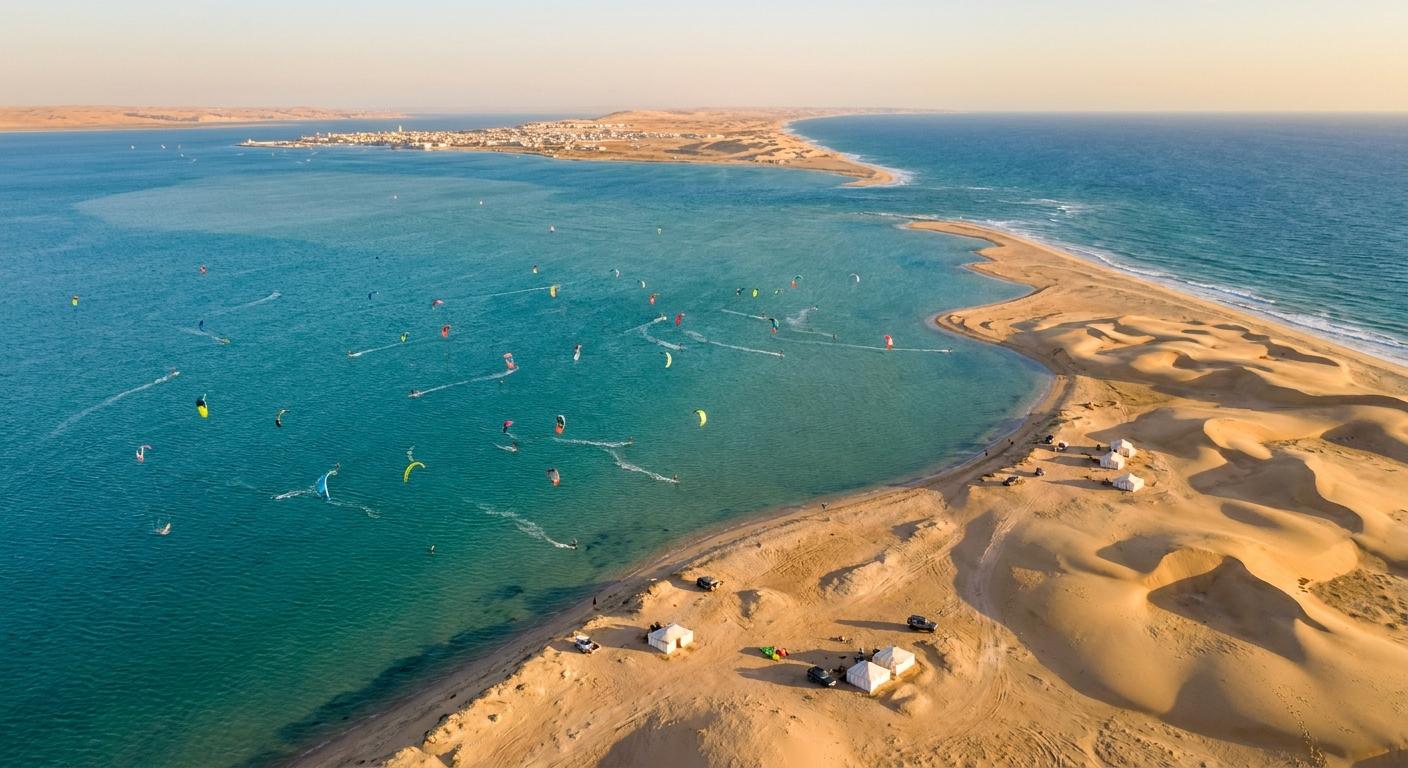
White sand dunes meeting the Atlantic 25km from Laâyoune — spectacular and almost completely deserted.
Laâyoune Plage
A dramatic Atlantic beach backed by dunes, 25km from the city — powerful surf and extraordinary light at sunset.
Mosquée Hassan II
The city's grand mosque — an impressive piece of Moroccan-Sahraoui architecture in the city centre.
Place du Mechouar
The main ceremonial square of Laâyoune — surrounded by administrative buildings in a distinctive Sahraoui-Moroccan style.
Bou Craa Phosphate Conveyor
The world's longest conveyor belt (98km) carries phosphate from the desert mine to the coast — visible from the road south.
Food & Drink
Camel Brochettes
Grilled camel meat skewers seasoned with cumin and black pepper — a Sahraoui staple available at any medina grill stall.
Dried Fish with Argan
Atlantic fish dried in the desert sun and eaten with argan oil and bread — an ancient coastal Sahraoui dish.
Saharan Mint Tea
Three glasses, ground-level ceremony, very sweet — accepting all three is the correct form of respect for the host.
Haoud
A slow-cooked meat and vegetable stew served in a communal bowl — the traditional Sahraoui family meal.
Insider Tips
- ✓Laâyoune is safe and fully functional for tourism — ignore outdated advisories.
- ✓The city is modern and prices for accommodation are higher than northern Morocco — budget accordingly.
- ✓A car is essential to reach Foum El Oued and the Atlantic beaches.
- ✓The road south to Dakhla (540km) is one of Morocco's great drives — flat desert highway along the Atlantic.
- ✓Evening is when the city comes alive — the wide boulevards fill with families until midnight.
Neighborhoods
Ville Nouvelle
Spanish-built colonial grid, now modernised with wide Moroccan boulevards and the main commercial district.
Cité Dakhla
Residential neighbourhood with traditional khaïma tent culture and local Sahraoui life.
Laâyoune Plage
Coastal suburb 25km away with beach restaurants and weekend activity.
Getting There
Hassan I Airport (EUN) receives flights from Casablanca (1.5h daily). CTM buses from Agadir (10h) and Dakhla (6h). The N1 coastal highway is the main road connection — dramatic but very long from the north.
Photos
LaâyouneLocation
Laâyoune, Laâyoune-Sakia El Hamra
27.1536°N, 13.2033°W
Budget Guide / Day
Best Time to Visit