Culture &
traditions
“Morocco is not visited, it is lived. Its culture is a millennia-old dialogue between Africa, the Orient, and the Mediterranean.”
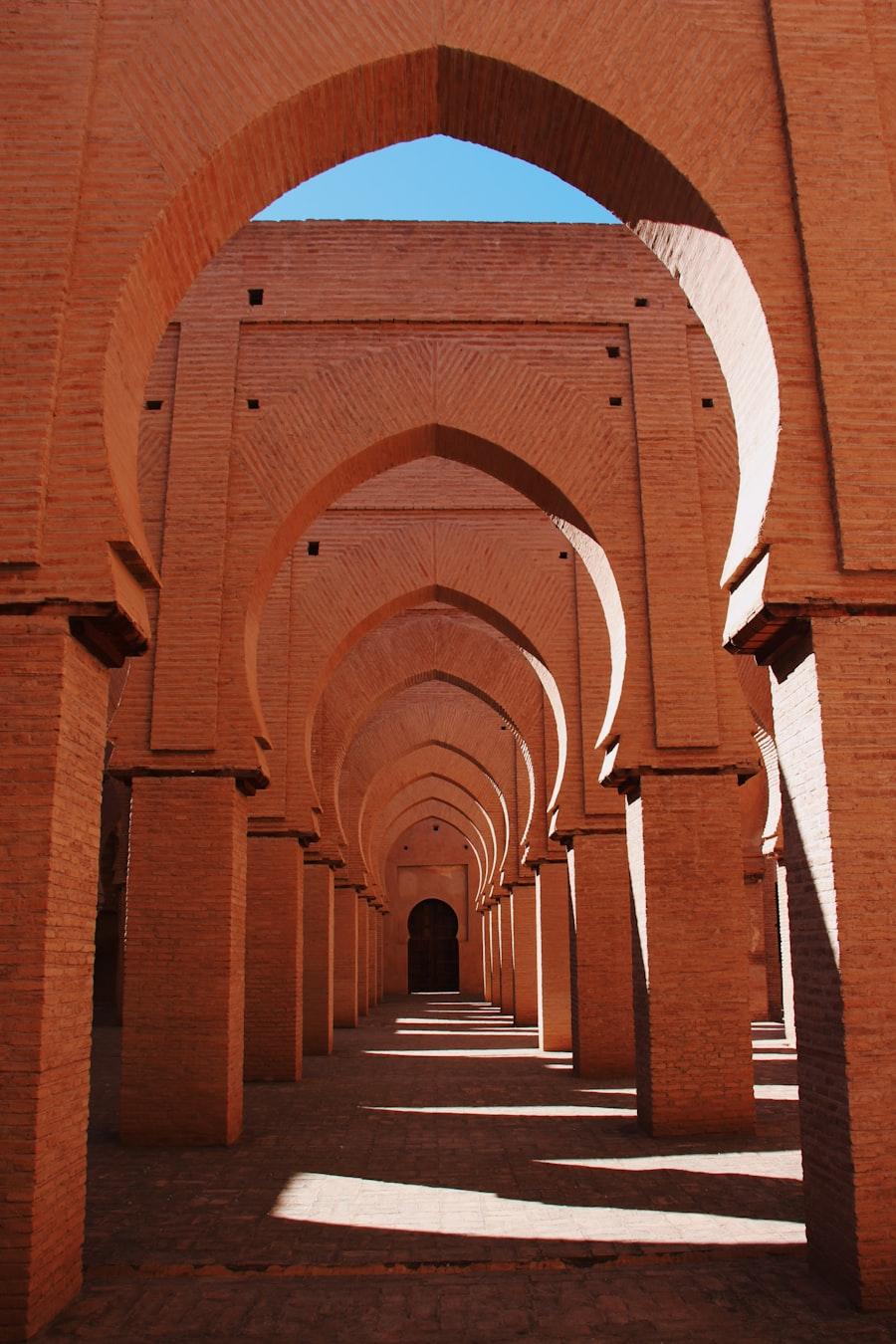
Zellige & architecture
Zellige is one of Morocco's most iconic decorative arts. These geometric mosaics, composed of hand-cut glazed terracotta tesserae, have adorned palaces, mosques, fountains, and riads since the 10th century.
Each piece is individually shaped by a maâlem (master craftsman) who carries on a know-how passed down from father to son. The patterns, with their stunning mathematical precision, rely on symmetries that Western mathematicians only formalized in the 20th century.
Fez remains the undisputed capital of zellige: the Bou Inania Madrasa, the Al-Attarine Madrasa, and the Royal Palace are the most spectacular examples. In Marrakech, the Saadian Tombs and the Bahia Palace rival them in splendor.
Origin
10th century, Fez
Colors
40+ natural shades
Tesserae/m²
800 to 1,200 pieces
From Gnawa to Chaabi
Gnawa music was born from the encounter between sub-Saharan spiritual traditions and Moroccan Sufism. Its hypnotic rhythms, carried by the guembri (three-stringed lute) and qraqeb (metal castanets), accompany the lilas — therapeutic trance ceremonies.
Morocco is also the birthplace of Andalusian music, a legacy of the courts of Cordoba and Granada. The orchestras of Fez and Tetouan perpetuate this refined art during nouba evenings. Chaabi, the quintessential popular music, enlivens weddings and neighborhood celebrations.
Every year, the Gnaoua Festival in Essaouira (June) attracts 300,000 spectators and programs fusions with jazz, blues, and electronic music. The Fez Festival of World Sacred Music brings together Sufi artists, gospel, and liturgical singers in the magical setting of Bab Makina.
Gnawa
UNESCO 2019
Essaouira
300,000 festival-goers
Genres
Gnawa, Andalusian, Chaabi, Raï
Hammam — the ritual
The hammam is much more than a bath: it is an ancient social ritual, a place for purifying body and spirit. Every Moroccan neighborhood has its public hammam, visited at least once a week by families.
The ritual takes place in three rooms of increasing heat. You start in the warm room to open the pores, then apply black soap (beldi) made from olive oil and eucalyptus. Scrubbing with the kessa glove removes dead skin. Finally, rhassoul (clay from the Middle Atlas) purifies and softens the skin.
Two experiences await you: the public hammam (10-30 MAD, authentic, separate for men/women) or the riad hammam (200-500 MAD, private, with essential oils and massage). Both are unforgettable, but the public hammam offers a unique cultural immersion.
Public hammam
10 — 30 MAD
Riad hammam
200 — 500 MAD
Local frequency
1 to 2×/week
Festivals & moussems
Morocco's cultural calendar is exceptionally rich. From international festivals to rural moussems, every season offers a reason to celebrate.
The must-sees: the Gnaoua Festival in Essaouira (June), the Fez Festival of World Sacred Music (June), Mawazine in Rabat (June, one of the world's largest festivals with 2.5 million spectators), the Marrakech International Film Festival (December), and the Moussem of Tan-Tan (UNESCO, September).
Moussems are traditional gatherings blending spirituality, trade, and festivities. The Moussem of Betrothal in Imilchil (September, Atlas) is the most famous: Amazigh tribes come together to celebrate collective weddings according to ancestral traditions.
Mawazine
2.5M spectators
Tan-Tan
UNESCO since 2008
FIFM
December, Marrakech
Living craftsmanship
Moroccan craftsmanship is among the richest and most diverse in the world. Each region has its specialty: Berber carpets from the Middle Atlas, pottery from Safi and Fez, tanned leather from Fez (the famous Chouara tanneries), babouches from Marrakech, silver jewelry from Tiznit, thuya wood from Essaouira.
Berber carpets tell stories. Each motif — diamond, chevron, eye — has a meaning: fertility, protection, life's path. An authentic Beni Ourain carpet (virgin wool, hand-knotted) is negotiated between 2,000 and 8,000 MAD depending on size and complexity.
To buy authentic goods, favor artisan cooperatives (fixed prices, fair wages) or state-run artisan complexes. In the souks, bargaining is an art: start at 40% of the asking price, keep smiling, and don't be afraid to walk away — the seller will often call you back.
Beni Ourain carpet
2,000 — 8,000 MAD
Leather babouches
80 — 250 MAD
Safi pottery
50 — 500 MAD
Culture calls.
The journey begins.
Create a tailor-made cultural itinerary to experience authentic Morocco.
Plan my trip