AAt the foot of Erg Chebbi, Merzouga is a young village on very old land: the Tafilalet, where Sijilmasa ruled the gold caravans and where the Alaouite dynasty began. Nomads, Gnawa musicians and camel drivers still tell that story.
9,000 to 10,000 years ago the region was not a desert: the Sahara was then going through a wet period, with abundant vegetation and lakes. The Tafilalet's marine fossils, trilobites, ammonites and orthoceras hundreds of millions of years old, recall that a sea once covered the whole area.
Erg Chebbi, Merzouga's sea of dunes, stretches some thirty kilometres from north to south, on the edge of the great stony plain, the hamada.
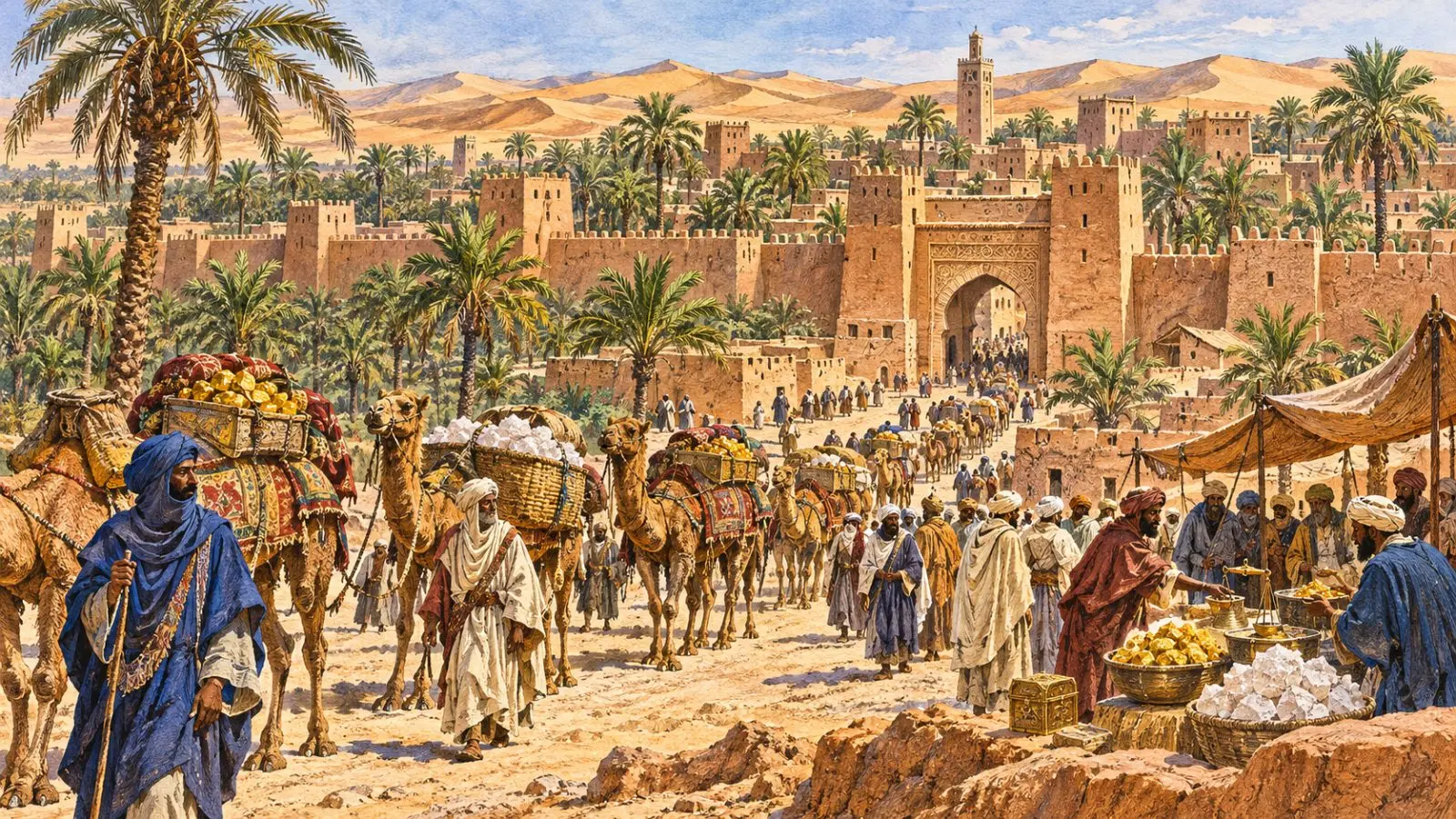
Sijilmassa, gateway of gold (8th-14th century)
About forty kilometres north, in the Tafilalet oasis near today's Rissani, stood Sijilmassa. According to the geographer al-Bakri, it was founded in the 8th century by Sufrite Kharijites after the Berber revolts against the Umayyads; the Midrarid dynasty, from the Miknasa tribe, made it independent of the Abbasid caliphate as early as 771.
Northern terminus of the great trans-Saharan route, Sijilmassa became one of the richest trading centres of the Maghreb: Sudanese gold was minted into coin here, and the traveller Ibn Hawqal wrote in the 10th century of seeing a bill of credit for 42,000 dinars, a sum he had never heard of. Its ruins stretch for about eight kilometres along the Ziz river.
Fatimids, Almoravids and Almohads
Around 905 Abd Allah al-Mahdi, future founder of the Fatimid caliphate, hid in Sijilmassa with his son; imprisoned on Baghdad's orders, he was freed in 909 by an army from Ifriqiya. In the 10th century the Maghrawa, allies of Cordoba, took the city.
In 1055 Abdallah ibn Yasin, spiritual leader of the Almoravids, seized Sijilmassa: their very first conquest, and the city housed their first mint, the empire's only one from 1058 to 1100. The Almohads took it in 1146, then the Marinids in the 13th century. In 1352 Ibn Battuta stayed here before crossing the desert to the Mali Empire, praising its dates as better than those of Basra.
Cradle of the Alaouites
Rissani, cradle of the Alaouites
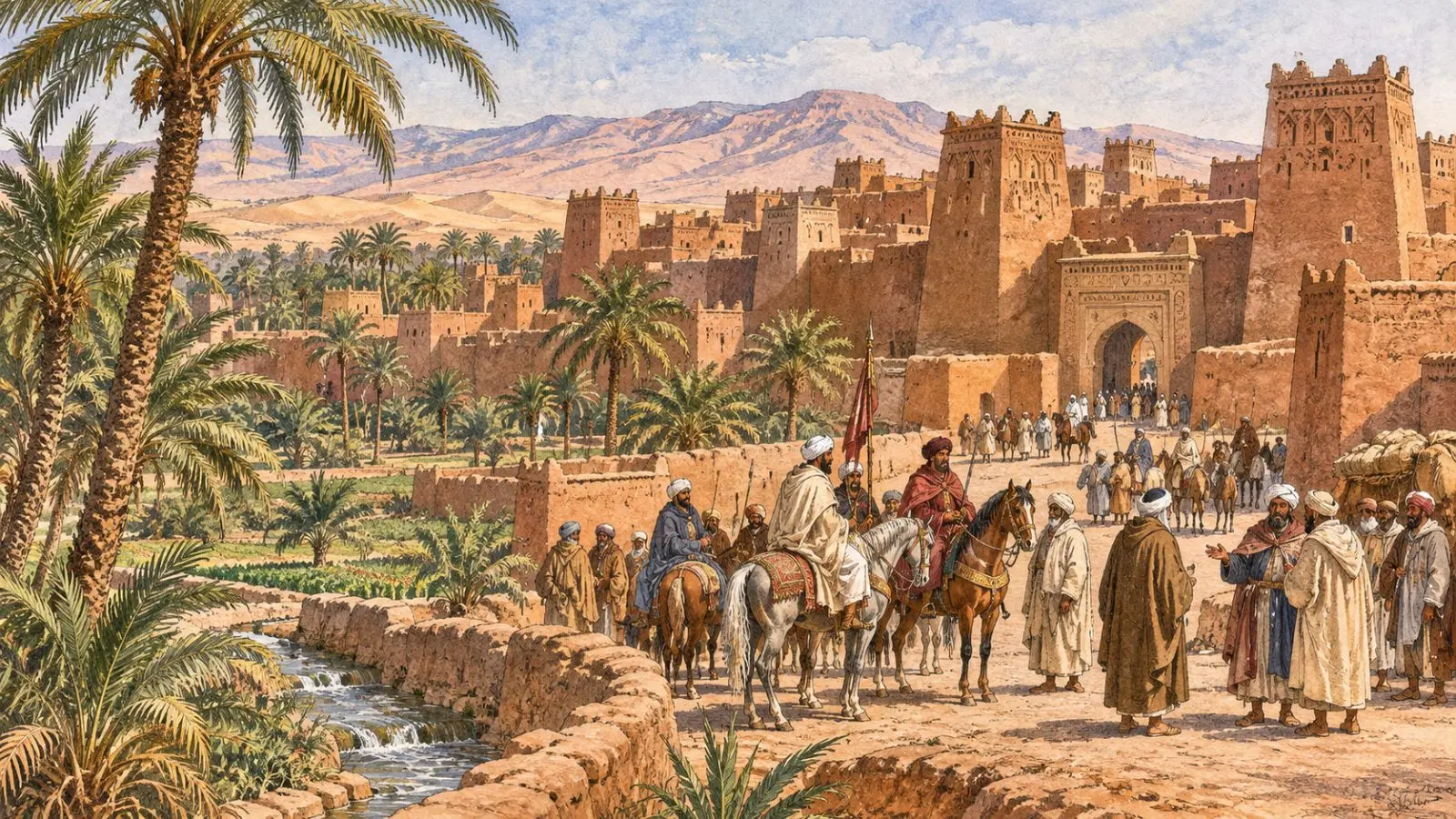
In the 13th century shorfa from Arabia, descendants of the Prophet, settled in the Tafilalet. From this family, the Filalis, came the Alaouite dynasty, which still rules Morocco. Its namesake ancestor, Moulay Ali Cherif, lies in a mausoleum in Rissani.
In the 17th century the Alaouites set out from the Tafilalet to conquer the country: Moulay Rashid took Fes in 1666 and reunified Morocco. Sijilmassa, in decline since the late 14th century, was abandoned, and Rissani became the oasis's centre.
Nomads, Legion and rally (20th-21st century)
Merzouga itself was just an uninhabited watering place, a stop for merchants heading to Timbuktu and a gathering point for Ait Atta and Ait Khebbach nomads. The Tafilalet long resisted the French conquest: fighting lasted from 1916 to 1932, and the Foreign Legion then built fortified posts in the region.
From the 1990s guesthouses and camps multiplied at the foot of the dunes. On the night of 26 May 2006 a flash flood destroyed about 140 houses and hotels, killed three people and displaced 1,200. Since 2010 the Merzouga Rally has drawn drivers from around the world, and in 2024 the seasonal Lake Yasmina filled again after heavy rain.
— II —
CHAPTER III
Key dates
757
Sijilmassa, the caravan city of the Tafilalet, is founded about 50 km away.
1631
The Alaouite dynasty rises in the Tafilalet.
— III —
CHAPTER IV
Landmarks
1
Erg Chebbi
Some twenty kilometres of orange dunes, the highest close to 150 m. Climb a ridge before dawn: the colour changes every minute, from ochre to pink.
2
Khamlia, the Gnawa village
Home to descendants of people from sub-Saharan Africa, this hamlet keeps Gnawa music alive. The musicians welcome visitors over tea, to the sound of qraqeb and guembri.
3
Dayet Srij
A seasonal lake at the foot of the dunes. After good rains it fills up and draws flamingos and migrating birds; the rest of the time it is a cracked plain.
4
Rissani and Sijilmasa
40 km to the north: Rissani's big souk (Tuesday, Thursday and Sunday), the mausoleum of Moulay Ali Cherif and the ruins of Sijilmasa, bare earthen walls among the palm trees.
— IV —
CHAPTER V
People
IIbn Battuta1304–1377The great traveller from Tangier passed through Sijilmasa in 1352 on his way to the Mali Empire.
MMoulay Ali Chérif†1659Sharifian leader of the Tafilalet and namesake ancestor of the Alaouite dynasty; his mausoleum is in Rissani.
MMoulay Rachid1631–1672Born in the Tafilalet, the first Alaouite sultan to rule all of Morocco, from 1666.
— V —
CHAPTER VI
Culture and traditions
A night at the camp
You reach the camp by dromedary in the late afternoon. After the tagine, drums echo around the fire, then comes the silence and a sky with no artificial light at all, where the Milky Way is visible to the naked eye.
The fossils of the Tafilalet
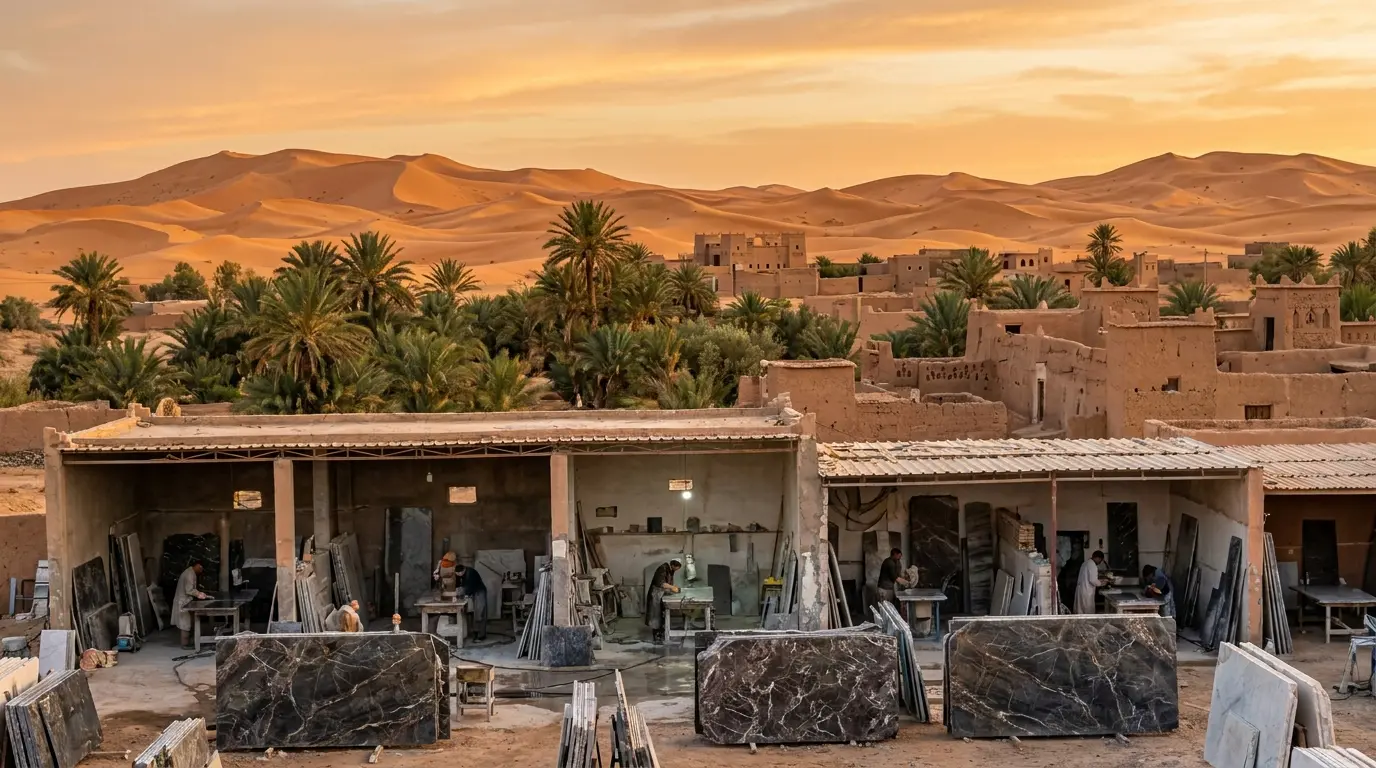
Hundreds of millions of years ago the region lay under the sea. Trilobites, ammonites and orthoceras show in the rock; workshops and quarries around Erfoud cut and polish them.
The Berber nomadic tradition is alive here — guides are often from families who have navigated the desert for generations. Camel (dromedary) caravans remain a practical reality, not just a tourist attraction. Traditional music around the fire — drums, guembri, and call-and-response singing — is authentic Berber entertainment. The festival of Taragalte celebrates nomadic culture annually.
— VI —
CHAPTER VII
The people
Nomads, Ait Khebbach and Gnawa
Residents come from the Ait Khebbach Amazigh tribe, long nomadic, and from Gnawa families, descendants of West African slaves, settled in Khamlia. Many dune guides are nomads' sons who know the erg by heart.
Desert languages
People mainly speak southeastern Tamazight and darija; guides often get by in French, English and Spanish learned from travellers.
— VII —
CHAPTER VIII
At the table
MedfounaRissani's “Berber pizza”: bread stuffed with minced meat, eggs, onions and spices, baked in a clay oven or under hot sand.
02A local legend says God created the erg to punish a rich family who refused hospitality to a poor woman and her son.
03The Dakar Rally passed through the Merzouga dunes several times.
— IX —
Frequently asked questions about Merzouga
How many days do you need in Merzouga?
Allow 2–3 days to see Merzouga without rushing. That is the length we use in our itineraries.
When is the best time to visit Merzouga?
The best months for Merzouga are October, November, March and April.
How much does a day in Merzouga cost?
Per person per day, accommodation included: about $60 on a budget, $150 mid-range and $400 for a luxury stay.
How do you get to Merzouga?
No train. CTM buses from Marrakech (9h) and Fes (8h). Most visitors drive or take organised tours. Shared taxis from Rissani (45 min) are the cheapest option.
What is there to see in Merzouga?
The must-sees of Merzouga: Erg Chebbi at sunset, Overnight desert camp, Camel trek and Dayet Srji salt lake.
What should you eat in Merzouga?
To taste in Merzouga: Camel tagine, Khobz, Moroccan mint tea and Oranges with cinnamon.
Where should you stay in Merzouga?
The best areas to stay: Merzouga village and Hassi Labied.
Is Merzouga safe?
Yes, Merzouga welcomes many travellers every year. The precautions are those of any tourist destination: watch your belongings in crowds, politely turn down unofficial guides, agree on a taxi fare before getting in.