Timeline

The history of Morocco, from Jebel Irhoud to today

Three hundred thousand years of history in sixteen eras: the first Homo sapiens, the Amazigh kingdoms, Rome, the coming of Islam, the great dynasties that made Morocco, the protectorates and independence. For each era, its capitals, rulers, monuments and key dates, linked to the cities where you can see them.

By Yassine and Issam · updated

  1. 315,000 years ago – 5th millennium BC

    Prehistory: the first Homo sapiens

    Morocco holds the oldest known fossils of Homo sapiens, found at Jebel Irhoud near Safi. Later, the hunters of the Iberomaurusian culture left at Taforalt one of the oldest cemeteries in the world, and the first herders carved the rocks of the High Atlas. The ancestors of the Amazigh then peopled all of North Africa.

    Monuments to see

    • 315,000 BCJebel Irhoud site · Safi
    • 2,000 BCOukaimeden rock carvings · Marrakech

    Key dates

    1. 315,000 BCHomo sapiens live at Jebel Irhoud; their fossils, dated in 2017, are the oldest known of our species.
    2. 82,000 BCAt Taforalt (Pigeons' Cave), pierced shells are worn as ornaments: some of the oldest known jewellery.
    3. 15,000 BCThe Iberomaurusians bury their dead at Taforalt, one of the oldest cemeteries in the world.
    4. 5,000 BCThe Neolithic: herding, pottery, and thousands of rock carvings in the High Atlas and the south.
  2. 8th century BC – 25 BC

    Phoenicians, Carthage and Amazigh kingdoms

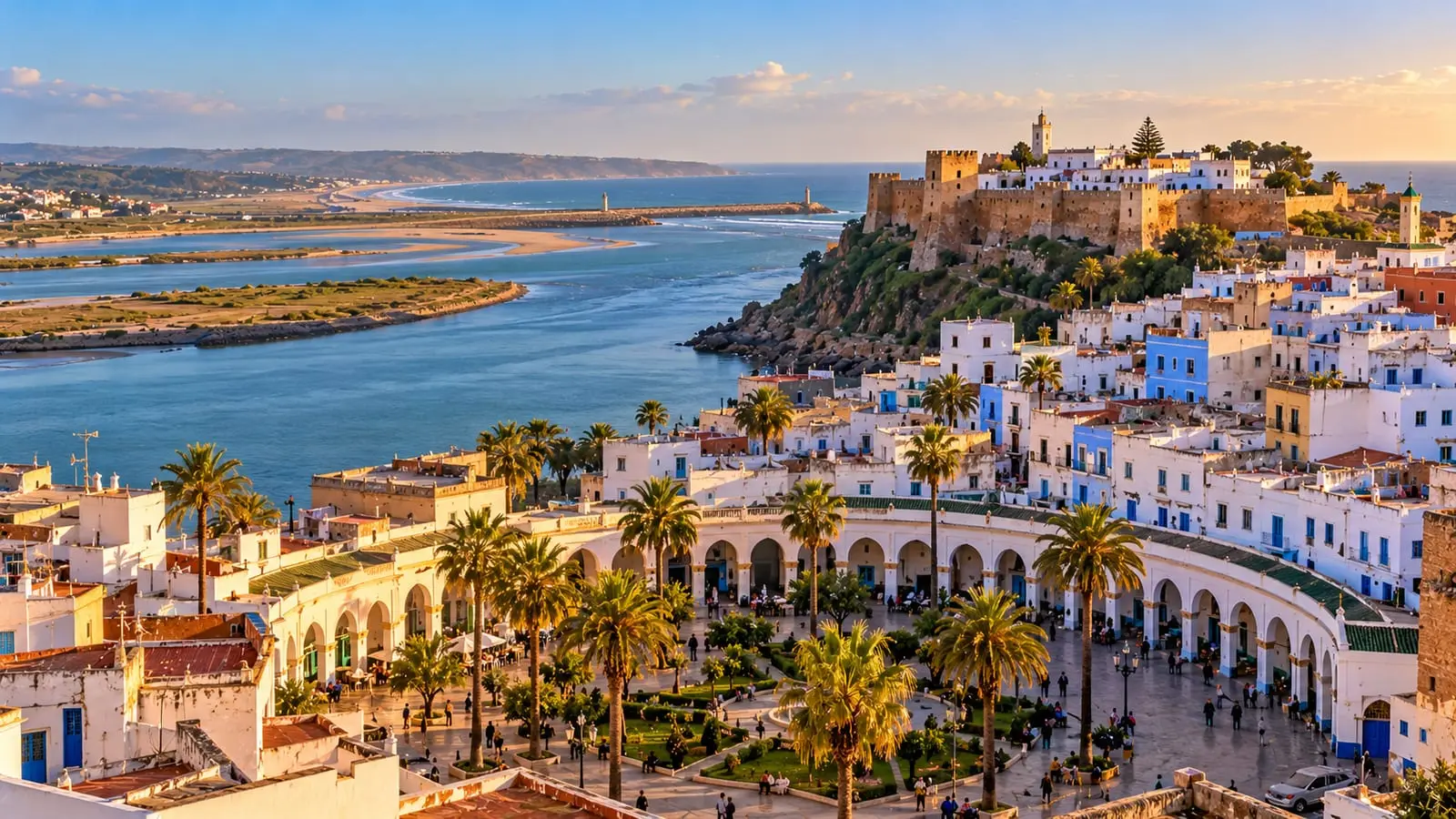
    Phoenician and then Carthaginian sailors founded trading posts on the coast: Lixus, Tingis, Mogador. Inland grew the Amazigh kingdom of Mauretania, whose kings played a part in Rome's wars in Africa.

    Monuments to see

    Rulers and figures

    • Bocchus I110 BC – 80 BC

      King of Mauretania; he handed Jugurtha over to the Romans in 105 BC.

    • Bocchus II49 BC – 33 BC

      At his death without an heir, the kingdom passed under Roman control.

    Key dates

    1. 700 BCPhoenician foundation of Lixus, near today's Larache.
    2. 650 BCThe Phoenicians use the island of Mogador, off Essaouira.
    3. 105 BCBocchus I hands his son-in-law Jugurtha, king of Numidia, to the Romans.
    4. 33 BCDeath of Bocchus II: Rome takes control of Mauretania.
  3. 25 BC – AD 40

    Juba II and Ptolemy, kings of Mauretania

    Augustus put on the throne Juba II, a Numidian prince raised in Rome and one of the scholars of his age, married to Cleopatra Selene, daughter of Cleopatra and Mark Antony. Their son Ptolemy succeeded him, until he was murdered on Caligula's orders.

    Capitals

    Monuments to see

    Rulers and figures

    • Juba II25 BC – 23

      A scholar king who wrote works of geography and history; he developed Volubilis and the purple-dye industry at Mogador.

    • Ptolémée de Maurétanie23 – 40

      Last king of Mauretania, grandson of Mark Antony, killed at Lyon on Caligula's orders.

    Key dates

    1. 25 BCAugustus makes Juba II king of Mauretania.
    2. 40Ptolemy is murdered; Aedemon's revolt breaks out against Rome.
  4. 42 – 429

    Roman Mauretania Tingitana

    Emperor Claudius created the province of Mauretania Tingitana, with Tingis (Tangier) as its capital. Volubilis, Sala (Rabat) and Lixus became Roman towns linked by roads, while the mountains and the south stayed with the Amazigh tribes. At the end of the 3rd century Rome drew back to the north.

    Capitals

    Monuments to see

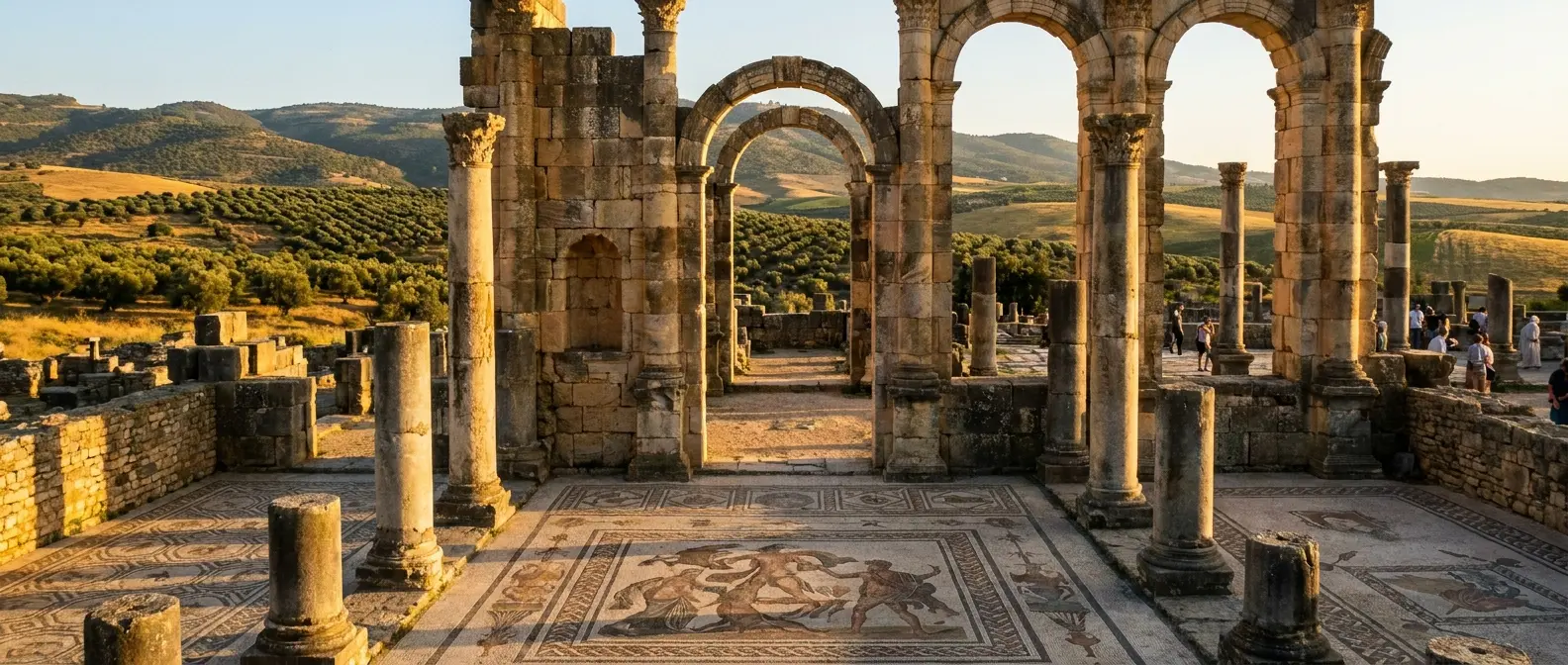
    • 217Arch of Caracalla, Volubilis · Volubilis
    • 40Sala Colonia (Chellah) · Rabat

    Key dates

    1. 42The province of Mauretania Tingitana is created.
    2. 217Volubilis raises a triumphal arch in honour of Emperor Caracalla.
    3. 285Under Diocletian, Rome abandons the interior and withdraws to the north.
    4. 429The Vandals cross from Spain to Africa over the strait.
  5. 681 – 788

    The coming of Islam and the first emirates

    Arab armies reached the Atlantic at the end of the 7th century and the Amazigh tribes gradually converted. In 711, mostly Amazigh troops led by Tariq ibn Ziyad crossed the strait to Spain. Then the great Amazigh revolt of 739 broke with the caliphate of Damascus, giving rise to independent states: Nekor on the Mediterranean, the Barghawata on the Atlantic, and Sijilmassa in the south.

    Rulers and figures

    • Uqba ibn Nafi622–683

      Arab general whose raid reached the Atlantic around 682.

    • Tariq ibn Ziyad670–720

      Governor of Tangier, he led the crossing to Spain in 711.

    Key dates

    1. 682Uqba ibn Nafi reaches the Atlantic.
    2. 710The emirate of Nekor is founded in the Rif, near today's Al Hoceima.
    3. 711Tariq ibn Ziyad crosses the strait: al-Andalus begins.
    4. 739The great Amazigh revolt, led by Maysara, against the Umayyad governors.
    5. 744The Barghawata confederation arises on the Atlantic coast.
    6. 757Sijilmassa, the caravan city of the Tafilalet, is founded.
  6. 788 – 974

    The Idrisids, the first Moroccan state

    Idris, a descendant of the Prophet who escaped the massacre of Fakh (786) in Arabia, was taken in by the Amazigh Awraba tribe at Volubilis. Proclaimed imam in 788, he founded the first Moroccan dynasty. His son Idris II built Fes, which became a centre of Islam and learning. After him the kingdom was shared among his sons and faded in the 10th century, caught between the Umayyads of Cordoba and the Fatimids.

    Capitals

    Monuments to see

    Rulers and figures

    • Idriss Ier788–791

      Founder of the dynasty; poisoned in 791 by an Abbasid envoy, he lies at Moulay Idriss Zerhoun.

    • Idriss II791–828

      Born after his father's death, he ruled in person from 803 and built Fes.

    Key dates

    1. 788Idris I is proclaimed imam by the Awraba at Volubilis.
    2. 789Fes is founded on the right bank of the river.
    3. 809Idris II builds the left bank and makes Fes his capital.
    4. 818Refugees from Cordoba arrive: the Andalusian quarter is born.
    5. 859Fatima al-Fihri founds al-Qarawiyyin.
    6. 974End of Idrisid power, fought over by Umayyads and Fatimids.
  7. 1040 – 1147

    The Almoravids, an empire from the desert

    A religious movement born among the nomadic Sanhaja of the Sahara, driven by the preacher Abdallah ibn Yasin, unified Morocco for the first time. Its leaders founded Marrakech and, called in by the Muslim kings of Andalusia, defeated the Castilians at Zallaqa in 1086. Their empire stretched from the Senegal river to the Ebro.

    Capitals

    Monuments to see

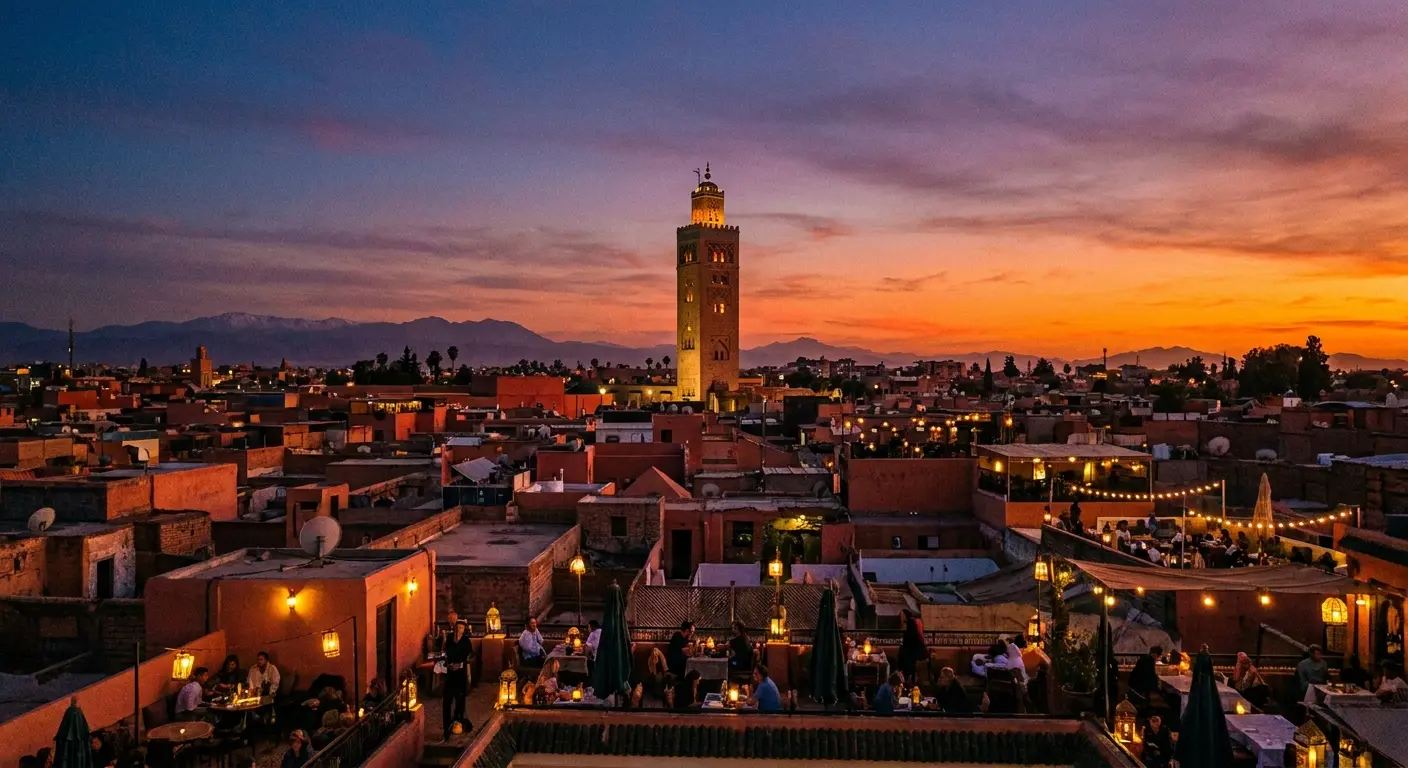
    • 1125Almoravid Koubba · Marrakech
    • 1135Enlargement of al-Qarawiyyin · Fes

    Rulers and figures

    • Abou Bakr ibn Omar1056–1087

      Founded the camp of Marrakech, then returned to fight in the Sahara.

    • Youssef ibn Tachfine1061–1106

      Builder of the empire, victor of Zallaqa, master of Andalusia.

    • Ali ibn Youssef1106–1143

      Embellished Marrakech and enlarged al-Qarawiyyin.

    Key dates

    1. 1040Abdallah ibn Yasin preaches among the Sanhaja of the Sahara: the Almoravid movement is born.
    2. 1058The Almoravids put an end to the Barghawata confederation.
    3. 1070Marrakech is founded.
    4. 1086Victory at Zallaqa over Alfonso VI of Castile.
    5. 1090The Almoravids annex the taifa kingdoms of Andalusia.
    6. 1147The Almohads take Marrakech: the dynasty ends.
  8. 1121 – 1269

    The Almohads, the height of the Muslim West

    Born in the High Atlas mountains around the reformer Ibn Tumart, the Almohad movement overthrew the Almoravids. Abd al-Mumin and his successors built the largest empire ever ruled from Morocco, from the Atlantic to Libya and into Andalusia. It was the age of the great minarets and the great thinkers, from Ibn Rushd to Ibn Tufayl.

    Monuments to see

    Rulers and figures

    • Ibn Toumert1121–1130

      A reformer proclaimed Mahdi, he made Tinmel in the High Atlas the cradle of the movement.

    • Abd al-Mumin1130–1163

      First Almohad caliph, conqueror of Marrakech and of the Maghreb as far as Tripoli.

    • Abou Yacoub Youssef1163–1184

      A scholarly caliph, patron of Ibn Tufayl and Ibn Rushd; he had the great mosque of Seville built.

    • Yacoub al-Mansour1184–1199

      Victor of Alarcos (1195), builder of the finished Koutoubia, the Hassan Tower and the Giralda.

    Key dates

    1. 1121Ibn Tumart is proclaimed Mahdi.
    2. 1147Abd al-Mumin takes Marrakech.
    3. 1160The Almohad empire reaches Tripoli: the whole Maghreb is united.
    4. 1195Victory at Alarcos over Castile.
    5. 1198Ibn Rushd (Averroes) dies in Marrakech.
    6. 1212Defeat at Las Navas de Tolosa: the retreat from Andalusia begins.
    7. 1269The Merinids take Marrakech: the Almohads fall.
  9. 1244 – 1465

    The Merinids, the golden age of Fes

    Zenata nomads from the east, the Banu Marin, seized power and made Fes their capital. Lacking religious legitimacy, they bet on learning: their madrasas, masterpieces of wood, stucco and zellige, trained jurists and scholars. Fes welcomed Ibn Battuta and Ibn Khaldun. In the 15th century the Wattasid viziers ruled in the sultans' place and the Portuguese gained a foothold on the coast.

    Capitals

    Monuments to see

    • 1276Fes el-Jdid · Fes
    • 1325Attarine madrasa · Fes
    • 1339Chellah necropolis · Rabat
    • 1350Bou Inania madrasa · Fes
    • 1438Mellah of Fes · Fes

    Rulers and figures

    • Abou Youssef Yacoub1258–1286

      Took Marrakech in 1269 and founded Fes el-Jdid in 1276.

    • Abou al-Hassan1331–1348

      The “black sultan”, who briefly reunited the Maghreb; builder of the Sahrij madrasa and the Chellah.

    • Abou Inan1348–1358

      Commissioned the Bou Inania madrasa and had Ibn Battuta's Rihla written down.

    Key dates

    1. 1244The Banu Marin enter the struggle for power in northern Morocco.
    2. 1269Marrakech is taken; the Almohads fall.
    3. 1276Fes el-Jdid is founded.
    4. 1355In Fes, Ibn Battuta dictates the account of his travels to Ibn Juzayy.
    5. 1415The Portuguese take Ceuta.
    6. 1465The last Merinid sultan, Abd al-Haqq, is killed in Fes.
  10. 1472 – 1554

    The Wattasids and the Portuguese coast

    The Wattasids ruled a weakened Morocco from Fes. Portugal seized almost the whole Atlantic coast, from Asilah to Agadir, while Spain completed the Reconquista. Muslim and Jewish refugees from Andalusia, after 1492, founded or repeopled Chefchaouen and Tetouan and brought their way of life. In the south, resistance grew around the Sufi brotherhoods and a family from the Draa: the Saadians.

    Capitals

    Monuments to see

    • 1471Portuguese walls of Asilah · Asilah
    • 1471Kasbah of Chefchaouen · Chefchaouen
    • 1484Medina of Tetouan · Tetouan
    • 1508Sea castle of Safi · Safi
    • 1514Portuguese City of Mazagan · El Jadida

    Rulers and figures

    • Mohammed ach-Cheikh1472–1504

      Founder of Wattasid rule in Fes.

    Key dates

    1. 1471The Portuguese take Asilah and Tangier; Chefchaouen is founded.
    2. 1484Andalusian refugees rebuild Tetouan.
    3. 1492Fall of Granada: waves of Muslim and Jewish exiles to Morocco.
    4. 1505Portuguese fort of Santa Cruz do Cabo de Gué (Agadir).
    5. 1514The Portuguese found Mazagan (El Jadida).
  11. 1510 – 1659

    The Saadians, gold and victory

    Coming from the Draa valley and claiming descent from the Prophet, the Saadians took the lead in the struggle against the Portuguese. They settled in Marrakech and took back Agadir and then Fes. In 1578, at the Battle of the Three Kings, they crushed the army of King Sebastian of Portugal. Ahmad al-Mansur, enriched by captives' ransoms, sugar and the gold of the Sudan, made Marrakech one of the most lavish capitals in the world.

    Monuments to see

    Rulers and figures

    • Mohammed ach-Cheikh1544–1557

      Took back Agadir (1541) and Fes (1549); unifier of Saadian Morocco.

    • Abdallah al-Ghalib1557–1574

      Rebuilt the Ben Youssef madrasa and created the mellah of Marrakech.

    • Abd al-Malik1576–1578

      Died during the Battle of the Three Kings, which he won.

    • Ahmed al-Mansour1578–1603

      “The Golden”: the El Badi palace, the Saadian tombs, the Timbuktu expedition, diplomacy with Elizabeth I of England.

    Key dates

    1. 1525The Saadians settle in Marrakech.
    2. 1541Agadir is taken back from the Portuguese, who then leave Safi and Azemmour.
    3. 1549Fes is taken: the Wattasids fall (a last attempt in 1554).
    4. 15784 August: the Battle of the Three Kings (Wadi al-Makhazin) near Ksar el-Kebir; King Sebastian dies there.
    5. 1591Ahmad al-Mansur's army defeats the Songhai empire at Tondibi and enters Timbuktu.
    6. 1603Al-Mansur dies: his sons fight over the throne and the kingdom splits.
    7. 1627The Moriscos found the corsair republic of the Bou Regreg at Rabat-Salé.
  12. 1631 – 1912

    The Alaouites, from Moulay Rachid to 1912

    Sharifs of the Tafilalet, the Alaouites reunified the country in 1666 and still reign. Moulay Ismail, a contemporary of Louis XIV, built Meknes, raised a standing army and drove the Europeans from almost the whole coast. Sidi Mohammed ben Abdallah opened Morocco to trade, founded Essaouira, rebuilt Casablanca and was among the first to recognise the independence of the United States. In the 19th century the kingdom held out against European ambitions until the Algeciras conference (1906).

    Monuments to see

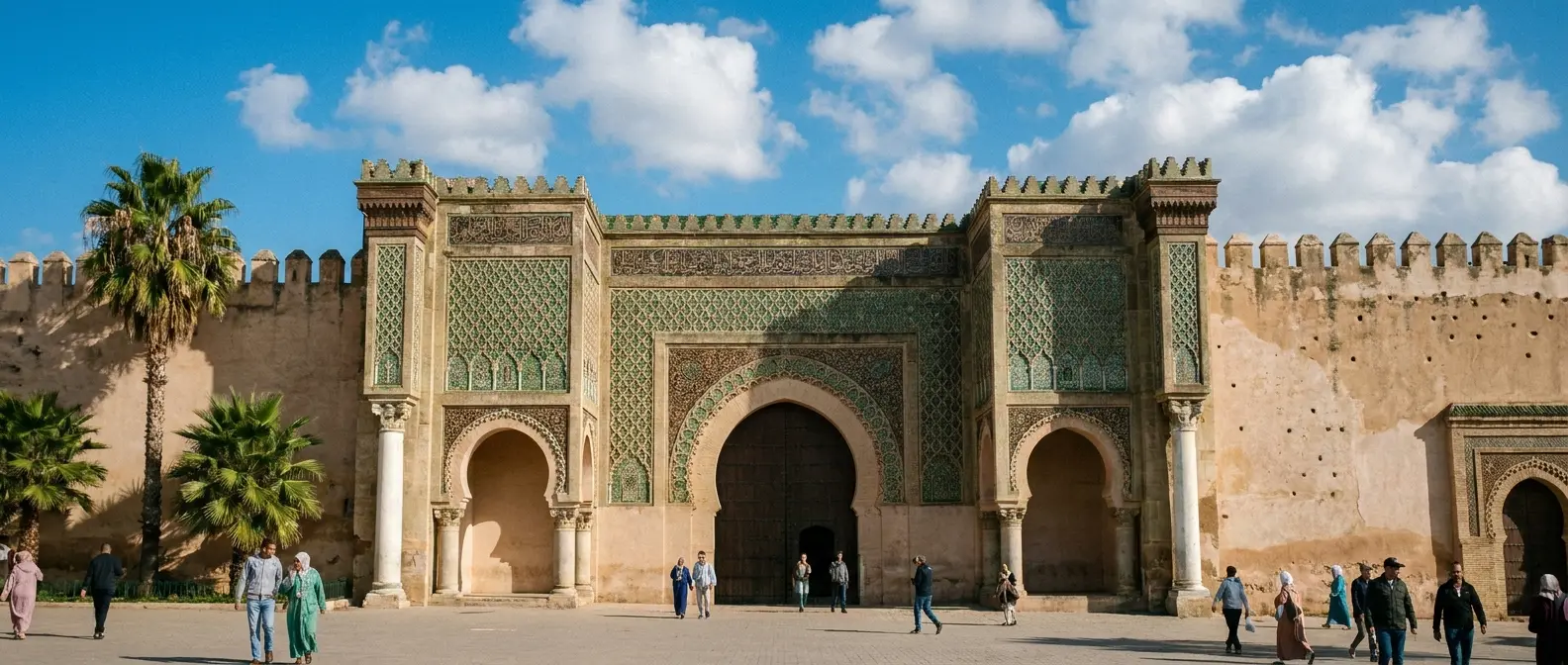
    • 1732Bab Mansour and the imperial city · Meknes
    • 1700Heri es-Souani, Moulay Ismail's granaries · Meknes
    • 1684Tangier kasbah (Dar el-Makhzen) · Tangier
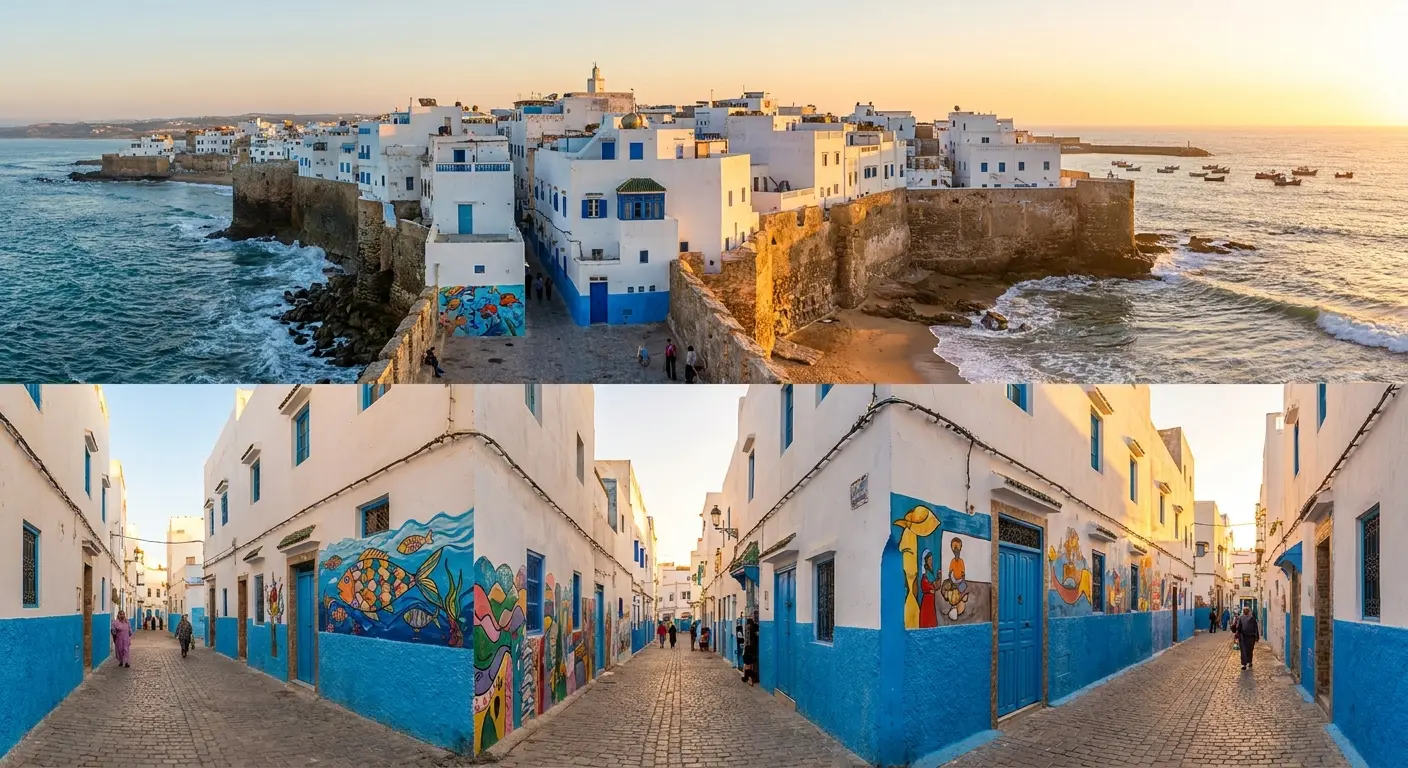
    • 1764Medina of Essaouira · Essaouira
    • 1882Walls of Tiznit · Tiznit
    • 1867Bahia palace · Marrakech

    Rulers and figures

    • Moulay Rachid1666–1672

      Took Fes in 1666 and Marrakech in 1669: the effective founder of the dynasty.

    • Moulay Ismaïl1672–1727

      A 55-year reign: Meknes, the Abid al-Bukhari guard, and the recapture of La Mamora, Tangier, Larache and Asilah.

    • Sidi Mohammed ben Abdallah1757–1790

      Founded Essaouira (1764), retook Mazagan (1769), rebuilt Casablanca, recognised the United States (1777).

    • Moulay Hassan Ier1873–1894

      A reforming sultan who ruled on horseback, campaign after campaign, to hold the country against European pressure.

    Key dates

    1. 1631Moulay Ali Sharif takes power in the Tafilalet.
    2. 1666Moulay Rachid enters Fes.
    3. 1672Moulay Ismail comes to the throne and makes Meknes his capital.
    4. 1684The English leave Tangier.
    5. 1755The Lisbon earthquake strikes Meknes, Fes and the coast hard.
    6. 1764Essaouira is founded.
    7. 1777Morocco is one of the first states to recognise the United States; a treaty of friendship follows in 1786.
    8. 1844Defeat at Isly against France, coming from neighbouring Algeria.
    9. 1860Spanish–Moroccan war: Spain occupies Tetouan until 1862.
    10. 1906Algeciras conference: the European powers put Morocco under supervision.
  13. 1912 – 1956

    The protectorates and the struggle for independence

    The Treaty of Fes placed Morocco under a French protectorate, with Spain receiving the north and south and Tangier becoming an international zone. The resident-general Lyautey set the capital at Rabat and built new towns. In the Rif, Abd el-Krim dealt Spain the defeat of Annual and proclaimed a republic. Nationalism grew, from the manifesto of 1944 to the Tangier speech of 1947; the exile of Sultan Mohammed V in 1953 set off the “Revolution of the King and the People”, all the way to independence.

    Capitals

    Monuments to see

    Rulers and figures

    • Hubert Lyautey1912–1925

      First French resident-general; he created the new towns beside the medinas.

    • Abd el-Krim el-Khattabi1882–1963

      Leader of the Rif resistance, victor of Annual, founder of the Republic of the Rif (1921–1926).

    • Mohammed V1927–1961

      Sultan and then king, exiled from 1953 to 1955, the symbol and architect of independence.

    Key dates

    1. 191230 March: the Treaty of Fes begins the French protectorate; a Franco-Spanish agreement follows in November.
    2. 1921Battle of Annual: Abd el-Krim defeats the Spanish army.
    3. 1923Tangier becomes an international zone.
    4. 1926Abd el-Krim surrenders to the French and Spanish armies.
    5. 1930The “Berber dahir” stirs a wave of protest: the national movement is born.
    6. 194411 January: the independence manifesto.
    7. 19479 April: Mohammed V's speech in Tangier for unity and independence.
    8. 195320 August: Mohammed V is exiled; the Revolution of the King and the People begins.
    9. 195516 November: Mohammed V's triumphant return.
    10. 19562 March: independence; Spain recognises the end of its protectorate on 7 April.
  14. 1956 – today

    Independent Morocco

    The kingdom recovered Tangier, Tarfaya and then Sidi Ifni, adopted a constitution and became a regional player under Hassan II. Since 1999 Mohammed VI has led major projects: the reform of the family code, the 2011 constitution that made Amazigh an official language, the Tanger Med port, the Al Boraq high-speed train. Morocco rejoined the African Union in 2017 and will co-host the 2030 World Cup.

    Capitals

    Monuments to see

    Rulers and figures

    • Mohammed V1956–1961

      First king of independent Morocco.

    • Hassan II1961–1999

      The 1962 constitution, the Green March of 1975, the Hassan II Mosque.

    • Mohammed VI1999–

      The family code (2004), the 2011 constitution, major infrastructure projects.

    Key dates

    1. 1956October: Tangier rejoins Morocco.
    2. 1958The Tarfaya strip is handed back.
    3. 196029 February: the Agadir earthquake kills about 12,000 people.
    4. 1962Morocco's first constitution.
    5. 1969Spain hands back Sidi Ifni.
    6. 19756 November: the Green March.
    7. 1993The Hassan II Mosque opens in Casablanca.
    8. 199923 July: Mohammed VI comes to the throne.
    9. 2004New family code (Moudawana).
    10. 2011New constitution: Amazigh becomes an official language alongside Arabic.
    11. 2017Morocco rejoins the African Union.
    12. 2018Al Boraq, Africa's first high-speed train, opens between Tangier and Casablanca.
    13. 2022The Atlas Lions reach the World Cup semi-final, a first for an African team.
    14. 20238 September: the Al Haouz earthquake in the High Atlas.
    15. 2030Morocco co-hosts the World Cup with Spain and Portugal.