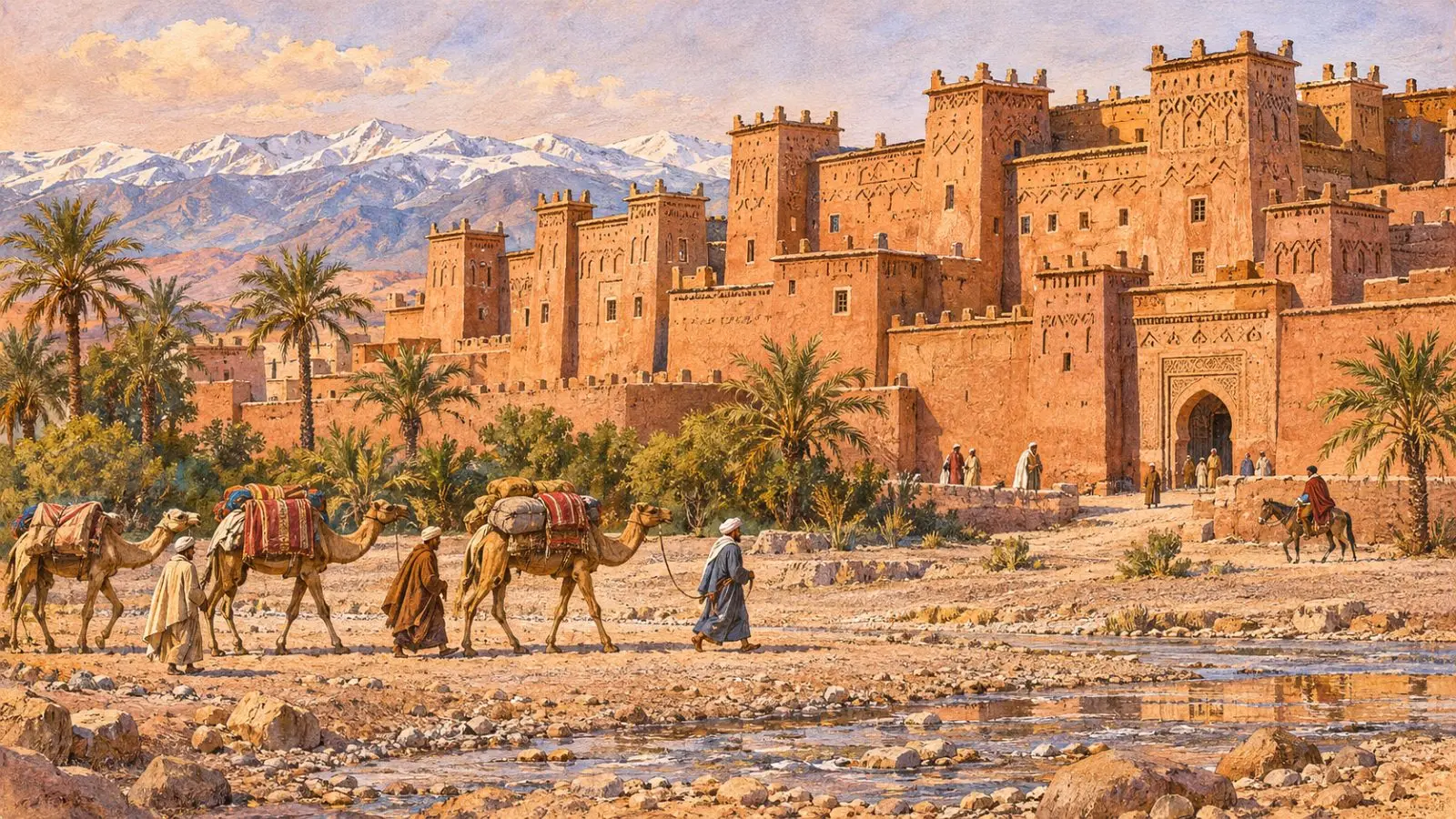
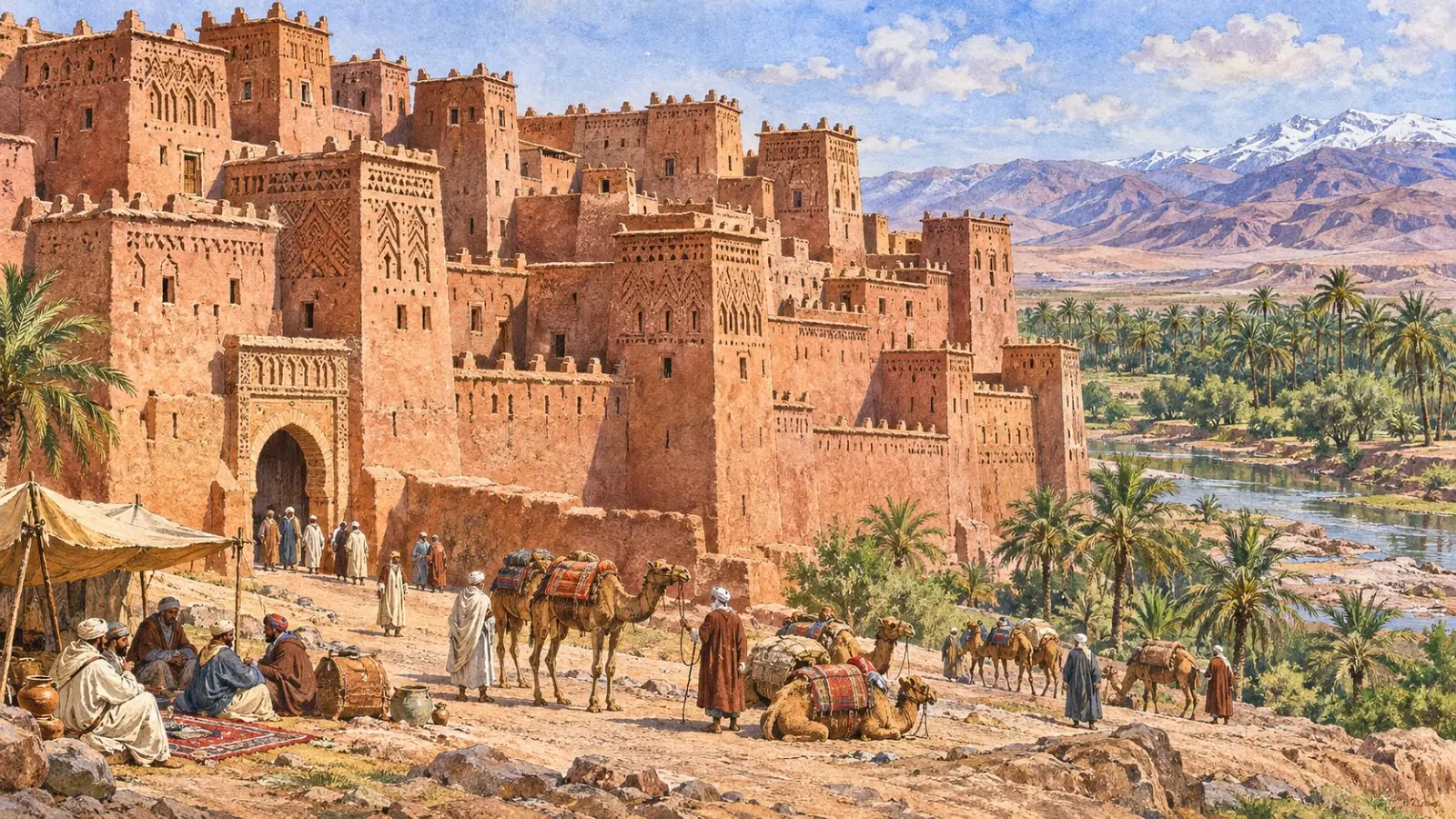
AA caravan crossroads between the Atlas and the Sahara, a stronghold of the powerful Glaoui family, a French garrison in 1928 and then the “Hollywood of Africa”: Ouarzazate is the gateway to the road of a thousand kasbahs, from Ait Benhaddou to the Draa Valley.
Palaeolithic stone tools, cleavers of the Moroccan Acheulean, have been found on the town's site. The region was peopled mainly by Masmuda Amazighs, with Jewish communities and Haratin, descendants of the oases' first farmers later mixed with slaves from sub-Saharan Africa.
The name "Ouarzazat" first appears in the 11th century in the geographer al-Bakri, describing the road from Sijilmassa to Aghmat: the oasis was a stop between the Saharan kingdoms and the cities of Morocco.
On the gold road (7th-16th century)
The region was gradually Islamised after Uqba ibn Nafi passed through in 681. The founding of Sijilmassa in the 8th century diverted part of the trade to the Tafilalet; from the 13th century Arab Maqil tribes settled on the southern plains.
Under the Saadians, especially after Ahmad al-Mansur's expedition to Timbuktu in 1591, trans-Saharan trade passed through the Draa valley and the Ouarzazate oasis, gateway to the Atlas passes towards Marrakech. But there was still no town, only ksour and kasbahs. After al-Mansur's death, trade shifted to the Atlantic ports and the region declined.
The age of the Glaoui (19th century)
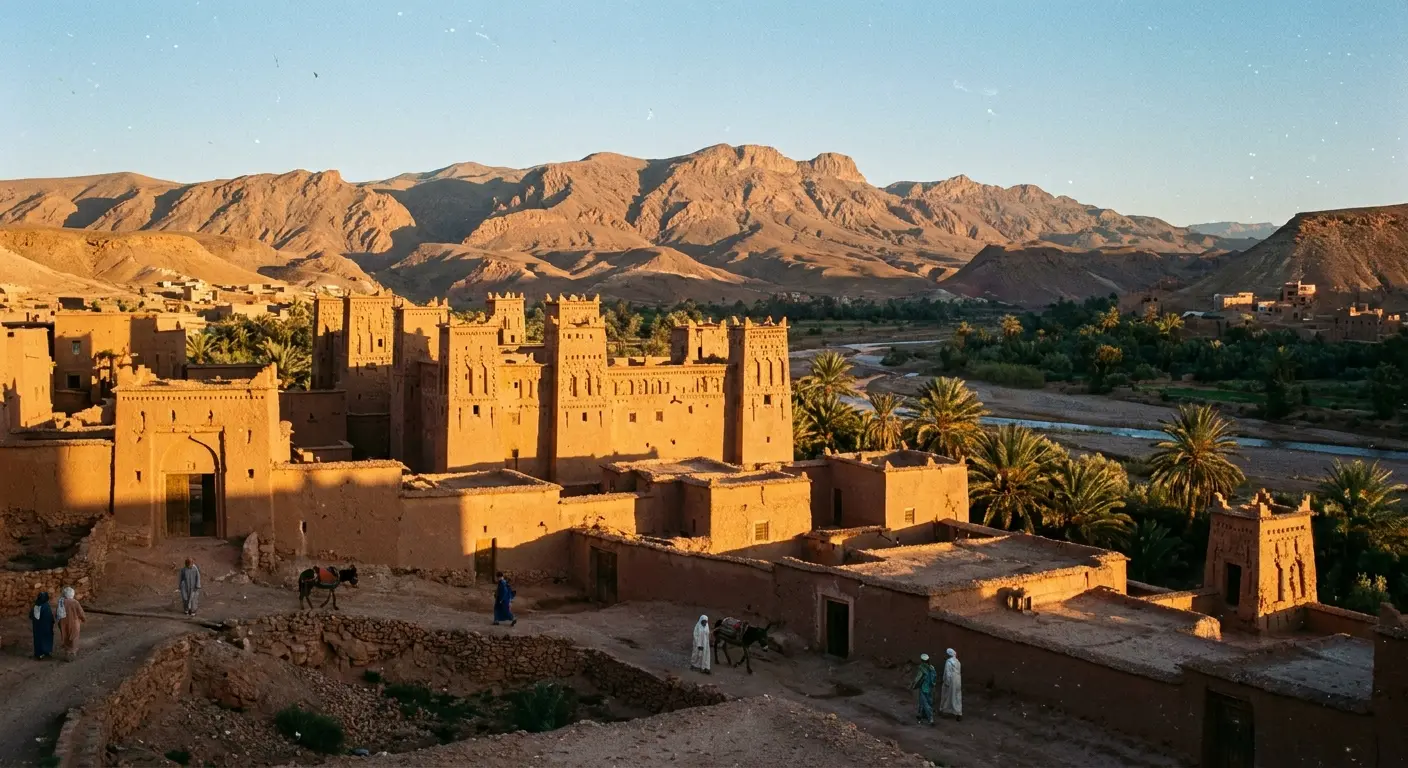
the Taourirt kasbah
In the 19th century the region came under the authority of the Glaoui caids of Telouet, appointed by the Alaouite sultans. In 1884 Charles de Foucauld described the oasis: the kasbahs of Tifoultoute, Taourirt and Tamasla, a dozen ksour, a single souk at Zaouia Sidi Othmane, and eight mellahs with many Jewish residents. There was still no real town.
In 1893, returning from an expedition to the Tafilalet, Sultan Moulay Hassan I crossed the oasis and stopped at the Tifoultoute kasbah.
1928: a town is born
The present town was born in 1928, when the French army set up a military post in the ruins of an old kasbah, some distance from the Taourirt ksar. With its native affairs office, souk and a few traders, the post became the administrative centre of the Draa region.
The same year a military airfield, ancestor of the airport, was laid out, and a road linked Ouarzazate to Marrakech over the Tizi n'Tichka pass.
Cinema, dam and sun
The region's landscapes drew filmmakers from the 1950s-60s: Lawrence of Arabia was partly shot here. Atlas Studios, opened in 1983, and other studios made Ouarzazate the "Hollywood of Africa", with thousands of residents working as extras.
The El Mansour Eddahbi dam, built between 1972 and 1979, irrigates the Draa valley and supplies the town with drinking water. Since 2016 the Noor solar complex, north of the town, has been one of the largest in the world.
— II —
CHAPTER III
Key dates
1800–1900
The Glaoui family builds up the kasbah of Taourirt.
1928
The French found the modern town as a garrison.
1983
Atlas Studios open, making Ouarzazate a film-making capital.
— III —
CHAPTER IV
Landmarks
1
Ait Benhaddou
30 km away, Morocco's most famous ksar, listed by UNESCO in 1987: a hill of earthen houses and crenellated towers above the Ounila river. Come early in the morning, when the light is low and the village empty.
2
The Taourirt kasbah
Right in the town centre, the former Glaoui residence spreads out its mud-brick towers, courtyards and reception rooms with painted cedar ceilings. Part of it can be visited; the rest is still lived in.
3
The studios and cinema museum
At the edge of town, the studios open their sets to visitors: Egyptian temples, palaces and ancient cities in plaster. The cinema museum, opposite the kasbah, keeps more sets and cameras.
4
The Fint oasis
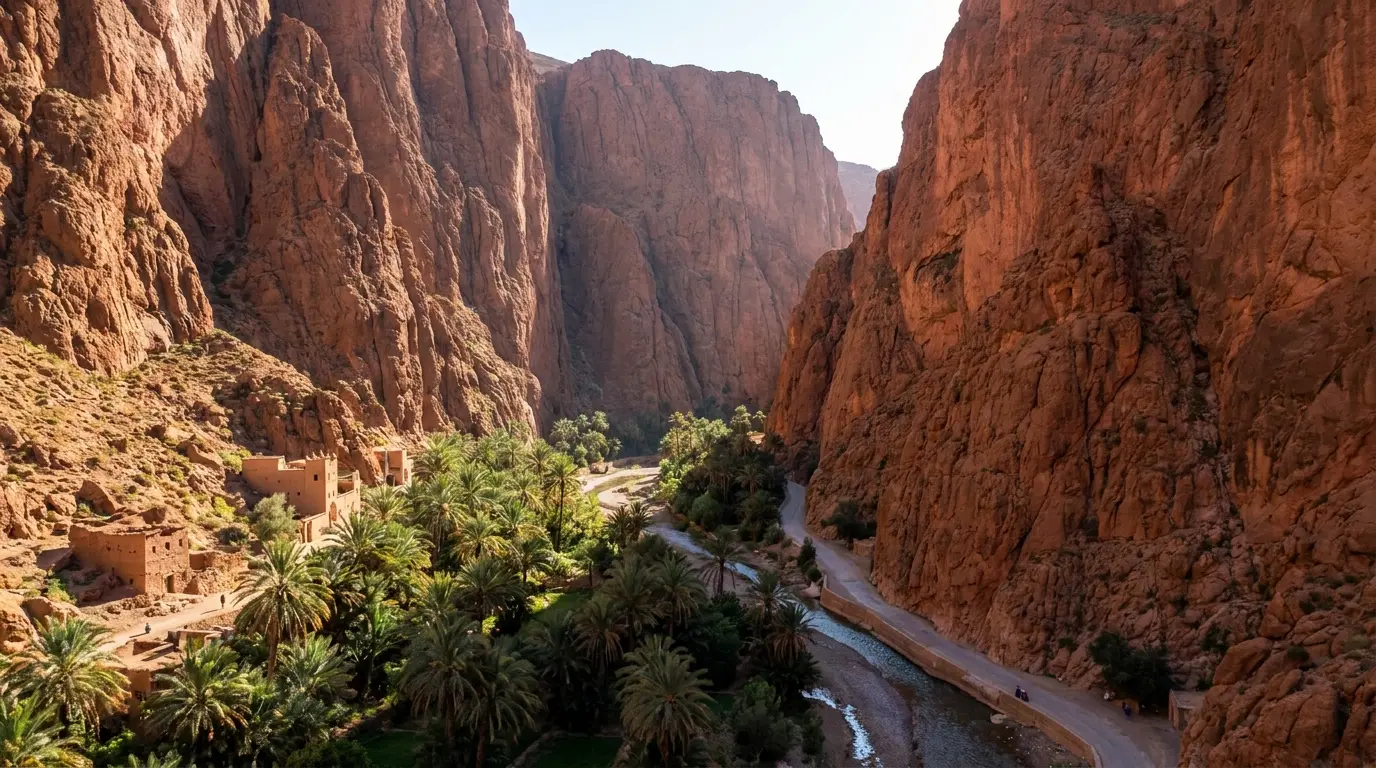
About fifteen kilometres away, a palm grove hidden at the bottom of a black-rock canyon, with its earthen village and irrigated gardens: the south in miniature.
— IV —
CHAPTER V
People
MMadani El Glaoui1866–1918The eldest of the family, he built the Glaoui power in the south and became grand vizier in the early 20th century.
TThami El Glaoui1879–1956Pasha of Marrakech, ally of the French and master of the southern kasbahs; he backed Mohammed V's exile in 1953, then begged his forgiveness in 1955.
— V —
CHAPTER VI
Culture and traditions
Ahwach
A group dance of the High Atlas and Anti-Atlas villages: men and women in facing lines, to the beat of frame drums and call-and-response singing. You see it at weddings and moussems.
The roses of Kelaat M'Gouna
In the Dades Valley, 90 km away, hedges of Damask roses bloom in spring. In May the rose moussem celebrates the harvest, which goes into rose water.
Kasbah architecture — earthen towers with geometric carved details, built by Berber tribes for defense — is the defining visual culture of the region. The rose cultivation around Kelaa M'Gouna (Rose Valley) produces essential oils and hosts a famous Rose Festival in May. Carpet weaving by Amazigh women using natural dyes is a living tradition.
— VI —
CHAPTER VII
The people
The people of Ouarzazate
The city brings together Amazigh tribes from the Draa and Dades valleys and the Atlas. Thousands of residents have worked as film extras: it's common for a driver or waiter to have played a Roman soldier or a Tibetan monk.
Southeastern Tamazight
People mostly speak Tashelhit and valley Tamazight, along with darija; ahwach, a collective song and dance, sets the rhythm of celebrations.
— VII —
CHAPTER VIII
At the table
Berber tagineGarden vegetables stacked in a pyramid over the meat and cooked slowly over charcoal: the dish of the guesthouses on the kasbah road.
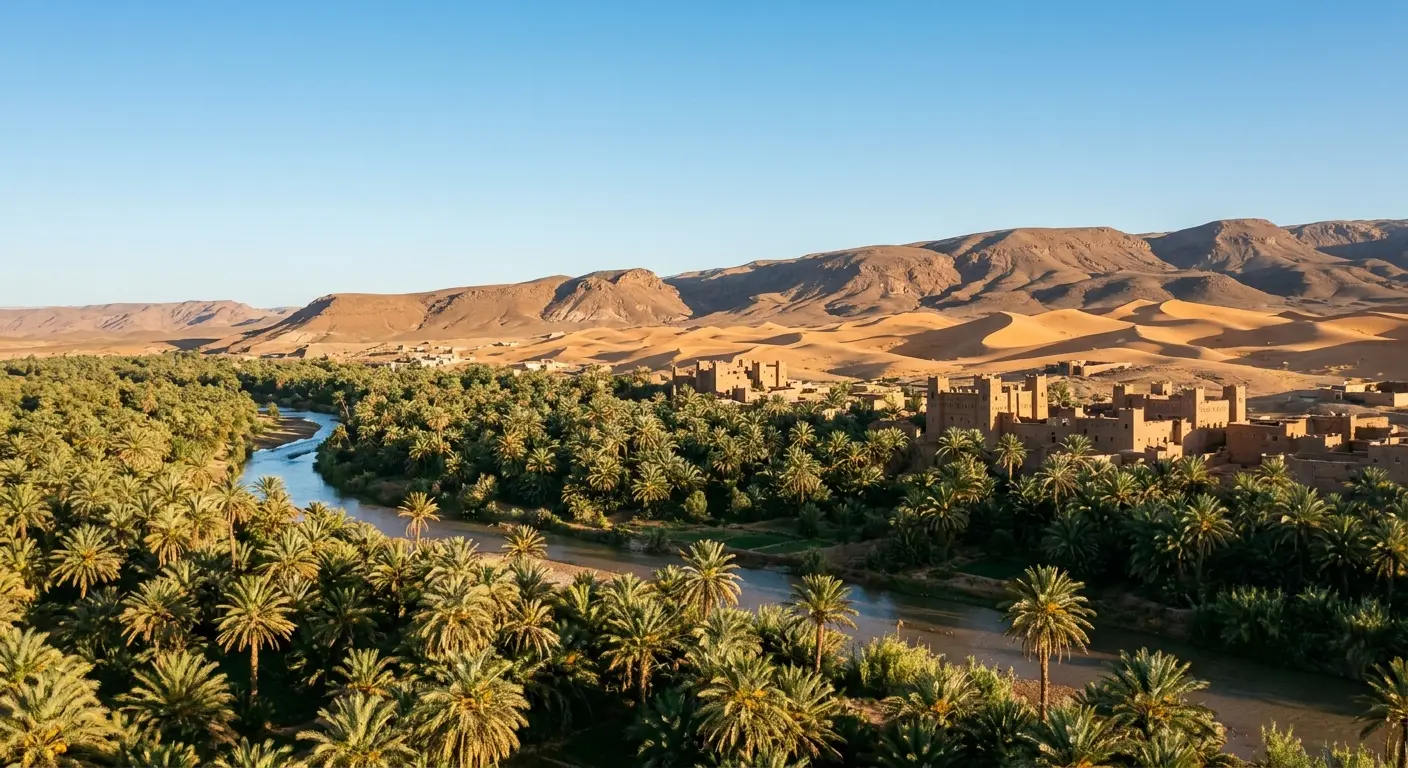
Draa Valley datesThe Draa Valley to the south has hundreds of thousands of palm trees. In autumn you can taste local varieties such as bouskri and jihel, sold by weight in the souks.
— VIII —
CHAPTER IX
Did you know?
01The Noor Ouarzazate solar plant near the city is one of the world's largest concentrated solar power plants.
02The name comes from Amazigh and is said to mean "without noise".
03Lawrence of Arabia, Gladiator, Kundun and Game of Thrones were shot in the region.
— IX —
Frequently asked questions about Ouarzazate
How many days do you need in Ouarzazate?
Allow 1–3 days to see Ouarzazate without rushing. That is the length we use in our itineraries.
When is the best time to visit Ouarzazate?
The best months for Ouarzazate are March, April, October and November.
How much does a day in Ouarzazate cost?
Per person per day, accommodation included: about $40 on a budget, $90 mid-range and $250 for a luxury stay.
How do you get to Ouarzazate?
Ouarzazate Airport (OZZ) has limited direct European flights. CTM buses from Marrakech (4h via Tizi n'Tichka pass). The mountain drive from Marrakech is spectacular.
What is there to see in Ouarzazate?
The must-sees of Ouarzazate: Aït Ben Haddou, Atlas Studios, Taourirt Kasbah and Draa Valley.
What should you eat in Ouarzazate?
To taste in Ouarzazate: Mechoui, Camel tagine, Khobz and Moroccan mint tea.
Where should you stay in Ouarzazate?
The best areas to stay: City center and Near Taourirt Kasbah.
Is Ouarzazate safe?
Yes, Ouarzazate welcomes many travellers every year. The precautions are those of any tourist destination: watch your belongings in crowds, politely turn down unofficial guides, agree on a taxi fare before getting in.