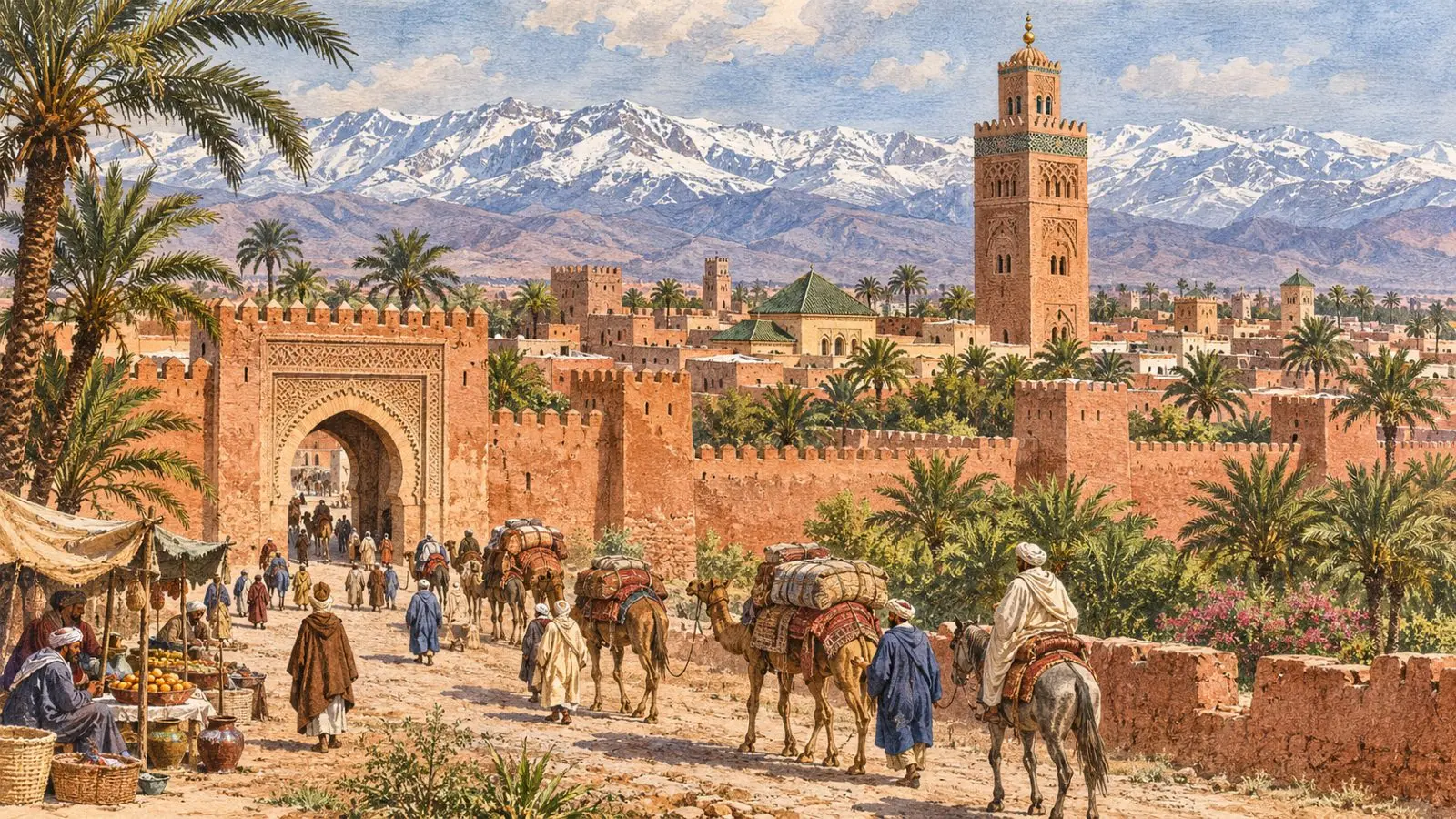
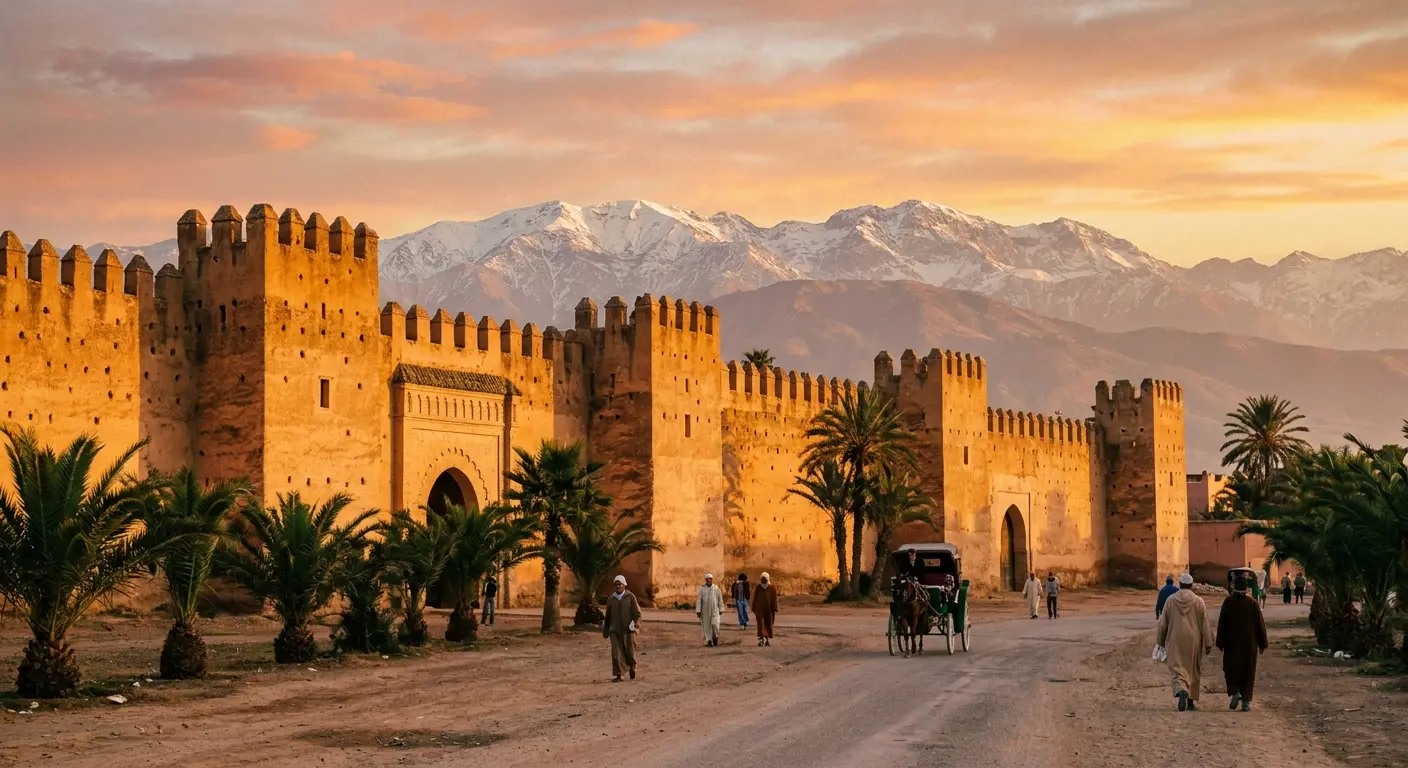
FFounded around 1070 by the Almoravids, Marrakech was the capital of an empire stretching from Andalusia to the Sahara. It even gave the country its name in many languages: “Morocco”, “Marruecos” and “Maroc” all come from Marrakech. Almohads, Saadians and Alaouites each added to it, up to the red city of today.
Long before Marrakech, the Haouz plain at the foot of the High Atlas was home to Amazigh farmers: many Neolithic stone tools have been found here. In the 11th century the region's main town was not Marrakech but Aghmat, at the foot of the mountains, capital of the Haouz.
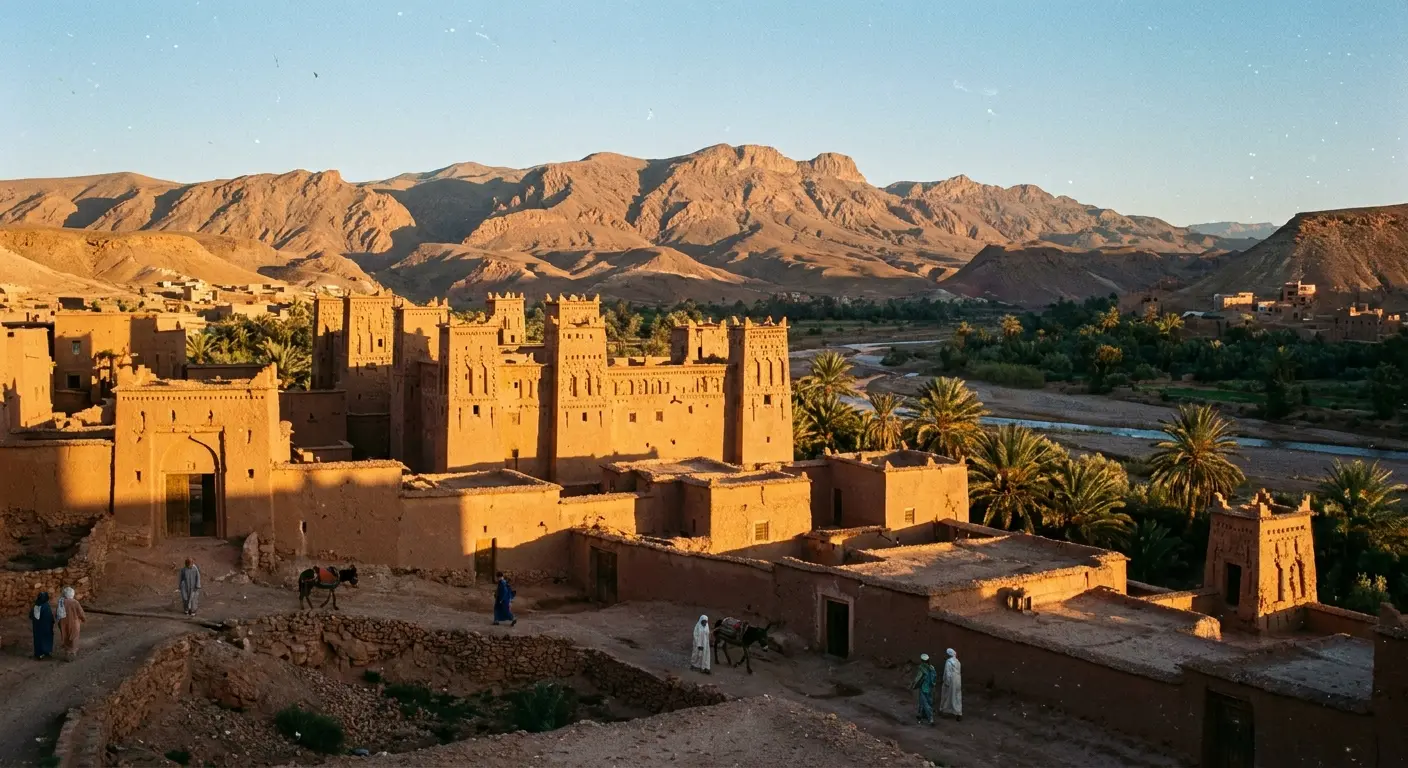
The plain had one great asset: water flowing down from the Atlas. It later allowed rulers to dig khettaras, underground channels that carry water for kilometres, and to irrigate vast gardens.
The Almoravid foundation (around 1070)
Marrakech was founded by Abu Bakr ibn Umar, leader of the Almoravids, a religious reform movement born among the Sanhaja nomads of the Sahara. Chroniclers disagree on the date: 1062 according to Ibn Abi Zar and Ibn Khaldun, 1078 according to al-Idrisi. Historians most often use 1070.
His cousin Yusuf ibn Tashfin made it the capital of a huge empire, from Senegal to central Spain. The first buildings rose near today's Koutoubia: mosques and a fortified residence, the Ksar al-Hajar. In front of its gates lay a public square, the Rahbat al-Ksar: the ancestor of Jemaa el-Fna. The main souks grew between this square and the great mosque, where they still are today.
Capital of an empire
Under the Almoravids, Marrakech became a crossroads between the Maghreb and sub-Saharan Africa. Yusuf ibn Tashfin minted coins here and brought gold and silver by caravan. The city replaced Aghmat as the centre of the Haouz.
His son Ali ibn Yusuf built the great Ben Youssef Mosque between 1120 and 1132, walled the city for the first time in 1126-1127 and developed the khettaras. Craftsmen from Cordoba and Seville brought the Andalusian style, with carved domes and multifoil arches, which blended with Saharan traditions: the birth of an architecture all Marrakech's own. From this period survives the small Almoravid Qubba, one of the few Almoravid monuments still standing.
The Almohads and the Koutoubia (1147-1269)
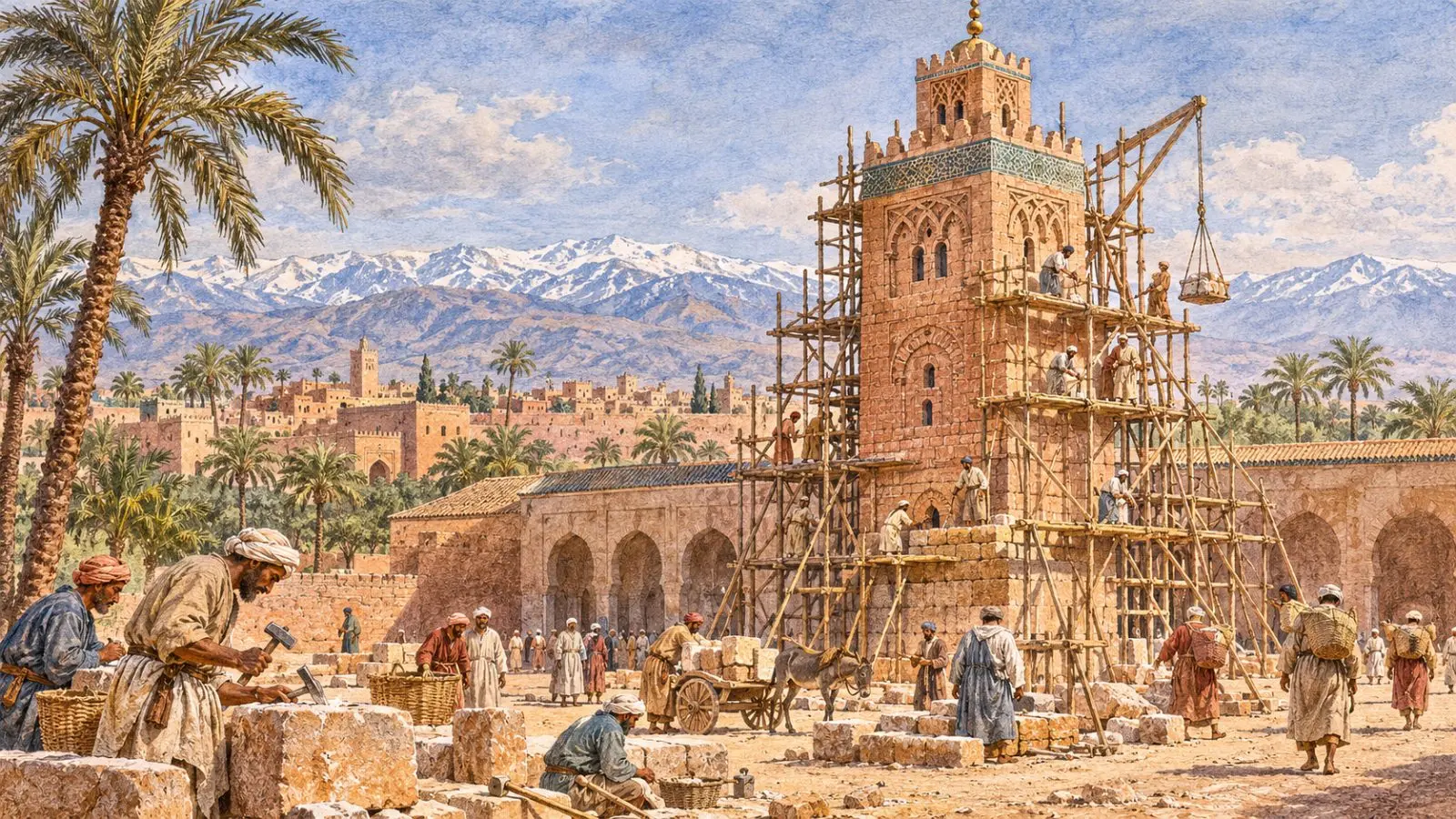
the Koutoubia under construction in the Almohad era
In 1125 the preacher Ibn Tumart settled in Tinmel, in the Atlas, and founded the Almohad movement, backed by the Masmuda tribes. A first siege of Marrakech failed in 1130; Ibn Tumart died the same year. His successor Abd al-Mu'min took the city in 1147 after a siege of several months and made it his capital.
The Almohads demolished or abandoned the Almoravid mosques and founded the Koutoubia in 1147. Abd al-Mu'min created the Menara gardens in 1157; his successor Abu Ya'qub Yusuf began the Agdal gardens. Ya'qub al-Mansur (1184-1199) built the Kasbah, the palace and government district, with the Bab Agnaou gate. The city drew scholars and artists from al-Andalus, among them the philosopher Averroes of Cordoba.
Turmoil, then Fes as capital (1224-1500)
The death of Caliph Yusuf II in 1224 opened a period of instability. Caliphs and pretenders seized and lost the city by force. In 1226 Caliph al-Ma'mun, coming from Seville, took it, had Almohad sheikhs massacred and publicly renounced Ibn Tumart's doctrine. On his death in 1232 the inhabitants avoided the sack promised to mercenaries by paying a ransom of 500,000 dinars.
In 1269 the Marinids, a Zenata tribe, conquered Marrakech. The city remained important but lost its capital status to Fes and entered a long relative decline; in the early 16th century it was held by the Hintata emirs.
The Saadian golden age (16th century)
the El Badi palace in the Saadian golden age
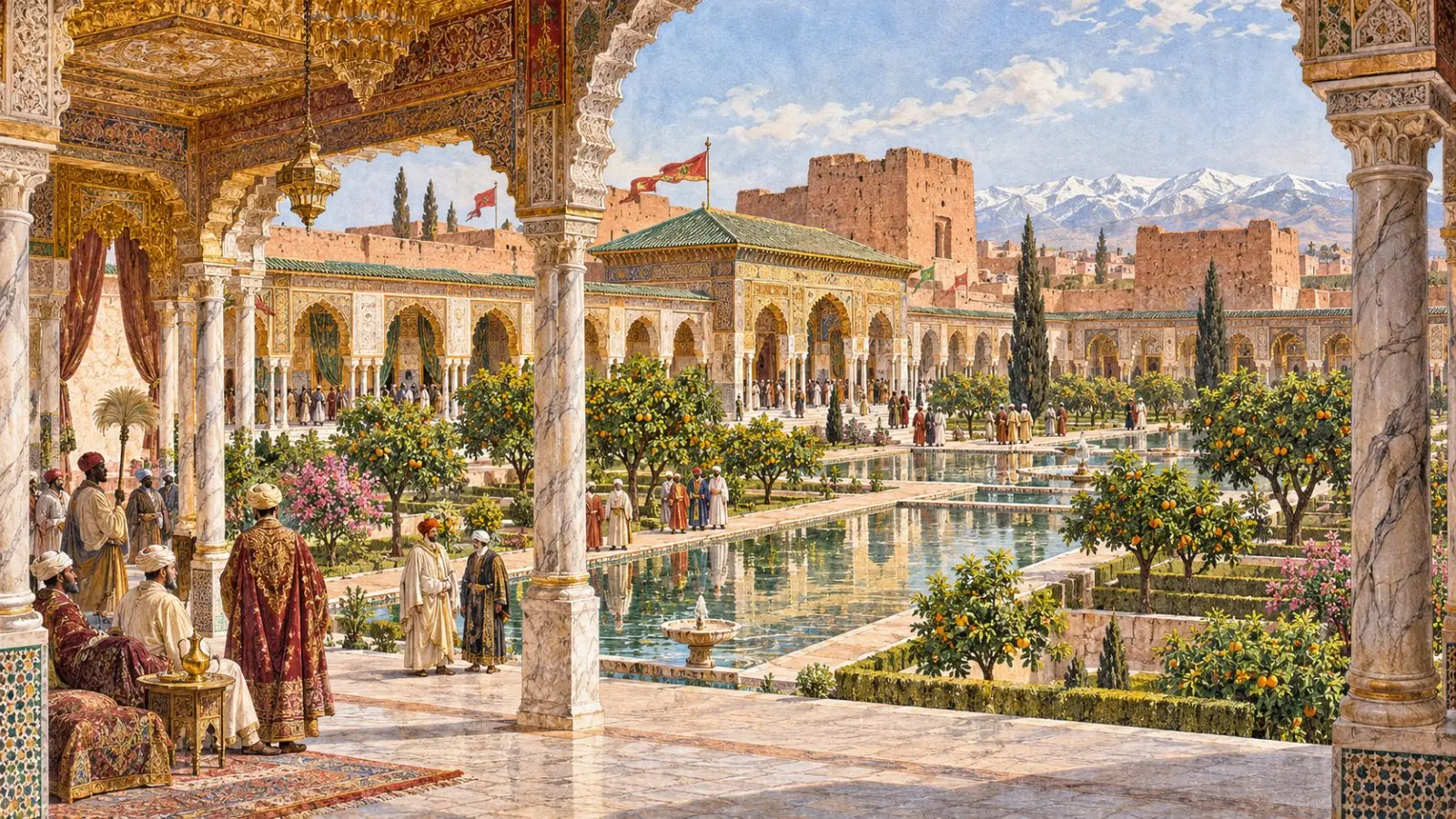
In the 16th century the Saadian dynasty, from the Draa valley, made Marrakech Morocco's capital again, under Sultans Abdallah al-Ghalib and then Ahmad al-Mansur. Thanks to accumulated wealth, notably after the Battle of the Three Kings in 1578 and the conquest of Timbuktu in 1591, the city filled with palaces and its old monuments were restored.
Ahmad al-Mansur began the El Badi palace, "the Incomparable", in 1578, built with costly materials including Italian marble. There he received ambassadors from Spain, England and the Ottoman Empire. The Saadians also built the Ben Youssef Madrasa in its present form and their own tombs beside the Kasbah mosque.
Alaouites and the Seven Saints
With the Alaouites, in the 17th century, the capital moved to Meknes under Moulay Ismail, who had part of the El Badi palace stripped for his own buildings. Marrakech remained an imperial city where sultans regularly resided.
At Moulay Ismail's request the scholar Abu Ali al-Yusi founded the pilgrimage of the Seven Saints (sab'atu rijal), whose tombs are visited in a set order: Sidi Yusuf ibn Ali, Qadi Iyad, Sidi Bel Abbas, the city's patron, Sidi Muhammad al-Jazuli, Sidi Abdelaziz al-Tebaa, Sidi Abdallah al-Ghazwani and Imam al-Suhayli. Until 1867, European Christians could only enter the city with the sultan's permission.
From the Hafidiya to Pasha Glaoui (1907-1956)
In the early 20th century Morocco went through a deep crisis. In 1907 the great caids of the south proclaimed Moulay Abd al-Hafid sultan in Marrakech against his brother Abd al-Aziz: the Hafidiya. That same year the French doctor Émile Mauchamp was killed in the city; France used it as a pretext to occupy Oujda.
After the protectorate treaty of 30 March 1912, Ahmed al-Hiba, coming from the Sahara, entered Marrakech, but he was defeated at Sidi Bou Othman in September 1912 and French troops took the city. Thami el-Glaoui, the "Lord of the Atlas", became its pasha for almost the entire protectorate. An ally of France, he took part in the 1953 plot that exiled Mohammed V. The king's return in November 1955 ended his power; independence was signed on 2 March 1956.
Marrakech today
After independence Marrakech became a world destination. In the 1960s-70s artists and musicians flocked here; Yves Saint Laurent and Pierre Bergé bought the Majorelle Garden in 1980. The medina was listed as UNESCO World Heritage in 1985, and Jemaa el-Fna square was recognised as a masterpiece of oral heritage in 2001.
The city hosts major events: the signing of the Marrakesh Agreement creating the World Trade Organization on 15 April 1994, the COP22 climate conference in November 2016, then the IMF and World Bank annual meetings in October 2023, a month after the Al Haouz earthquake of 8 September 2023, which damaged medina monuments and devastated Atlas villages.
— II —
CHAPTER III
Key dates
1070
The Almoravids found Marrakech as their capital.
1147
The Almohads take the city; the Koutoubia minaret is completed later in the century.
1578
The Saadian sultan Ahmad al-Mansur begins the El Badi palace.
1985
The medina is listed by UNESCO.
— III —
CHAPTER IV
Landmarks
1
The Koutoubia
The great 12th-century Almohad mosque takes its name from the booksellers (koutoubiyine) who kept shop at its foot. Its 77 m minaret, visible from the whole city, is Marrakech's landmark; an unwritten rule forbids building higher than it in the medina.
2
Jemaa el-Fna square
The beating heart of the city. By day, orange-juice sellers, snake charmers and henna artists; at night the food stalls start smoking and the halqa, circles of storytellers and musicians, gather. It was to protect this oral tradition that UNESCO created the idea of intangible heritage in 2001.
3
The Ben Youssef madrasa
Morocco's largest Quranic school, rebuilt by the Saadians around 1565. Around its pool, zellige, carved stucco and sculpted cedar cover every surface; upstairs, more than a hundred tiny cells housed the students.
4
The Saadian tombs
The necropolis of the Saadian dynasty, with the Hall of Twelve Columns in Carrara marble where Ahmad al-Mansur lies. Walled up under Moulay Ismail, the tombs slept for more than two centuries before being rediscovered in 1917.
5
The Bahia palace
Built in the late 19th century by the grand viziers Si Moussa and then Ba Ahmed, “the Brilliant” spreads its courtyards, planted gardens and painted ceilings over nearly eight hectares: a summary of the Moroccan art of living of the time.
6
The El Badi palace
Begun in 1578 by Ahmad al-Mansur with gold from the Sudan and marble from Italy, “the Incomparable” was dismantled a century later by Moulay Ismail. What remains are huge ochre walls, pools, storks, and a view over the medina from its terraces.
7
The Majorelle garden
Created from the 1920s by the painter Jacques Majorelle around his studio, painted an intense blue now called “Majorelle blue”. Yves Saint Laurent and Pierre Bergé saved it in 1980; the Yves Saint Laurent museum opened next door in 2017.
8
The ramparts and Bab Agnaou
Nearly twenty kilometres of red rammed-earth walls have surrounded the medina since the Almoravids. Bab Agnaou, an Almohad gate carved in bluish sandstone, once opened onto the royal kasbah.
— IV —
CHAPTER V
People
YYoussef ibn Tachfine1009–1106The great Almoravid ruler who made Marrakech the capital of an empire running from Senegal to Andalusia.
YYacoub al-Mansour1160–1199Almohad caliph, builder of the finished Koutoubia and the Hassan Tower, patron of the scholars of his time.
IIbn Rochd (Averroès)1126–1198Andalusian philosopher and physician, commentator of Aristotle, called to the Almohad court; he died in Marrakech in 1198.
SSidi Bel Abbès1130–1205The patron saint of Marrakech, known for his charity towards the blind and the poor, first of the city's Seven Saints.
AAhmed al-Mansour1549–1603Saadian sultan, victor of the Battle of the Three Kings, builder of the El Badi palace and sponsor of the expedition to Timbuktu.
YYves Saint Laurent1936–2008The fashion designer, in love with the city from 1966, who saved the Majorelle garden; his ashes were scattered there.
— V —
CHAPTER VI
Culture and traditions
The Seven Saints
Marrakech is under the protection of seven saints (Sebaatou Rijal), whose shrines form a pilgrimage through the medina. The moussem in their honour still marks the city's spiritual life.
The halqa, the storyteller's art
On Jemaa el-Fna, storytellers, Gnawa musicians, acrobats and fortune-tellers gather circles of onlookers: the halqa. Epics and tales are still told there in Darija, passed on by word of mouth.
Souks and craftsmen
Each souk is named after its trade: dyers, coppersmiths, slipper-makers, weavers, ironworkers. The tanneries of Bab Debbagh still work hides with age-old methods.
Festivals
The National Festival of Popular Arts, born in 1960, brings together troupes from all over the country; the International Film Festival, created in 2001, draws world cinema every year.
The city is renowned for its living craft traditions: zellige tile-making, leatherwork in the tanneries, brass lantern forging, and intricate wood carving. The hammam ritual is central to daily life. Every Thursday evening, henna artists gather near the Bahia Palace. The Gnawa music tradition — rooted in sub-Saharan spiritual practices — remains alive in the medina's squares.
— VI —
CHAPTER VII
The people
The Marrakchis
Marrakchis are known as Morocco's funniest people: the nokta, the quick joke, is a local art, and the storytellers of Jemaa el-Fna are its heirs. The city mixes Arab families, Amazigh families from the Atlas and Souss, and descendants of the Mellah's Jewish community.
The Marrakchi way of speaking
Marrakech darija is recognisable by its fast pace, drawn-out vowels and a few words of its own. You also hear a lot of Tashelhit, the Amazigh language of the south, in the souks and neighbourhoods.
01Jemaa el-Fna square has been listed by UNESCO as a masterpiece of humanity's oral heritage since 2001.
02The Koutoubia minaret served as a model for the Giralda in Seville and Hassan Tower in Rabat.
03Marrakech is called "the ochre city": a rule still requires that colour on façades.
— IX —
Frequently asked questions about Marrakech
How many days do you need in Marrakech?
Allow 2–5 days to see Marrakech without rushing. That is the length we use in our itineraries.
When is the best time to visit Marrakech?
The best months for Marrakech are March, April, October and November.
How much does a day in Marrakech cost?
Per person per day, accommodation included: about $40 on a budget, $100 mid-range and $300 for a luxury stay.
How do you get to Marrakech?
Marrakech Menara Airport (RAK) receives direct flights from 50+ European cities. Trains connect to Casablanca (3h) and Rabat (4.5h). CTM buses link to most Moroccan cities.
What is there to see in Marrakech?
The must-sees of Marrakech: Jemaa el-Fna, Koutoubia Mosque, Bahia Palace and Saadian Tombs.
What should you eat in Marrakech?
To taste in Marrakech: Marrakech tagine, Mechoui, Kefta meatball tagine and Pigeon pastilla.
Where should you stay in Marrakech?
The best areas to stay: Medina, Gueliz and Mellah.
Is Marrakech safe?
Yes, Marrakech welcomes many travellers every year. The precautions are those of any tourist destination: watch your belongings in crowds, politely turn down unofficial guides, agree on a taxi fare before getting in.