AA port of purple dye under King Juba II and a Portuguese fortress in the 16th century, Essaouira (once Mogador) was rebuilt in 1764 by Sultan Mohammed ben Abdallah to become Morocco's great royal port. Its wind-beaten ramparts, white-and-blue medina and Gnawa music make it a city apart.
The bay, sheltered from the wind by Mogador island, has been occupied since prehistory and is considered one of the best anchorages on the Moroccan coast. In the 5th century BC the Carthaginian navigator Hanno is said to have founded a trading post here.
Around the start of our era, the Berber king of Mauretania Juba II set up a purple-dye works here, extracting the dye from shellfish gathered on the rocks of the coast and the Purple Isles. This purple coloured the stripe on Roman senators' togas. A Roman villa, an amphora and 3rd-century coins have been found on the island; the objects are shown in Essaouira and at the Rabat museum.
Portuguese, corsairs and rivals (1506-1631)
In the Middle Ages a saint, Sidi Mogdoul, was buried here: his name is probably the origin of "Mogador". In 1506 King Manuel I of Portugal had a fortress built, the Castelo Real de Mogador; it fell in 1510 to local resistance led by the Regraga brotherhood.
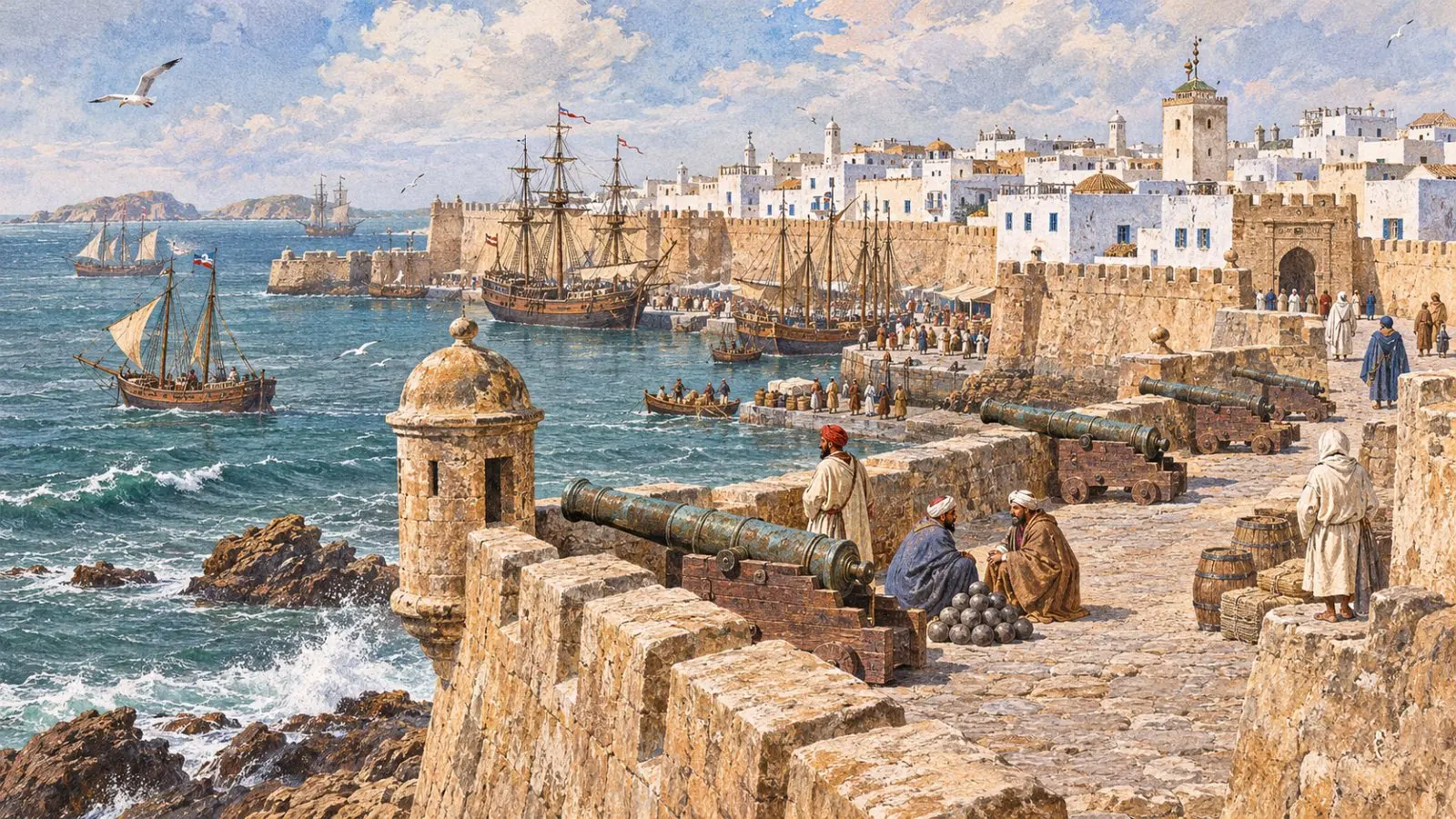
In the 16th century Spain, England, the Netherlands and France tried in vain to take it. The port exported sugar and molasses and served as a corsair haven. In 1629 the French admiral Isaac de Razilly landed about a hundred men on the island but re-embarked them a few days later; in 1631 France signed a trade treaty with the sultan.
The city designed by the sultan (1760-1770)
the town designed by the sultan
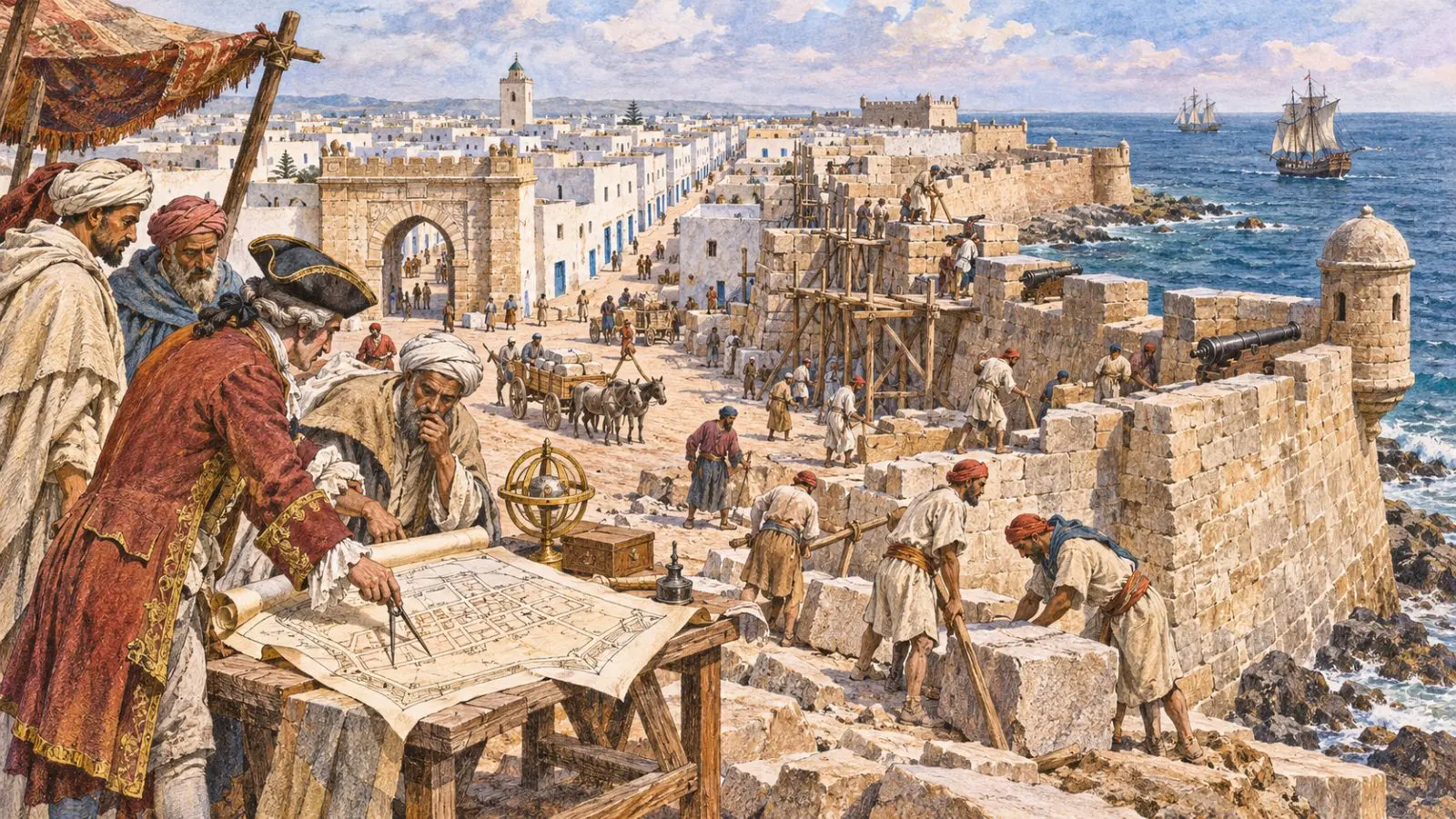
The present town was the project of Sultan Sidi Mohammed ben Abdallah, who wanted to turn the kingdom towards the Atlantic and European trade. He sought a port as close as possible to Marrakech and wanted to cut off trade through Agadir, which favoured a rival: he closed Agadir's port in 1767 and moved some of its inhabitants to the new town.
For twelve years the French engineer Théodore Cornut, helped by Moroccan architects from Fes, Marrakech and Rabat, laid out the town and kasbah on a regular plan, rare in Morocco. The Sea Gate is the work of an English convert, Ahmed el-Inglizi. The name went from "Souira", the little fortress, to "Es-Saouira", the well-designed. By an ordinance of 21 January 1765, European merchants in Rabat-Salé had to move here.
The port of caravans and tujjar
the port of caravans and merchants
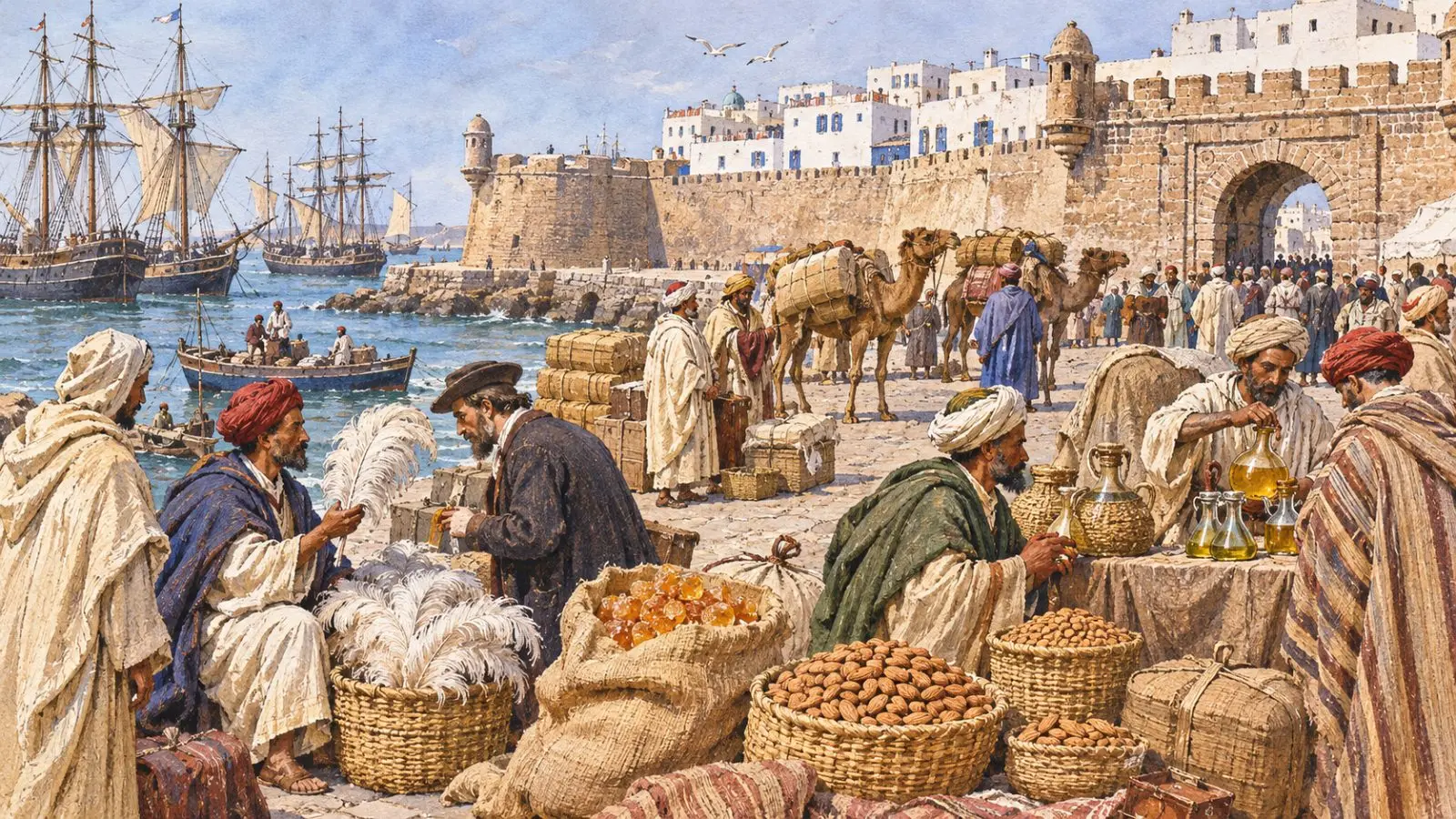
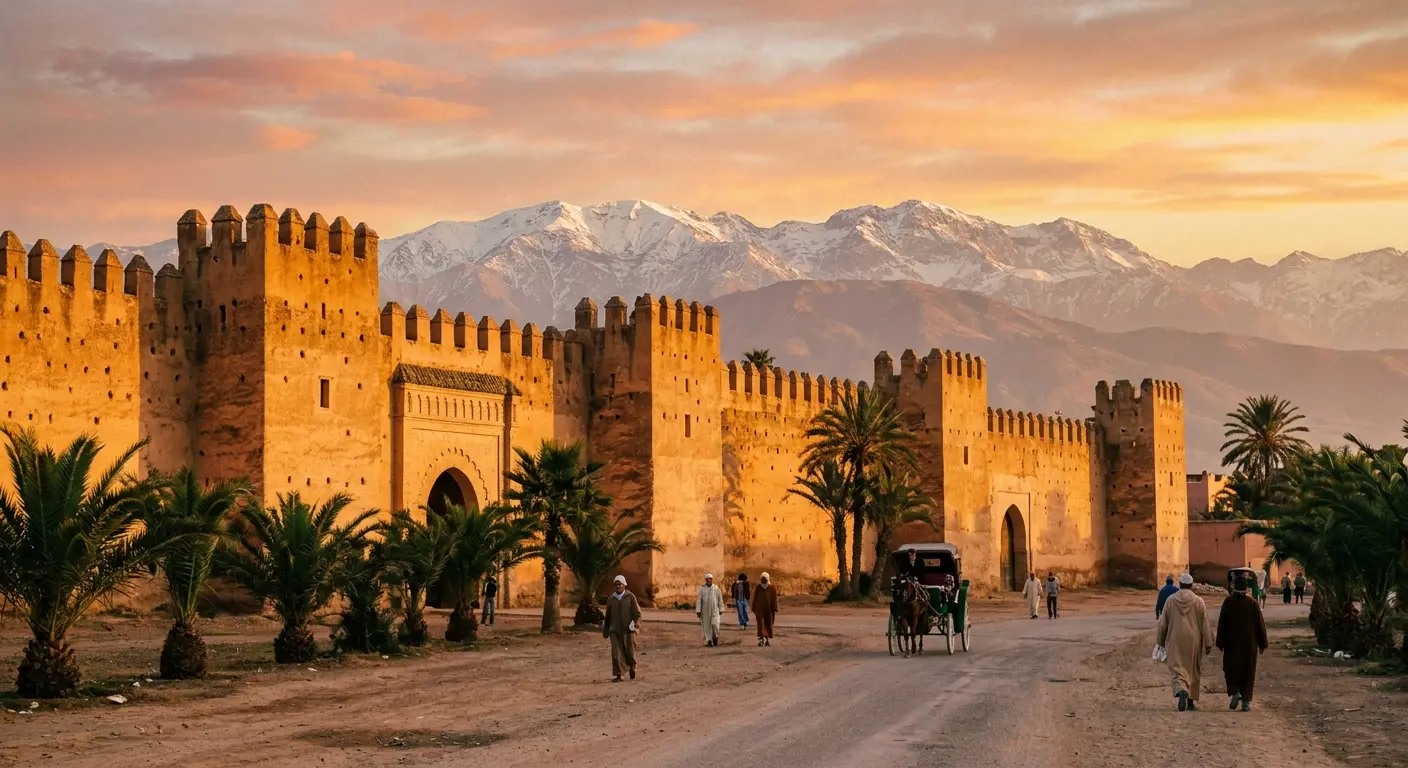
From its founding until the late 19th century, Essaouira was Morocco's main port. Caravan goods from sub-Saharan Africa, via Timbuktu and Marrakech, were shipped from here to Europe: the road from Marrakech to Essaouira is almost straight. In the 19th century its trade was roughly double Rabat's, and European powers opened consulates and trading houses here.
The sultan encouraged Jewish merchants to settle and handle trade with Europe. In 1867 a French botanist estimated that half of the 12,000 inhabitants were Jewish. The decline of the caravans, then the creation of Israel and Moroccan independence led to their departure; Essaouira's last Jewish resident died in 2025. King Mohammed VI visited Bayt Dakira, the Jewish heritage house, on 15 January 2020.
Bombardments and protectorate (1844-1956)
Because Morocco supported the Algerian emir Abd el-Kader, the Prince de Joinville's French fleet bombarded Mogador and briefly occupied the island on 16 August 1844. In 1864 an American Confederate ship, the CSS Georgia, even fired on the coast after its crew was refused landing.
From 1912 to 1956 the town was part of the French protectorate. It served as a base for 8,000 soldiers for the expedition against the Dar Anflous kasbah, taken on 25 January 1913. The French presence left a Franco-Moroccan school, still visible, and many residents still speak fluent French.
Othello, hippies and UNESCO
In the early 1950s Orson Welles stayed at the Hôtel des Îles, just south of the walls, while filming his "Othello", which won the Palme d'Or at Cannes in 1952. From the late 1960s the town drew hippies, musicians and painters.
The medina was listed as UNESCO World Heritage in 2001, as an example of an 18th-century fortified town built on European principles in a North African setting. The port Skala was a set for the series "Game of Thrones". Every June the Gnawa festival brings together musicians from around the world.
— II —
CHAPTER III
Key dates
25 BC
Under King Juba II, workshops on Mogador island make the famous purple dye.
1506
The Portuguese build the Castelo Real de Mogador.
1764
Sultan Mohammed ben Abdallah founds the new city, laid out with Théodore Cornut.
2001
The medina is listed by UNESCO.
— III —
CHAPTER IV
Landmarks
1
The Skala and its cannons
The bastion facing the ocean, lined with 18th-century bronze cannons, gives Essaouira's most famous view, at sunset over the rocks.
2
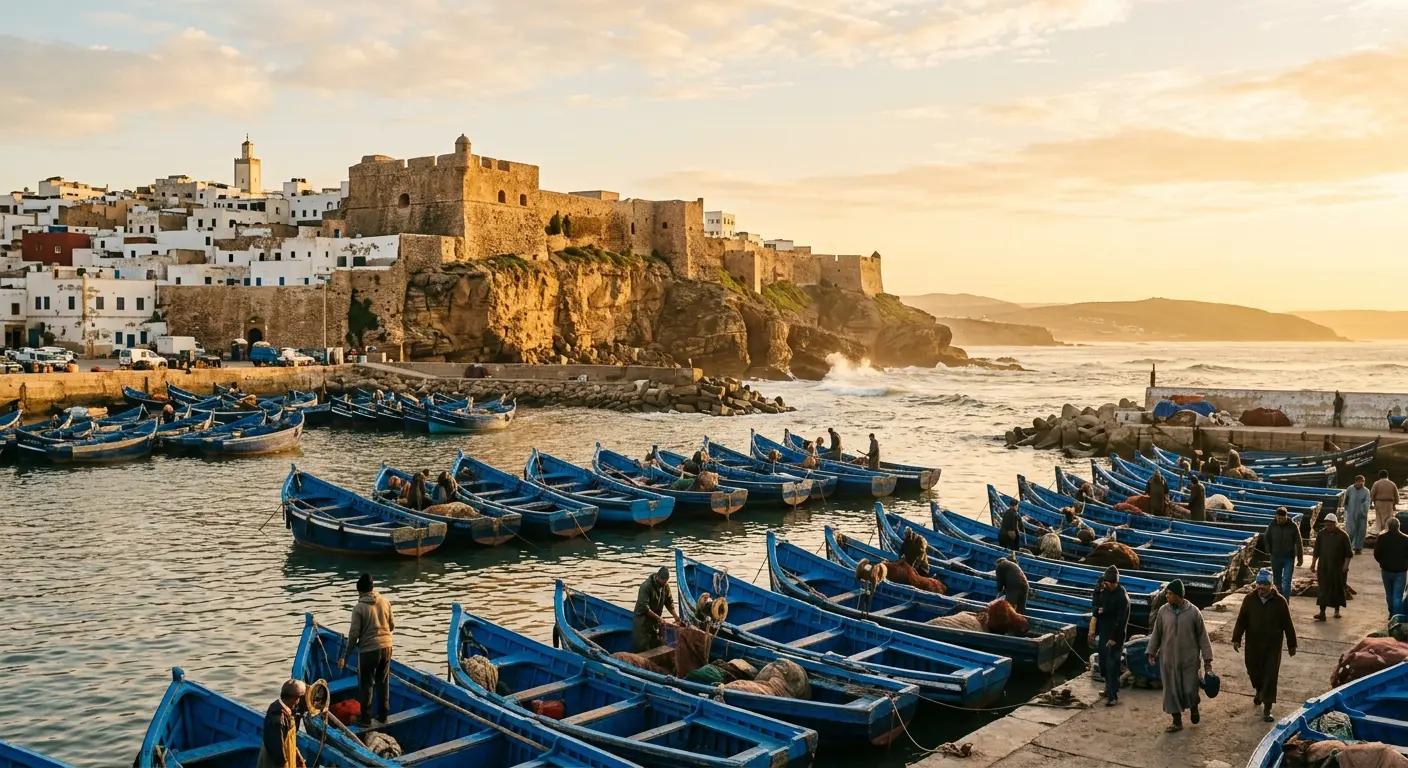
The harbour and the port Skala
Blue boats, wooden shipyards and the fish auction; you pick your sardine or sea bream and have it grilled on the spot.
3
The mellah and Slat Lkahal synagogue
In the 19th century the Jewish community made up a large share of the population. Bayt Dakira, a house of memory opened in 2020, tells this shared history.
4
Mogador island
A nature reserve facing the town, home of Eleonora's falcon; landing is not allowed, but you can admire it from the beach.
— IV —
CHAPTER V
People
JJuba II−48–23Scholarly king of Mauretania, husband of Cleopatra Selene, daughter of Cleopatra; under his reign Mogador island produced purple dye.
SSidi Mohammed ben Abdallah1710–1790Alaouite sultan, founder of the modern town in 1764 and of Casablanca; he opened Morocco to international trade.
OOrson Welles1915–1985He filmed Othello on the ramparts; the film won the Palme d'Or in 1952, and a square in the town bears his name.
— V —
CHAPTER VI
Culture and traditions
Gnawa music
Inherited from descendants of West Africans, the Gnawa tradition combines guembri, qraqeb and trance; it has been on UNESCO's intangible heritage list since 2019, and Essaouira is its capital every June.
Thuya wood
The cabinet-makers under the ramparts work thuya burl, the fragrant wood of the region, inlaid with lemonwood and mother-of-pearl.
Essaouira is the world capital of Gnawa music — the trance-inducing spiritual music brought by sub-Saharan slaves. The annual Gnawa World Music Festival (June) transforms the city. The town is famous for argan oil production (the surrounding region is an argan UNESCO Biosphere Reserve) and thuya wood craftsmanship — the swirling-grain wood used in boxes, frames, and furniture.
— VI —
CHAPTER VII
The people
The Souiris
Residents are known as calm and welcoming, like their town. Fishermen, thuya woodworkers, Gnawa musicians and artists live side by side; there's also a foreign community settled since the 1960s.
Between Arabic and Tashelhit
The town sits on the border between the Arab Chiadma tribes to the north and the Amazigh Haha to the south: you hear darija and Tashelhit, often within the same family.
— VII —
CHAPTER VIII
At the table
Grilled fish at the harbourSardines, sea bream, prawns and spider crabs, picked from the stall and grilled in front of you.
01The old name, Mogador, probably comes from a Phoenician word meaning "small fortress".
02In Antiquity, purple dye for emperors was made here from shellfish of the Purple Isles.
03Orson Welles filmed Othello here in 1949-1951; the film won the Palme d'Or at Cannes in 1952.
— IX —
Frequently asked questions about Essaouira
How many days do you need in Essaouira?
Allow 2–4 days to see Essaouira without rushing. That is the length we use in our itineraries.
When is the best time to visit Essaouira?
The best months for Essaouira are April, May, June, September and October.
How much does a day in Essaouira cost?
Per person per day, accommodation included: about $40 on a budget, $90 mid-range and $200 for a luxury stay.
How do you get to Essaouira?
CTM buses from Marrakech (2.5h), Casablanca (5h). Supratours buses connect to Agadir (3h). No train. Small airport with limited service.
What is there to see in Essaouira?
The must-sees of Essaouira: Skala de la Ville, Port de pêche, Medina souks and Beach.
What should you eat in Essaouira?
To taste in Essaouira: Marrakech tagine, Zaalouk, Taktouka and Amlou.
Where should you stay in Essaouira?
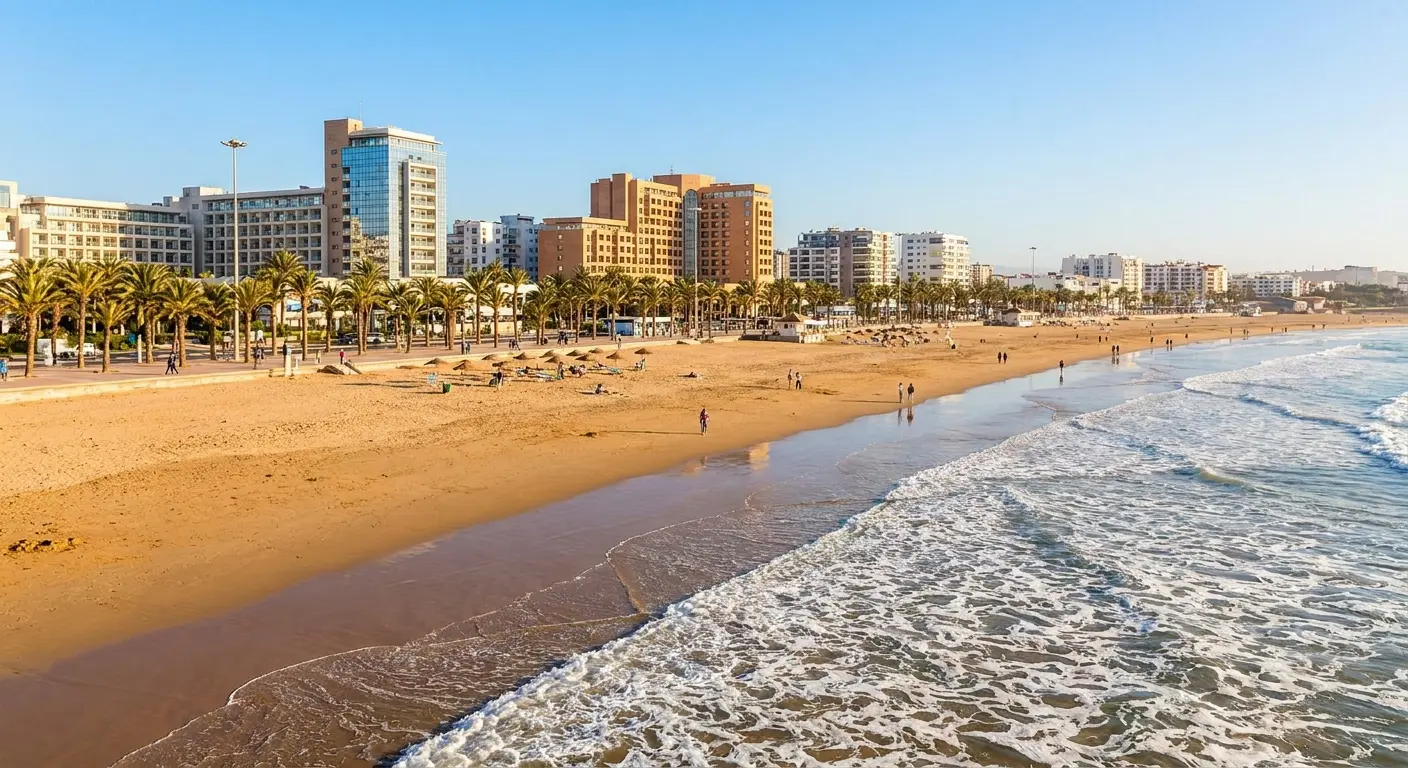
The best areas to stay: Medina and Beach quarter.
Is Essaouira safe?
Yes, Essaouira welcomes many travellers every year. The precautions are those of any tourist destination: watch your belongings in crowds, politely turn down unofficial guides, agree on a taxi fare before getting in.