Porto Mesegina and Agadir al-Harba
The oldest map showing the site dates from 1325: it marks a "Porto Mesegina", after the Amazigh Mesguina (or Ksima) tribe, known since the 12th century. The name Agadir, meaning "fortified granary" in Tashelhit, first appears in 1510, as Agadir al-Harba.
Santa Cruz do Cabo de Gué (1505-1541)
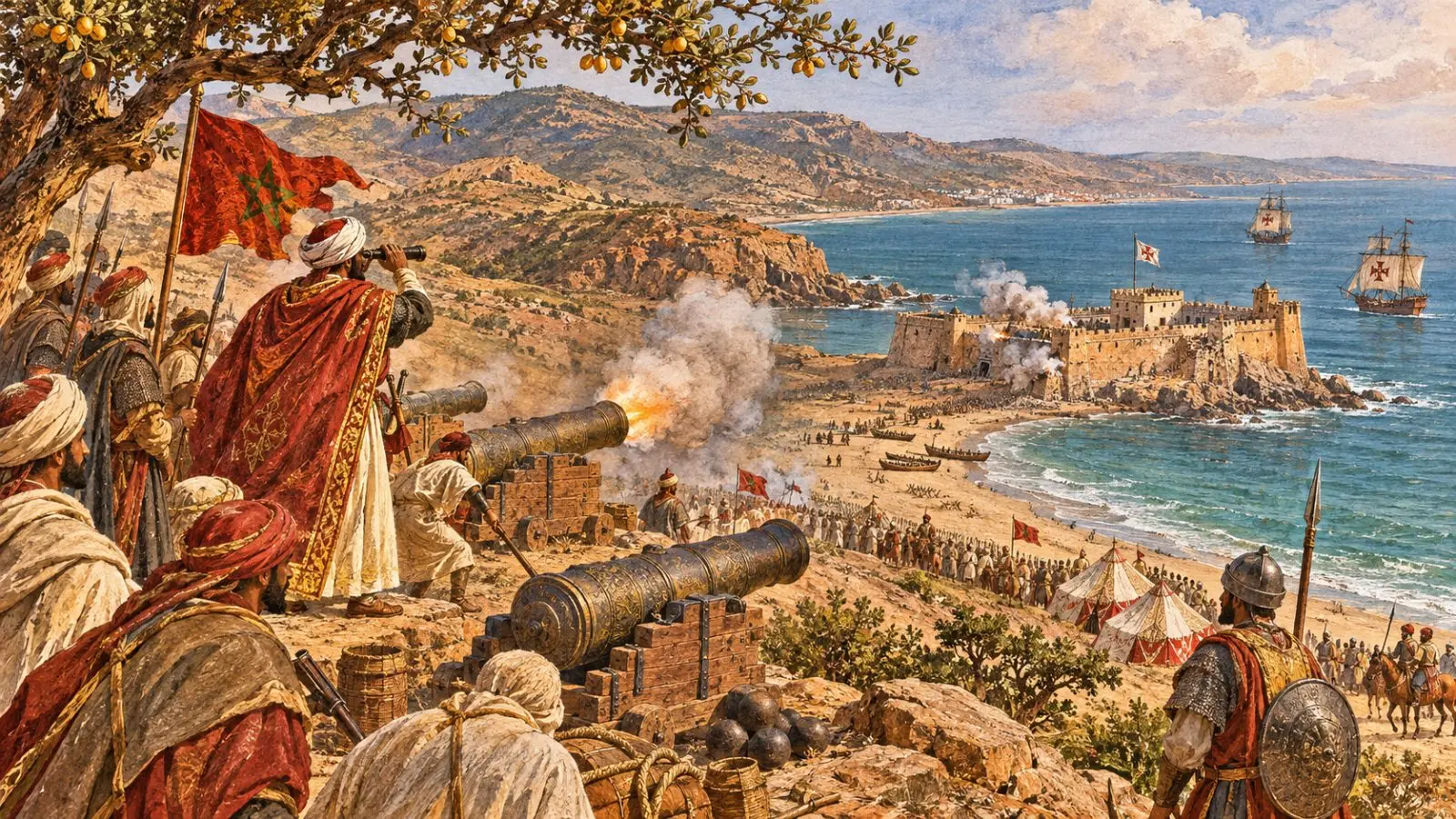
In 1505 the Portuguese nobleman João Lopes de Sequeira built a wooden castle at the foot of the hill, near a spring: the colony of Santa Cruz do Cabo de Gué. The district keeps the name Founti, from the Portuguese "fonte", fountain. The King of Portugal bought the castle on 25 January 1513.
The Souss tribes mounted a blockade lasting years. In 1510 Mohammed al-Qa'im, head of a sharifian family, led the resistance: his descendants founded the Saadian dynasty. In 1540 Mohammed ash-Sheikh set up cannon on the hill above the fort; the siege began on 16 February 1541 and the town fell on 12 March. Six hundred Portuguese were taken prisoner, including the governor Guterre de Monroy.
Agadir Oufella, the Saadian kasbah
The 1541 victory pushed the Portuguese to abandon Safi and Azemmour: by 1550 they held only Mazagan, Tangier and Ceuta in Morocco. Sultan Abdallah al-Ghalib (1557-1574) built a kasbah on top of the hill, called Agadir n'Ighir, the "granary of the hill".
In the 17th century, under the Amazigh principality of Tazerwalt, the port traded with Europe: sugar, wax, copper and hides for weapons and cloth. An earthquake destroyed the town in 1731.
The closed port (1760-1911)
From 1760 Sultan Sidi Mohammed ben Abdallah, wishing to punish the rebellious Souss, diverted trade to Essaouira and had Agadir's port closed. The decline lasted a century and a half: in 1789 a traveller described a ghost town of crumbling houses.
Moulay Hassan I reopened the port in 1881 to supply his 1882 and 1886 expeditions into the Souss. In 1884 Charles de Foucauld still described "a poor village, depopulated and without trade".
The Agadir crisis and the protectorate (1911-1956)
On 1 July 1911 Germany sent the gunboat Panther into Agadir bay to claim a share of Morocco. The Agadir crisis raised fears of war between France and Germany; the Franco-German treaty of 4 November 1911 gave France a free hand, and it established its protectorate the following year.
French troops landed on 15 June 1913 in a town of fewer than a thousand inhabitants. A port was built, then the Talborjt district, and around 1930 Agadir became an Aéropostale stop, used by Saint-Exupéry and Mermoz. The modern centre was laid out by Henri Prost from 1930, and the town lived from fishing, canneries and early tourism.
The earthquake of 29 February 1960 and rebirth
In 1960 Agadir had over 40,000 inhabitants. On 29 February, at quarter to midnight, a magnitude 5.7 earthquake lasting about fifteen seconds destroyed almost the whole city, including the old kasbah. The death toll is estimated at around 15,000, more than a third of the population.
King Mohammed V declared that the city would be reborn. It was rebuilt a little further south by Moroccan and French architects, including Jean-François Zevaco and Élie Azagury. Agadir passed half a million inhabitants in the early 21st century, with a large fishing port, long the world's leading sardine port, and one of the country's main beach resorts.