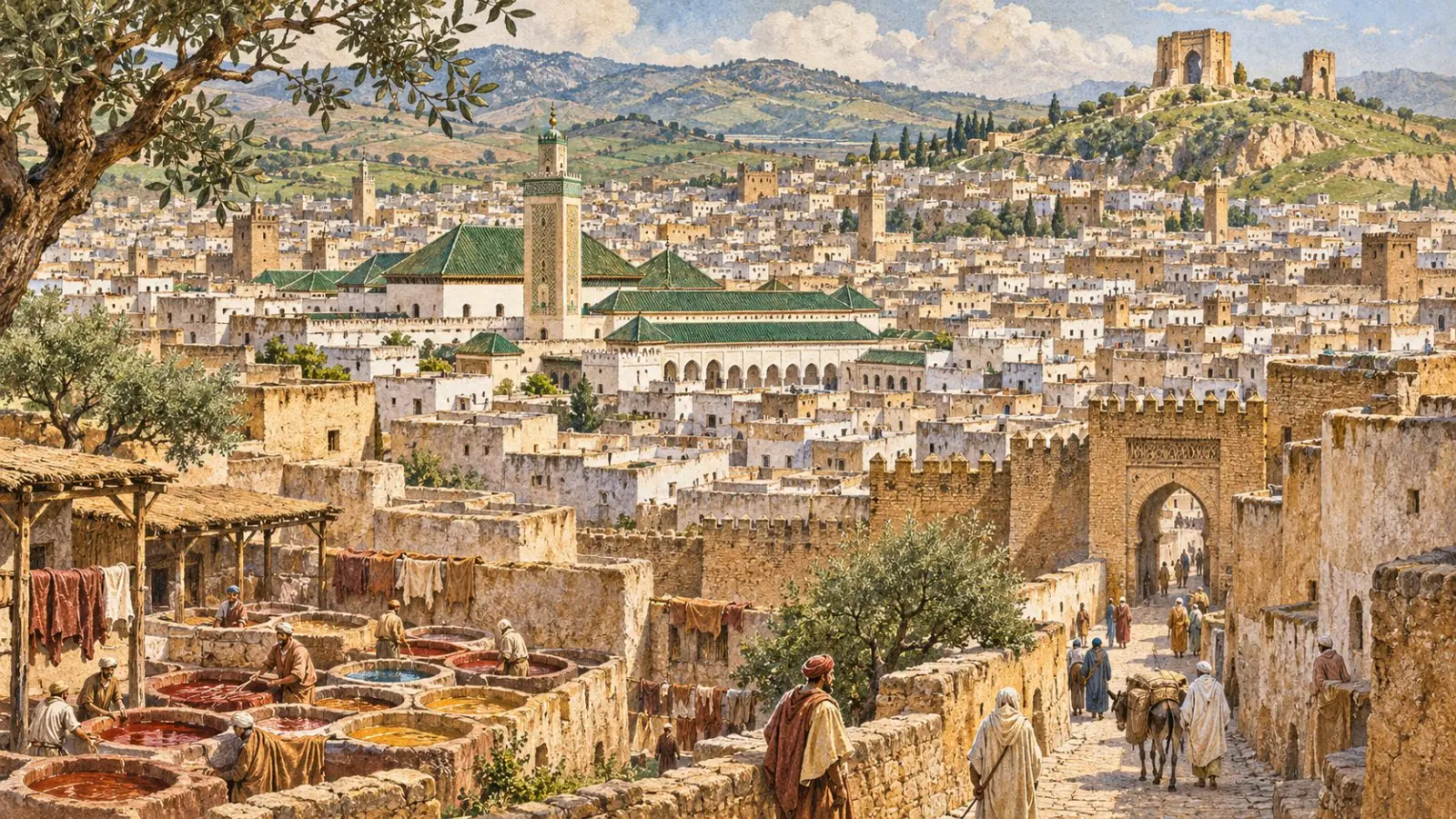
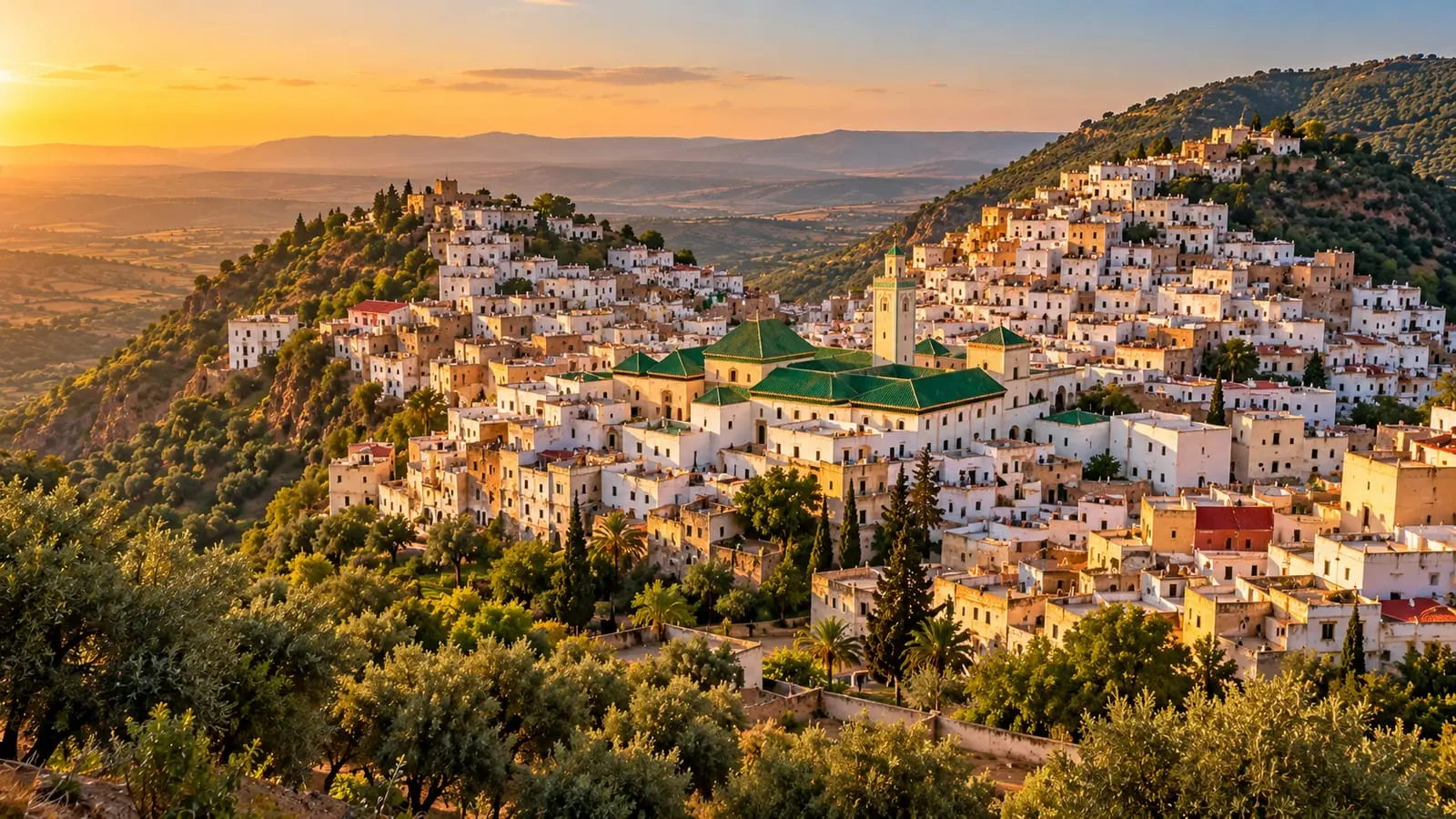
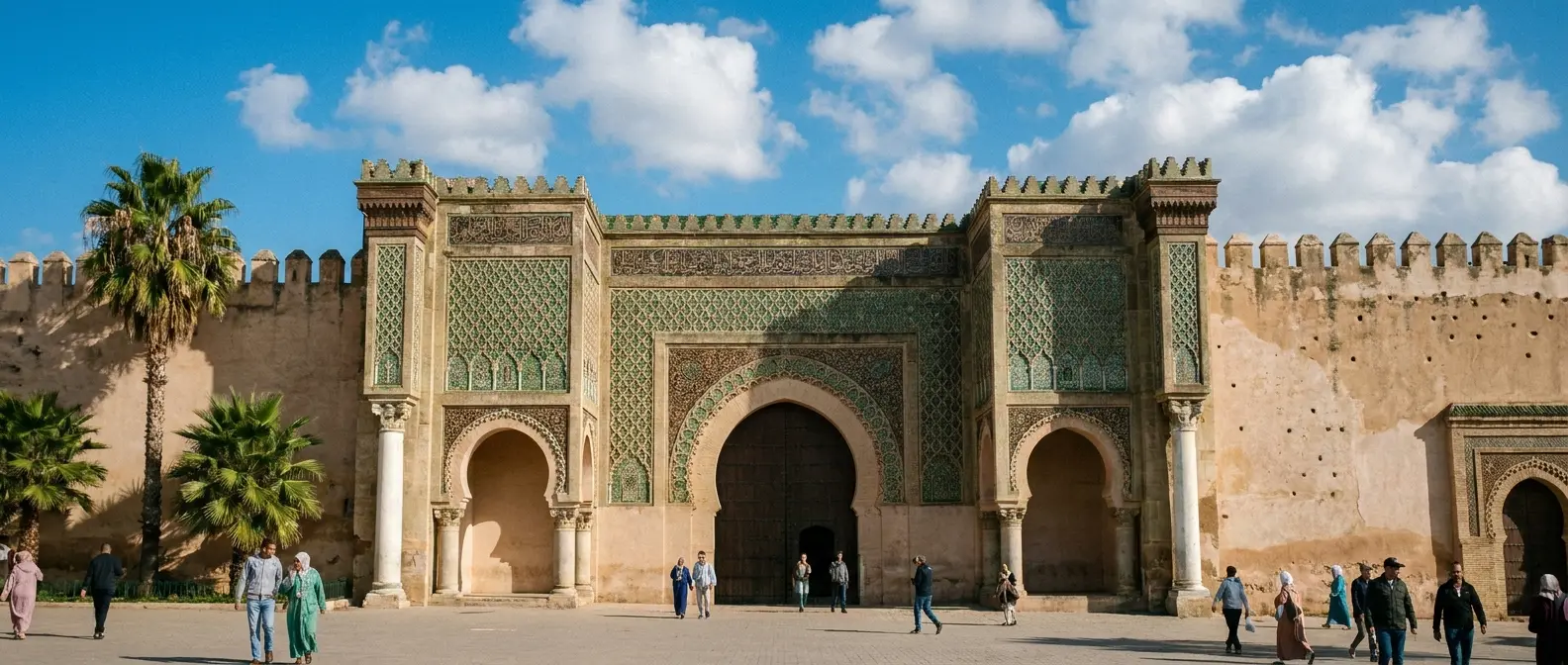
FFounded in 789 by Idris I and enlarged by his son Idris II, Fes is the oldest of the imperial cities and the cradle of the Moroccan state. Its medina, Fes el-Bali, is one of the largest medieval cities still lived in, car-free, with al-Qarawiyyin at its heart since 859.
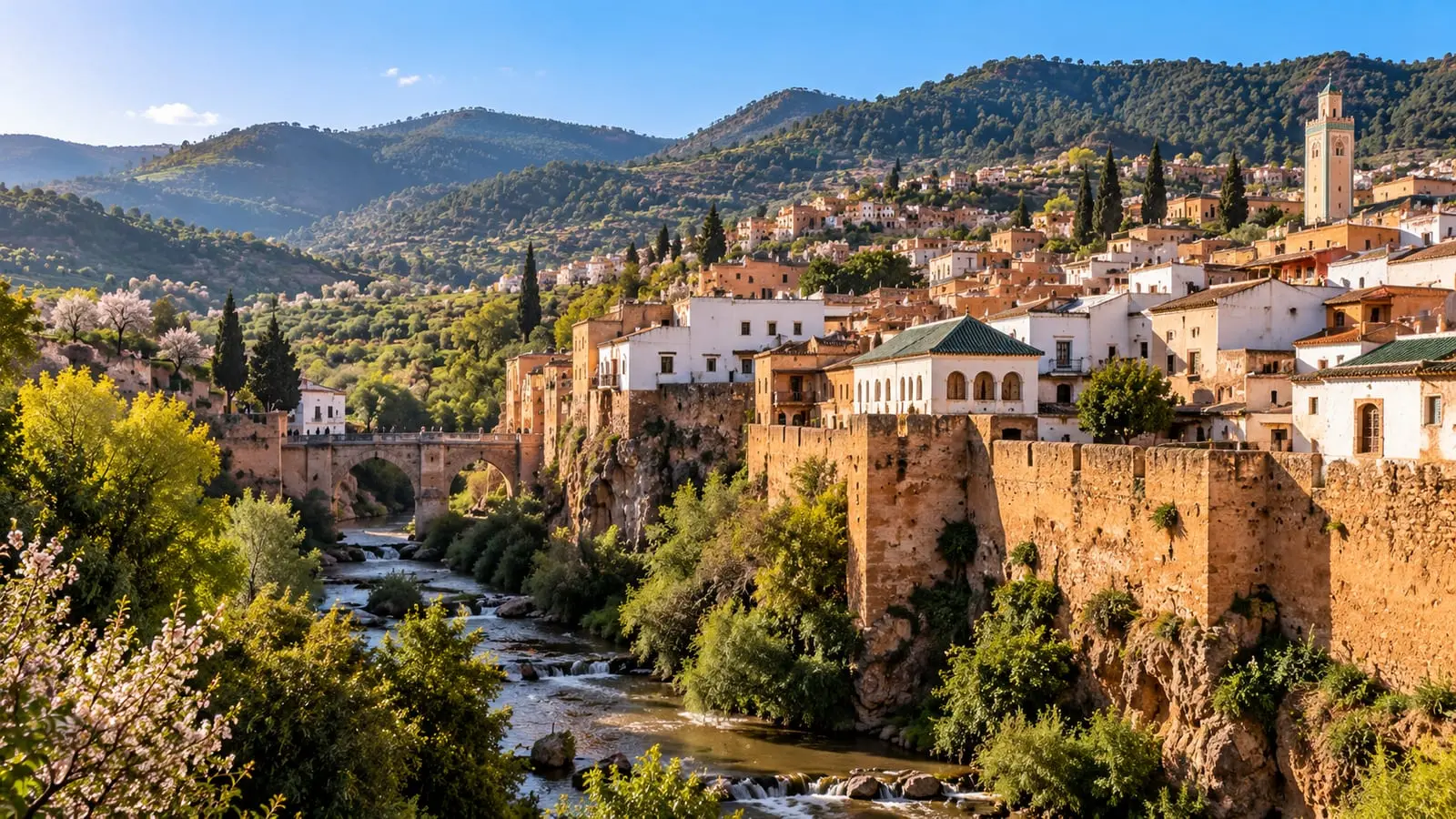
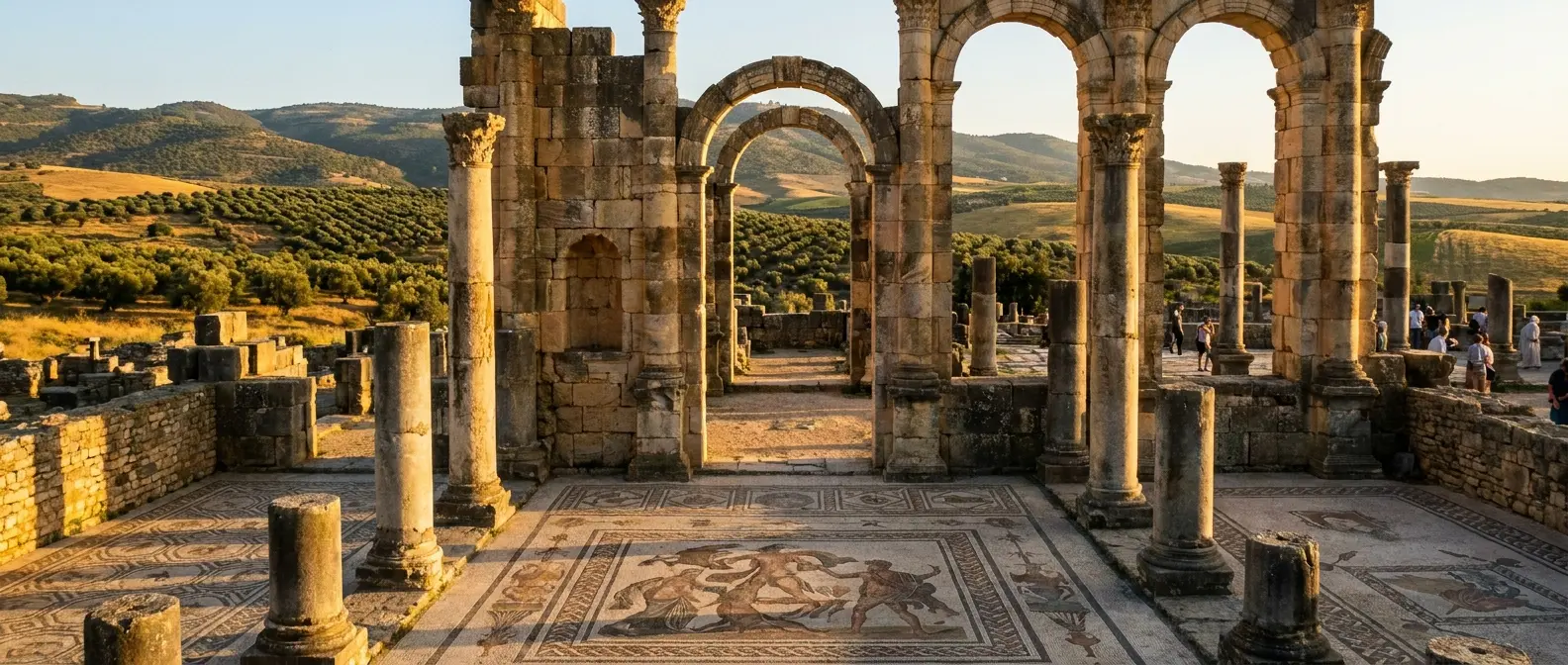
In 789 Idris I, a descendant of the Prophet who had fled Arabia after a failed revolt against the Abbasids, founded Madinat Fas on the right bank of the river, then called the Jawhar. In 809 his son Idris II built a second town, al-Aliya, on the opposite bank and moved his capital there from Walili (Volubilis).
The first inhabitants were mostly Amazigh, with a few hundred Arab horsemen from Kairouan in Idris II's entourage. From the start, Fes was a double city divided by a river.
Andalusians and Kairouanis
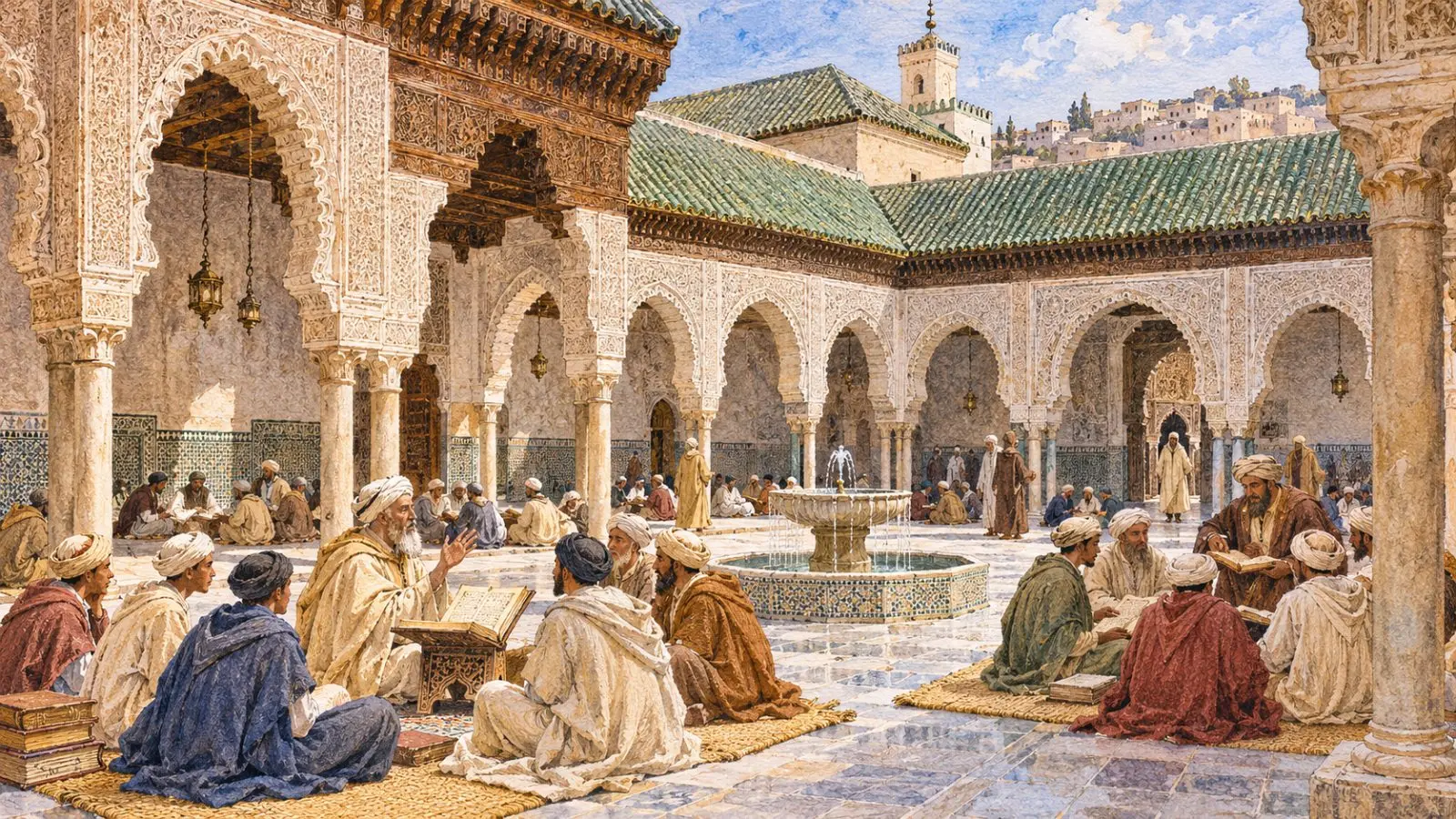
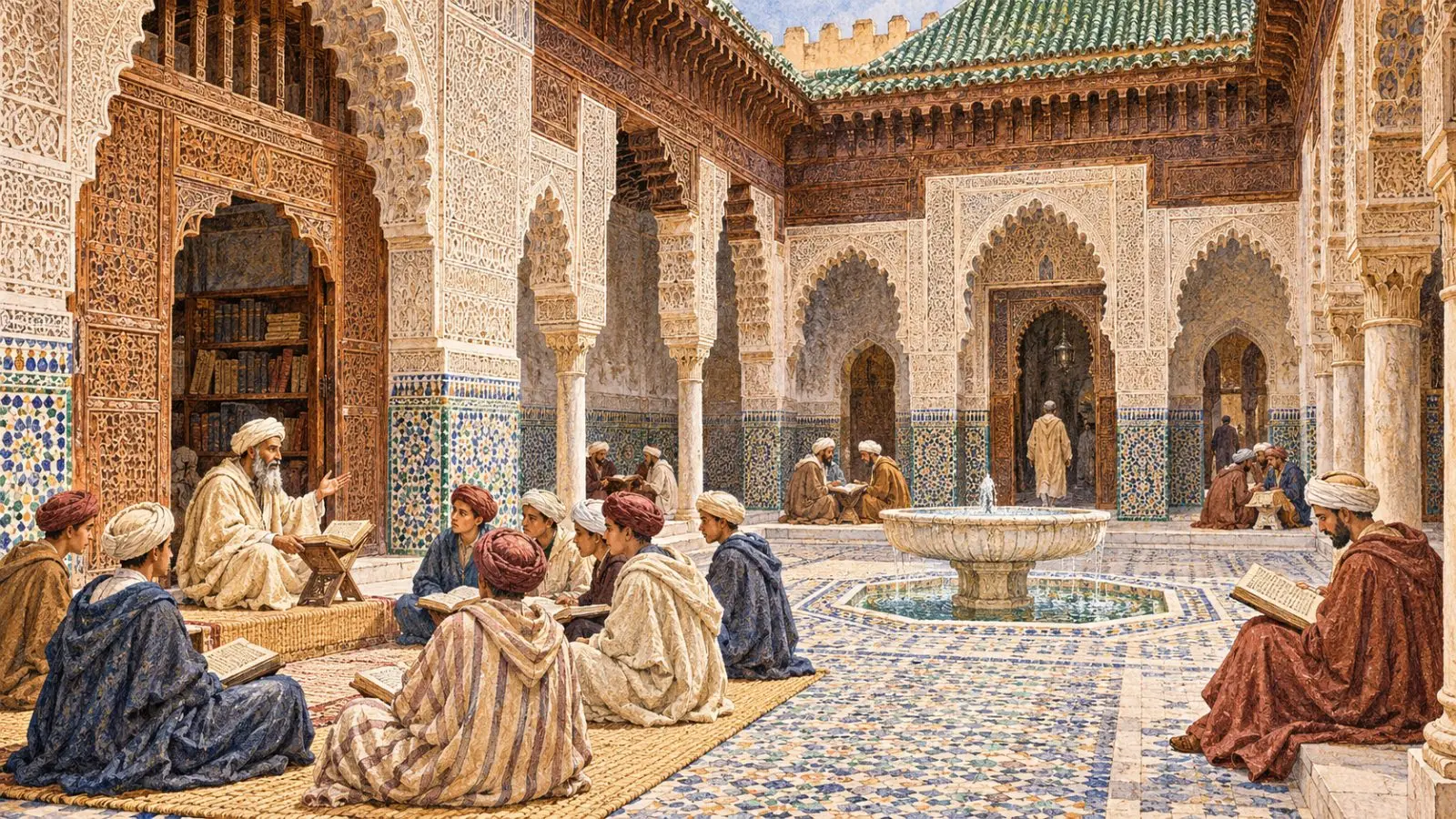
the Qarawiyyin mosque and its scholars
After a revolt in Cordoba in 817-818, Andalusian families expelled by Emir al-Hakam I settled on one bank. Other families from Kairouan settled on the other. The two quarters kept their names: Adwat al-Andalus and Adwat al-Qarawiyyin.
It was in the second quarter that Fatima al-Fihri, daughter of a wealthy Kairouan merchant, founded the al-Qarawiyyin mosque in 857 or 859; it would become one of the great centres of learning in the Muslim world. The city also had a large Jewish community, settled near today's Bab Guissa, and for a time a few Christians.
Between Cordoba and the Fatimids (10th-11th century)
After Idris II's death in 828, the kingdom was divided among his sons and weakened. In the 10th century Fes became the prize of two great powers: the Umayyad caliphate of Cordoba and the Fatimid caliphate of Ifriqiya. The Fatimids took the city in 927 and drove out the Idrisids for good; it then changed hands several times.
From about 980 Fes was ruled by the Maghrawa, Zenata allies of Cordoba. Emir Dunas ibn Hamama (1037-1049) created much of the city's water network, still partly in use today, as well as hammams, mosques and the first bridges. Around 1059-1061 two rival brothers each ruled one bank: their names survive in two gates, Bab Guissa in the north and Bab Ftouh in the south.
Almoravids and Almohads: one city
Around 1069-1070 Yusuf ibn Tashfin took Fes and finally united the two towns: he pulled down the wall between them, built or rebuilt bridges, surrounded the whole with new walls and built a kasbah to the west, near today's Bab Boujloud. He is sometimes considered Fes's second founder; the city became a renowned centre of Maliki law.
In 1145 the Almohad caliph Abd al-Mu'min took the city after fierce resistance and had its walls razed. But Fes mattered too much: Ya'qub al-Mansur ordered them rebuilt, and his successor Muhammad al-Nasir completed them in 1204, along the line Fes el-Bali still follows today. In the 12th century the city may have had 200,000 inhabitants, among the most populous in the world.
The Marinid golden age (1250-1465)
a Marinid madrasa
In 1250 the Marinids made Fes their capital: its golden age. After a revolt in 1276, Sultan Abu Yusuf Ya'qub founded Fes el-Jdid, "new Fes", as an administrative and military centre with the royal palace. Between 1271 and 1357 seven madrasas were built, among them Bou Inania and al-Attarine, some of the finest monuments of Moroccan architecture.
In the 15th century the Jewish community was moved to a new quarter of Fes el-Jdid, the Mellah; Jewish sources link this to the rediscovery of Idris II's body in 1437, which made the heart of the city sacred. After 1492 and 1496, Jews expelled from Spain and Portugal joined this community.
Wattasids, Saadians and Ottomans (1465-1666)
A revolt overthrew the last Marinid sultan in 1465. In 1472 the Wattasids, former Marinid viziers, took power from Fes. In January 1549 the Saadian sultan Mohammed ash-Sheikh seized the city; the Wattasids retook it in 1554 with Ottoman help, but only for a few months.
In 1558 Abdallah al-Ghalib stopped an Ottoman invasion at the Battle of Wadi al-Laban, north of Fes. The Saadians, based in Marrakech, distrusted the city: they ringed it with forts such as the Borj Nord, and only added the ablution pavilions in the Qarawiyyin courtyard. After Ahmad al-Mansur's death in 1603, Fes became the prize in the war between his sons, which lasted until 1627.
The Alaouites (1666-1912)
After an occupation by the Dila zawiya in 1641, Moulay Rashid, founder of the Alaouite dynasty, took Fes in 1666, restored it and made it capital again; he built the Cherratine Madrasa in 1670. His successor Moulay Ismail preferred Meknes and burdened the city with taxes. After his death Fes suffered decades of conflict with the Udaya military tribe.
Peace returned under Sidi Mohammed ben Abdallah (1757-1790), and Fes remained the main capital until the 20th century. In 1789 Ahmad al-Tijani settled here and founded the Tijaniyya brotherhood, now widespread as far as West Africa. Sultan Moulay Hassan I (1873-1894) finally linked Fes el-Bali and Fes el-Jdid with a walled corridor, where the Jnan Sbil garden and Dar Batha palace were created. Until the 19th century Fes was the only city making the fez.
The Treaty of Fes and the 20th century
In 1907-1908 the ulama of Fes, led by Muhammad ibn Abd al-Kabir al-Kattani, backed Moulay Abd al-Hafid against his brother Abd al-Aziz. Besieged in the city by Middle Atlas tribes in 1911, the sultan called on France: a French column reached Fes on 21 May 1911.
On 30 March 1912 the Treaty of Fes placed Morocco under a French protectorate. It sparked the Fes riots in April, harshly put down. Resident-General Lyautey moved the administrative capital to Rabat and had a new town built beside the medina, which was preserved as heritage. Fes became a centre of the nationalist movement, and its medina was listed as UNESCO World Heritage in 1981.
— II —
CHAPTER III
Key dates
789
Idris I founds the city on the right bank of the Fes river.
859
Fatima al-Fihri founds al-Qarawiyyin, often called the oldest university still in operation.
1276
The Merinids build Fès el-Jdid, the new royal town.
1981
The medina of Fes is listed by UNESCO.
— III —
CHAPTER IV
Landmarks
1
Al-Qarawiyyin
Founded in 859 and enlarged by the Almoravids, the mosque-university holds one of the oldest libraries in the world, restored and reopened in 2016. The interior is for Muslims only, but its doors give a view of the courtyard and fountains.
2
The Bou Inania madrasa
Built by the Merinid sultan Abu Inan between 1350 and 1357, it is the only madrasa in Fes with a minaret. Cedar wood, stucco and zellige reach a peak of Merinid art; opposite stands a 14th-century water clock, the Dar al-Magana, which once timed the prayers.
3
The Attarine madrasa
Completed in 1325 beside the spice-sellers' souk (attarine), it is considered one of the masterpieces of Merinid architecture: small but extraordinarily dense in decoration.
4
Bab Boujloud
The “blue gate”, main entrance to the medina, was built in 1913: blue on the outside (the colour of Fes), green on the inside (the colour of Islam). Behind it open the medina's two main streets, Talaa Kebira and Talaa Seghira.
5
The Chouara tannery
The most famous of the Fes tanneries, where hides have been treated for centuries in stone vats of plant dyes. You watch it from the terraces of the neighbouring leather shops, a sprig of mint under your nose.
6
Nejjarine square and museum
Around a zellige fountain, an 18th-century fondouk (caravanserai) houses the Museum of Wood Arts and Crafts, with a terrace over the medina's rooftops.
7
The Royal Palace and the mellah
In Fes el-Jdid, the monumental brass doors of Dar el-Makhzen, restored in the 20th century, lead into the royal palace. Next door, the mellah keeps its houses with wooden balconies, the Ibn Danan synagogue and its white cemetery.
8
The Merinid tombs
Ruined 14th-century mausoleums on the hill north of the medina: the best viewpoint over Fes el-Bali, especially at sunset, when the call to prayer rises from hundreds of minarets.
— IV —
CHAPTER V
People
IIdriss II791–828Son of Idris I and the true builder of Fes; his shrine, at the heart of the medina, is one of the most revered places in the country.
FFatima al-Fihriya800–880Heiress of a wealthy Kairouan merchant, she spent her fortune founding al-Qarawiyyin in 859.
MMaïmonide1138–1204Philosopher and physician born in Cordoba, one of the great figures of Jewish thought; his family lived in Fes in the 1160s.
IIbn Khaldoun1332–1406Historian and thinker, author of the Muqaddimah; he served at the Merinid court of Fes in the 1350s.
LLéon l'Africain (al-Hassan al-Wazzan)1494–1554Born in Granada and raised in Fes, a diplomat and later a captive in Rome, he wrote a Description of Africa that was Europe's reference for centuries.
— V —
CHAPTER VI
Culture and traditions
The capital of craftsmanship
Zellige, brasswork, Fassi embroidery, leather, cedar wood: each trade has its street and its masters, the maalems, who still train apprentices by hand.
Sacred and Andalusian music
Fes is one of the capitals of Arab-Andalusian music (al-Ala) and of malhoun. Its Festival of World Sacred Music, created in 1994, brings spiritual traditions into dialogue every year.
The moussem of Moulay Idriss II
Every year the craft guilds parade to the shrine of the city's founder with their offerings: one of the great moments of Fassi life.
Fes is Morocco's leather capital — the Chouara tannery has operated continuously since the 11th century. The city is renowned for its Fassi cuisine (considered Morocco's finest), its zellige craftsmen, and its tradition of Islamic scholarship. The Festival of World Sacred Music draws thousands annually. Traditional embroidery (Fassi broderie) uses distinctive geometric gold thread patterns.
— VI —
CHAPTER VII
The people
The Fassis
Fassi families long formed the country's merchant, scholarly and political elite. They're credited with a taste for refinement, sweet-and-savoury cooking and grand ceremonies. Many old families bear Andalusian surnames, a memory of ancestors driven out of Spain.
The Fes accent
The Fassi accent is one of Morocco's most recognisable: a throaty "r" close to "gh", and "q" often pronounced as a glottal stop ("a'al" instead of "qal"). Moroccans associate it with softness and good manners.
01The Fes el-Bali medina is the world's largest car-free urban area.
02The fez, the red hat, is named after the city, where its wool was dyed.
03The Qarawiyyin library, restored and reopened in 2016, holds manuscripts over a thousand years old.
— IX —
Frequently asked questions about Fes
How many days do you need in Fes?
Allow 2–4 days to see Fes without rushing. That is the length we use in our itineraries.
When is the best time to visit Fes?
The best months for Fes are March, April, May, September and October.
How much does a day in Fes cost?
Per person per day, accommodation included: about $35 on a budget, $90 mid-range and $250 for a luxury stay.
How do you get to Fes?
Fes-Saïss Airport (FEZ) has direct flights from Europe. Train connects to Casablanca (4h), Tangier (5h), Marrakech (8h). CTM buses serve all major cities.
What is there to see in Fes?
The must-sees of Fes: Chouara Tannery, Al-Qarawiyyin Mosque, Bou Inania Madrasa and Nejjarine Fountain & Museum.
What should you eat in Fes?
To taste in Fes: Marrakech tagine, Mechoui, Kefta meatball tagine and Pigeon pastilla.
Where should you stay in Fes?
The best areas to stay: Fes el-Bali, Fes el-Jdid and Ville Nouvelle.
Is Fes safe?
Yes, Fes welcomes many travellers every year. The precautions are those of any tourist destination: watch your belongings in crowds, politely turn down unofficial guides, agree on a taxi fare before getting in.