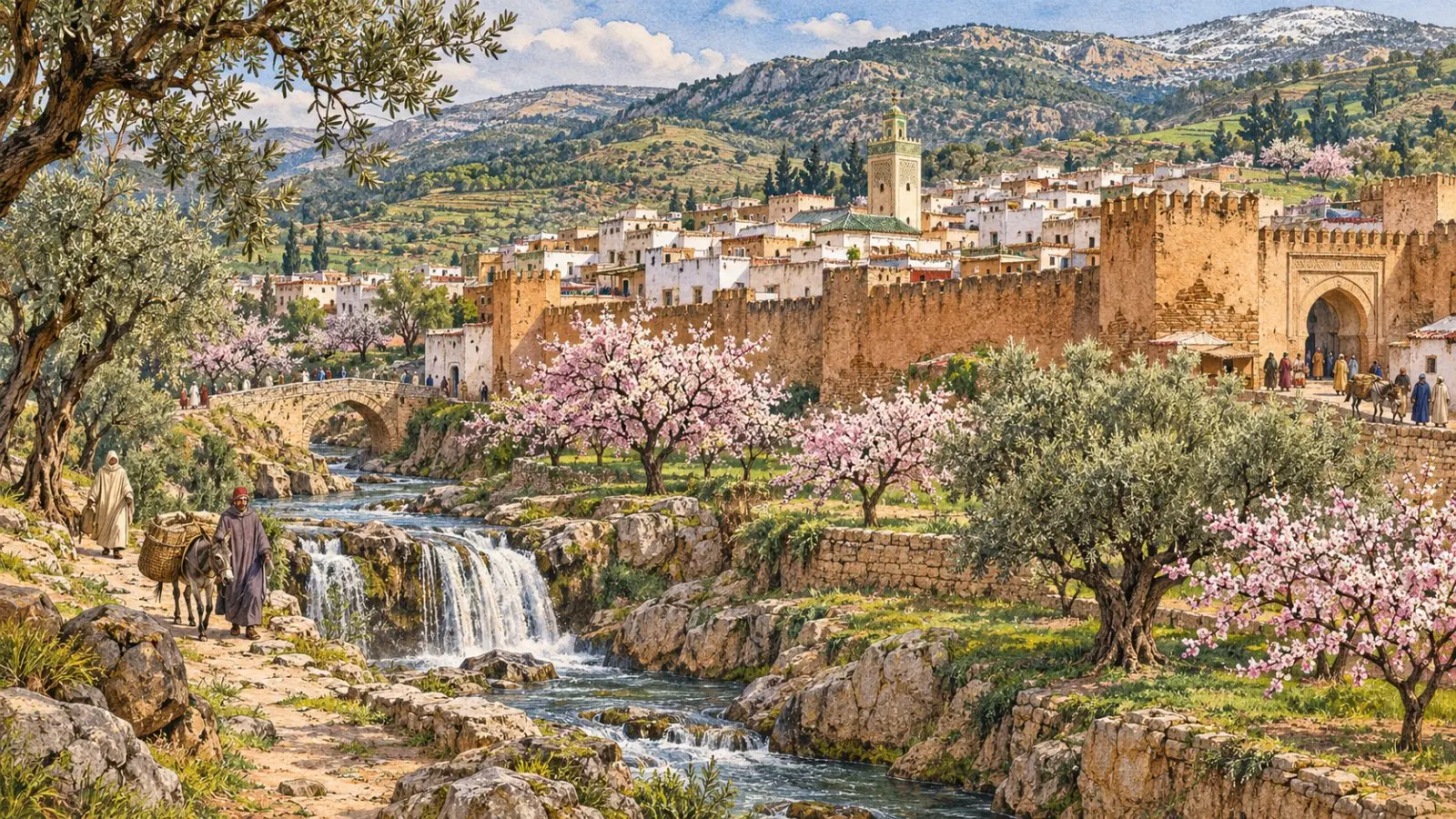
Sefrou, its gardens and the Aggai river

THE BOOK OF

Sefrou — All about Sefrou

صفرو

History, places, people, culture and food of Sefrou, told by two Moroccans.

10 chapters3 min readBy Yassine and Issam
Things to do in Sefrou
CONTENTS · I
  1. I. At a glance
  2. II. History
  3. III. Key dates
  4. IV. Landmarks
  5. V. People
  6. VI. Culture and traditions
  7. VII. The people
  8. VIII. At the table
  9. IX. Did you know?
  10. X. Frequently asked questions

CHAPTER I

At a glance

Older than its neighbour Fez, Sefrou is a small walled medina crossed by the Aggai river. Long nicknamed “little Jerusalem” for its large Jewish community, it is famous for its cherry festival, listed by UNESCO in 2012.

Arabic name
صفرو
Coordinates
33.8306, -4.8347
Best months
Mar, Apr, May, Jun, Sept, Oct

CHAPTER II

History

Older than Fes?

Sefrou is one of Morocco's oldest towns. Long before the Arabs arrived, Amazigh tribes lived on the banks of the Aggai river; the name is said to come from the Ahel Sefrou tribe. According to Leo Africanus the town was built before Fes, and the chronicler Ibn Abi Zar wrote that "one went from the town of Sefrou to the village of Fes".

In 807, as work on Fes began, Idris II settled for two years in a village on the Aggai called Habbouna, "those who loved us", now a quarter south of the medina. Walls and forts were raised at this time.
On the date road

Sefrou lies at a crossroads of caravan routes, including the "date road" linking Fes to Sijilmassa and the Tafilalet, along which African gold also travelled. The 11th-century geographer al-Bakri described it as "surrounded by streams and gardens".

On the foothills and in the valley, wheat, barley, olives, vines and flax were grown thanks to an ancient irrigation network.

Morocco's "little Jerusalem"

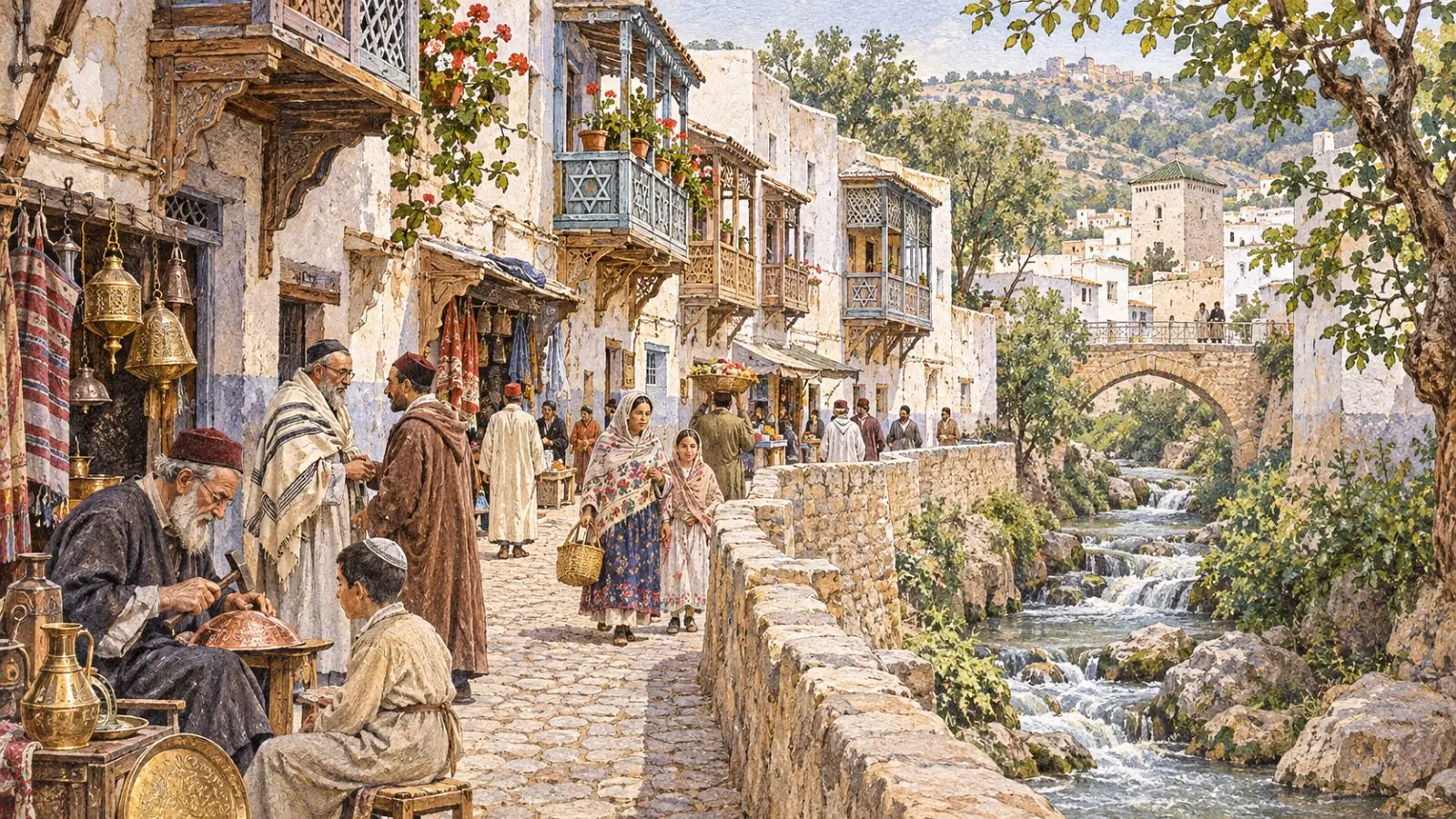
the mellah of Sefrou

Sefrou was home to one of Morocco's largest Jewish communities, up to about 8,000 people; in the 19th century Jews outnumbered Muslims there. They had varied origins: Judaised Amazighs, families from the Tafilalet, Arabic-speaking Jews from Fes and descendants of the 1492 exiles from Spain. The rabbi and judge Shaul Yehoshua Abitbol (1740-1809) wrote a famous collection of legal rulings here.

The writer Colette described the town as an "earthly paradise". Most Jewish families left for Israel, mainly around 1967.

The cherry town

Sefrou became a municipality in 1917, then the capital of its own province on 1 January 1991. Since 1920 it has celebrated the cherry harvest every June with a festival, listed in 2012 as UNESCO intangible cultural heritage.

In the 1960s the American anthropologist Clifford Geertz made Sefrou one of the most famous fieldwork sites in the anthropology of Morocco.

CHAPTER III

Key dates

  1. 1920

    First Cherry Festival, held every June since.

  2. 2012

    The Cherry Festival is inscribed on UNESCO's intangible heritage list.

CHAPTER IV

Landmarks

1

The medina and the mellah

Small, calm and authentic, with bridges over the river and craftsmen at work.

2

The waterfall

Just outside town, a waterfall and green paths.

3

The shrine of Sidi Bou Serghine

On the hill, a viewpoint over the town's roofs and the Fez plain.

CHAPTER V

People

  • Clifford Geertz1926–2006American anthropologist whose studies of Sefrou became classics.

CHAPTER VI

Culture and traditions

The cherry festival

Every June since the early 20th century: parades, music, and the crowning of the cherry queen.

The Cherry Festival (Fête des Cerises), held each June since 1920, is Séfrou's defining tradition — the surrounding hills produce Morocco's finest cherries, and the festival crowns a Cherry Queen from the local community. The city's embroidery tradition (Séfrou broderie) uses distinctive blue thread on white linen — a style specific to this city, sold in the medina's craft quarter. The Jewish cemetery above the town is one of the oldest and largest in Morocco, still maintained by the small remaining community.

CHAPTER VII

The people

A town of coexistence

In the mid-20th century nearly a third of Sefrou's residents were Jewish. Muslims and Jews shared trade, crafts and holy places such as the Kef el-Moumen cave. Most Jewish families left in the 1950s-60s.

Sefrou speech

Sefrou darija is close to that of Fes; around it, Middle Atlas villages speak Tamazight.

CHAPTER VIII

At the table

CherriesIn late May and June, the surrounding orchards fill the markets with cherries, sold by the kilo along the roads.

CHAPTER IX

Did you know?

  • The Sefrou cherry festival has run since 1920 and has been on UNESCO's intangible heritage list since 2012.
  • Anthropologist Clifford Geertz studied Sefrou in the 1960s.
  • Sefrou is only 30 km from Fes, at the foot of the Middle Atlas.

Frequently asked questions about Sefrou

How many days do you need in Sefrou?

Allow 1 day to see Sefrou without rushing. That is the length we use in our itineraries.

When is the best time to visit Sefrou?

The best months for Sefrou are March, April, May, June, September and October.

How much does a day in Sefrou cost?

Per person per day, accommodation included: about $25 on a budget, $55 mid-range and $110 for a luxury stay.

How do you get to Sefrou?

Grand taxis from Fes (28km, 30 min) depart from Bab Ftouh — the cheapest and most frequent option. CTM buses stop here on the Fes–Midelt route. No train or airport.

What is there to see in Sefrou?

The must-sees of Sefrou: Medina of Séfrou, Aggaï River Gorge & Waterfall, Mellah Quarter and Kef el-Moumen Cave.

What should you eat in Sefrou?

To taste in Sefrou: Khobz, Moroccan mint tea, Oranges with cinnamon and Msemen.

Where should you stay in Sefrou?

The best areas to stay: Medina, Mellah and Gorge de l'Aggaï.

Is Sefrou safe?

Yes, Sefrou welcomes many travellers every year. The precautions are those of any tourist destination: watch your belongings in crowds, politely turn down unofficial guides, agree on a taxi fare before getting in.

Is Sefrou good for families?

Yes, Sefrou is easy to visit with children.

Sources

To go further and check what we write.

Other sources

Read next

THE END

Now go and see Sefrou.

By Yassine and Issam · Spotted a mistake? Tell us