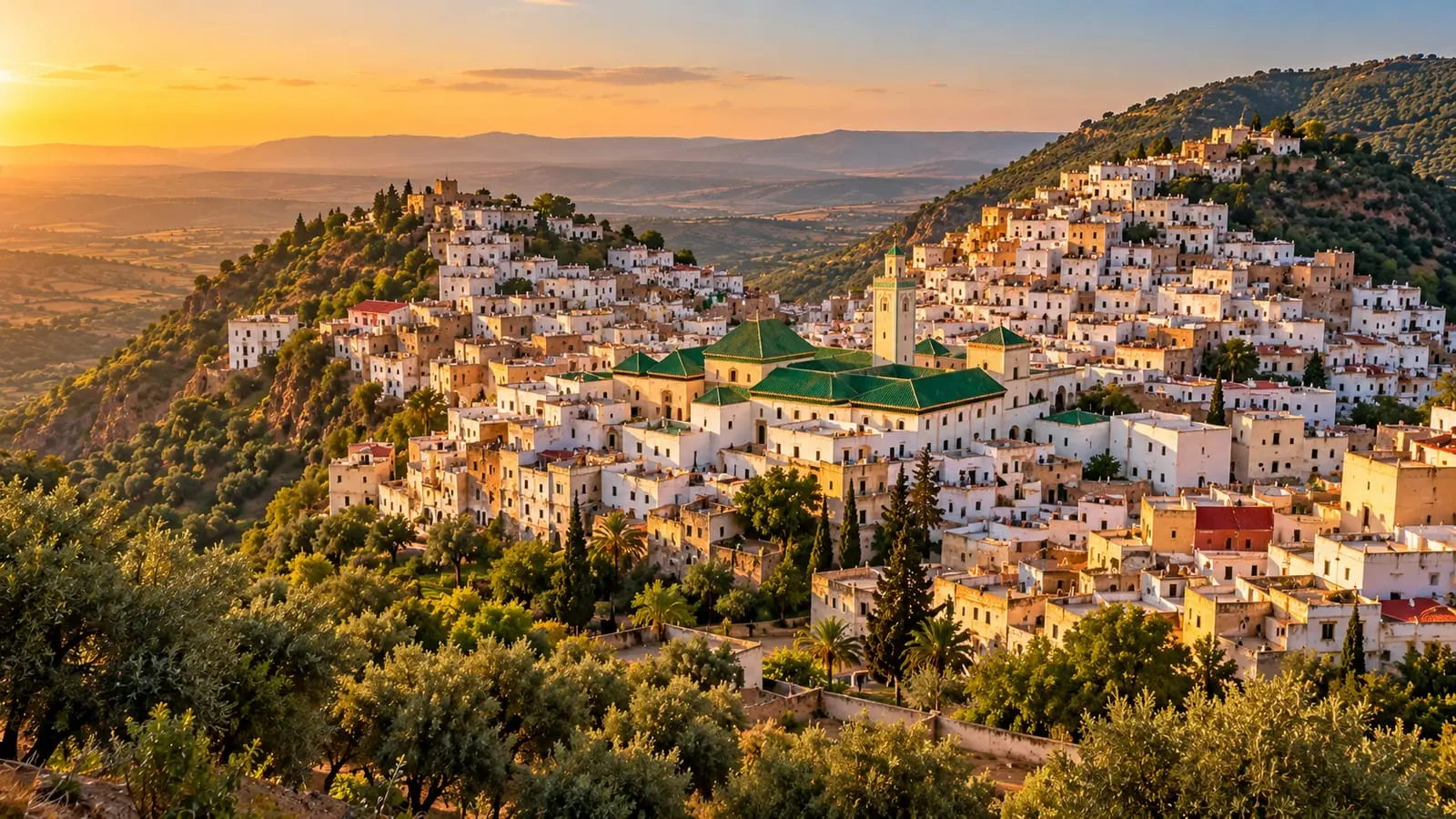
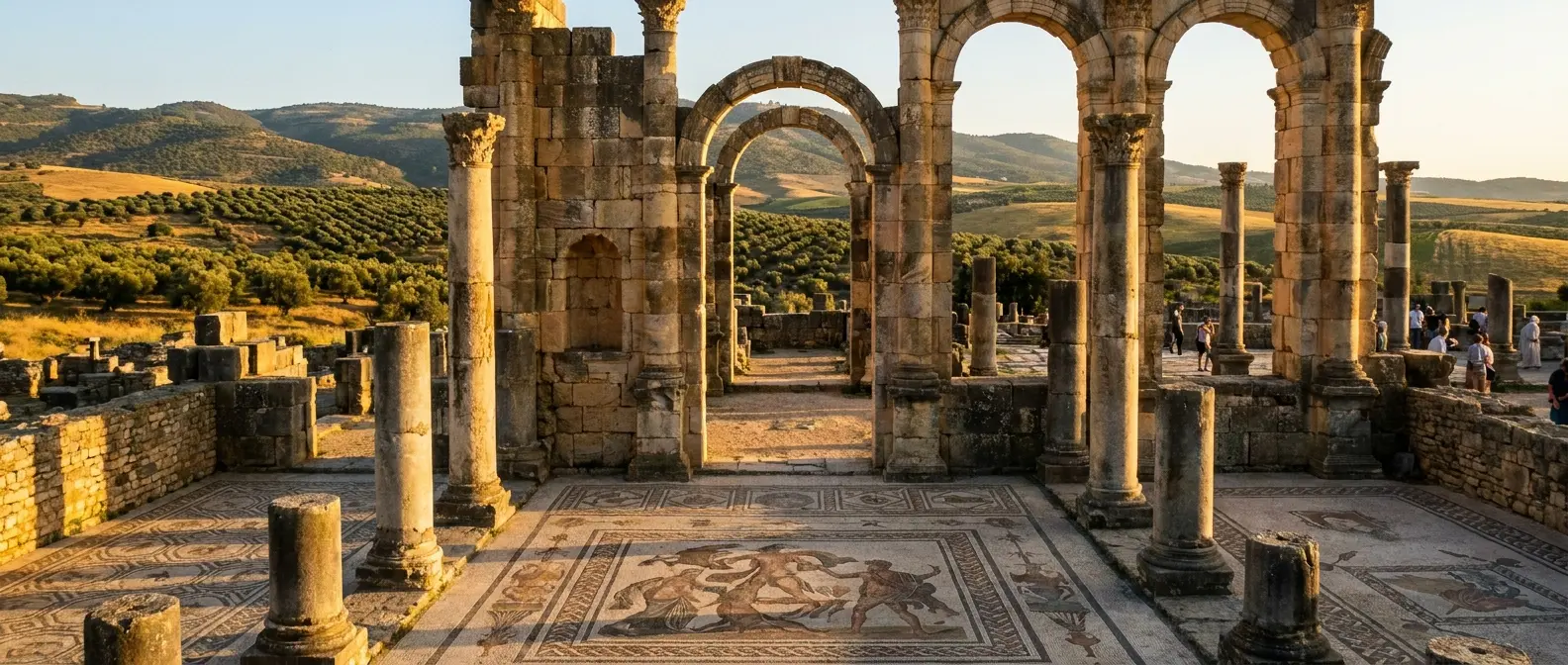
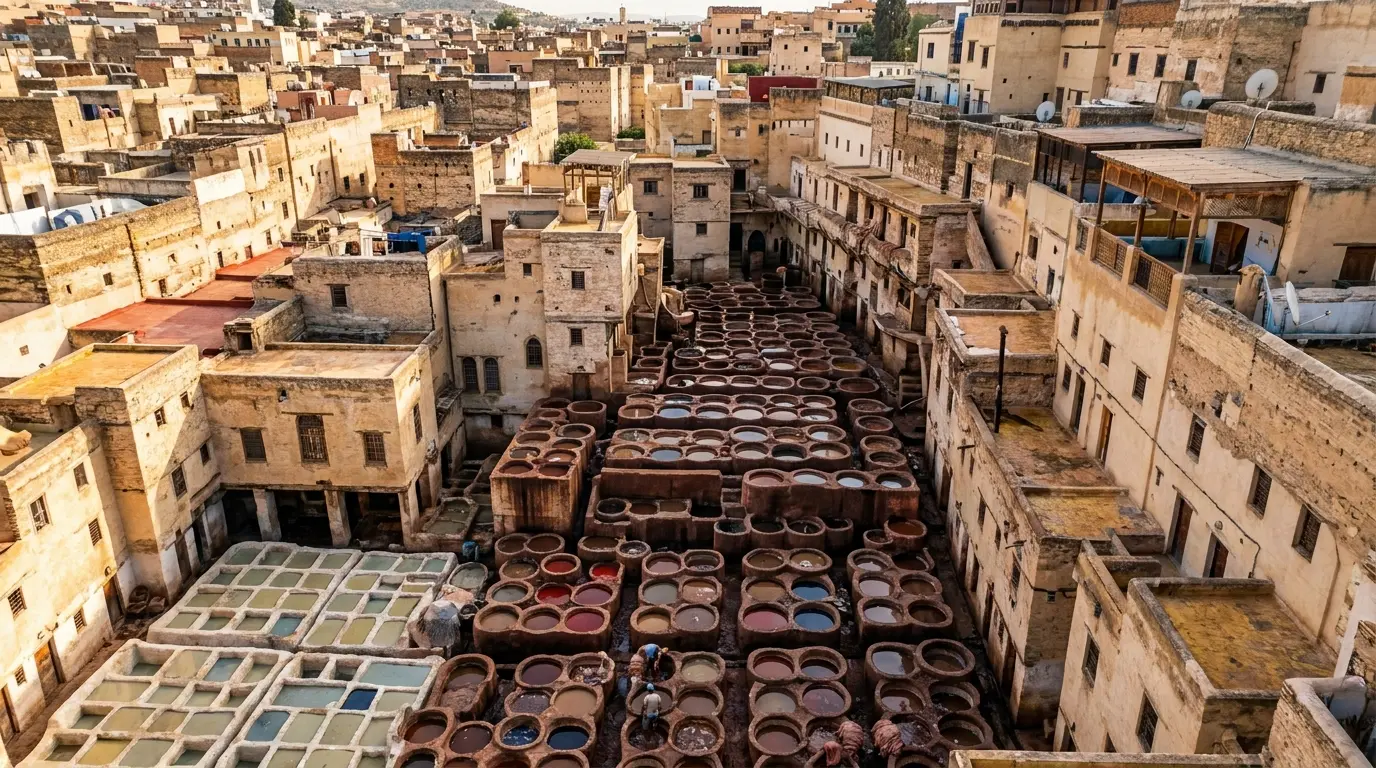
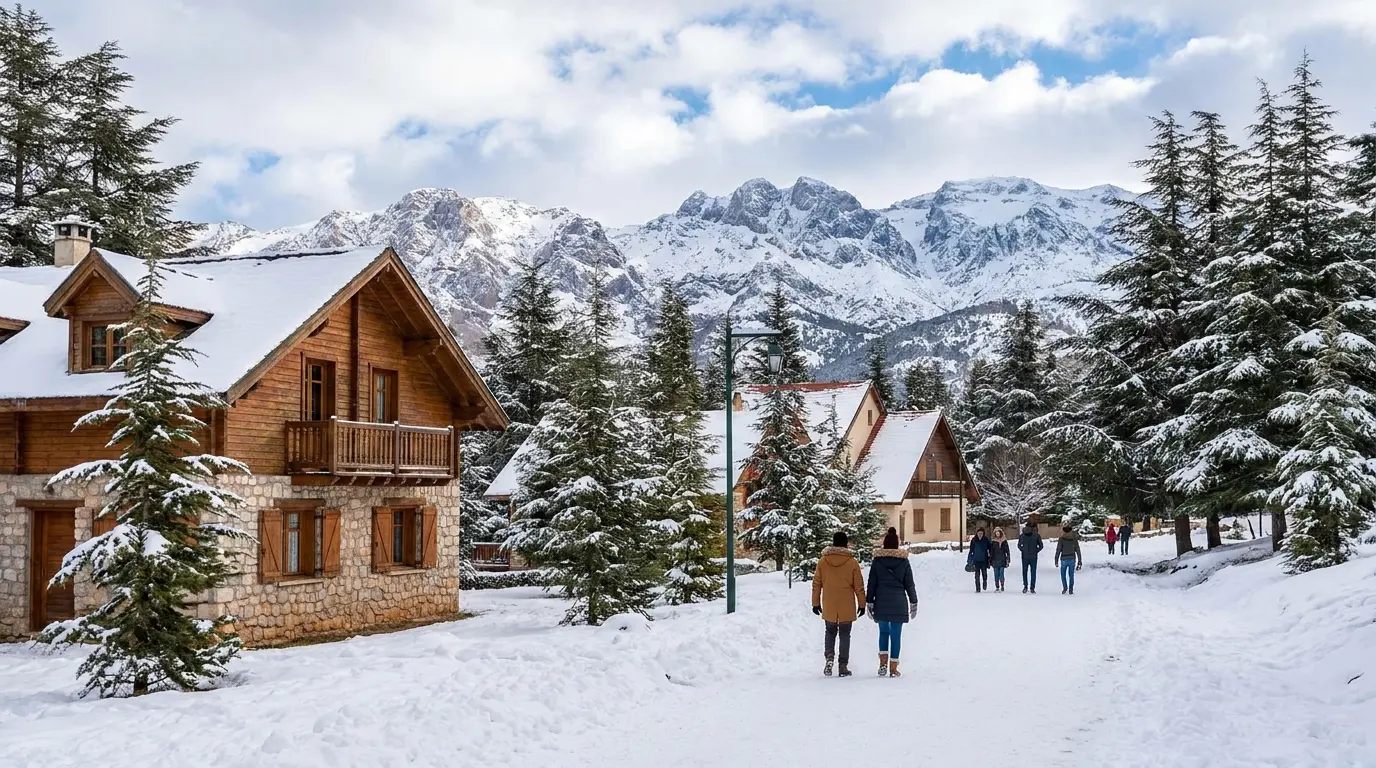
FFounded by the Berber Miknasa tribe, Meknes was chosen in 1672 by Moulay Ismail as his capital. Over a fifty-five-year reign the sultan raised miles of walls, giant granaries and monumental gates: an imperial city listed by UNESCO in 1996, a short drive from the Roman ruins of Volubilis.
The Roman ruins of Volubilis are close by, but the present city and its name come from an Amazigh tribe, the Miknasa, who settled in the region in the 10th century. They founded a group of unwalled villages called Miknasat al-Zaytun, "Meknes of the olives".
In the 11th century the Almoravids built a stronghold just to the south, Tagrart, which became the core of today's medina. The Nejjarine mosque, often described as the city's oldest, and the first Great Mosque date from this time.
Almohads and Marinids
The Almoravid stronghold resisted the Almohads, who destroyed it after a long siege in the 12th century. In the early 13th century Caliph Muhammad al-Nasir (1199-1213) rebuilt the city, its walls and its Great Mosque.
The Marinids took Meknes in 1244. In 1276 Sultan Abu Yusuf Ya'qub founded its first kasbah, the same year he created Fes el-Jdid. Marinid princes and viziers often lived here. Sultan Abu al-Hasan built three madrasas, including the Bou Inania Madrasa, completed around 1336. Under the Saadians, in the 16th century, the city was neglected.
Moulay Ismail's capital (1672-1727)
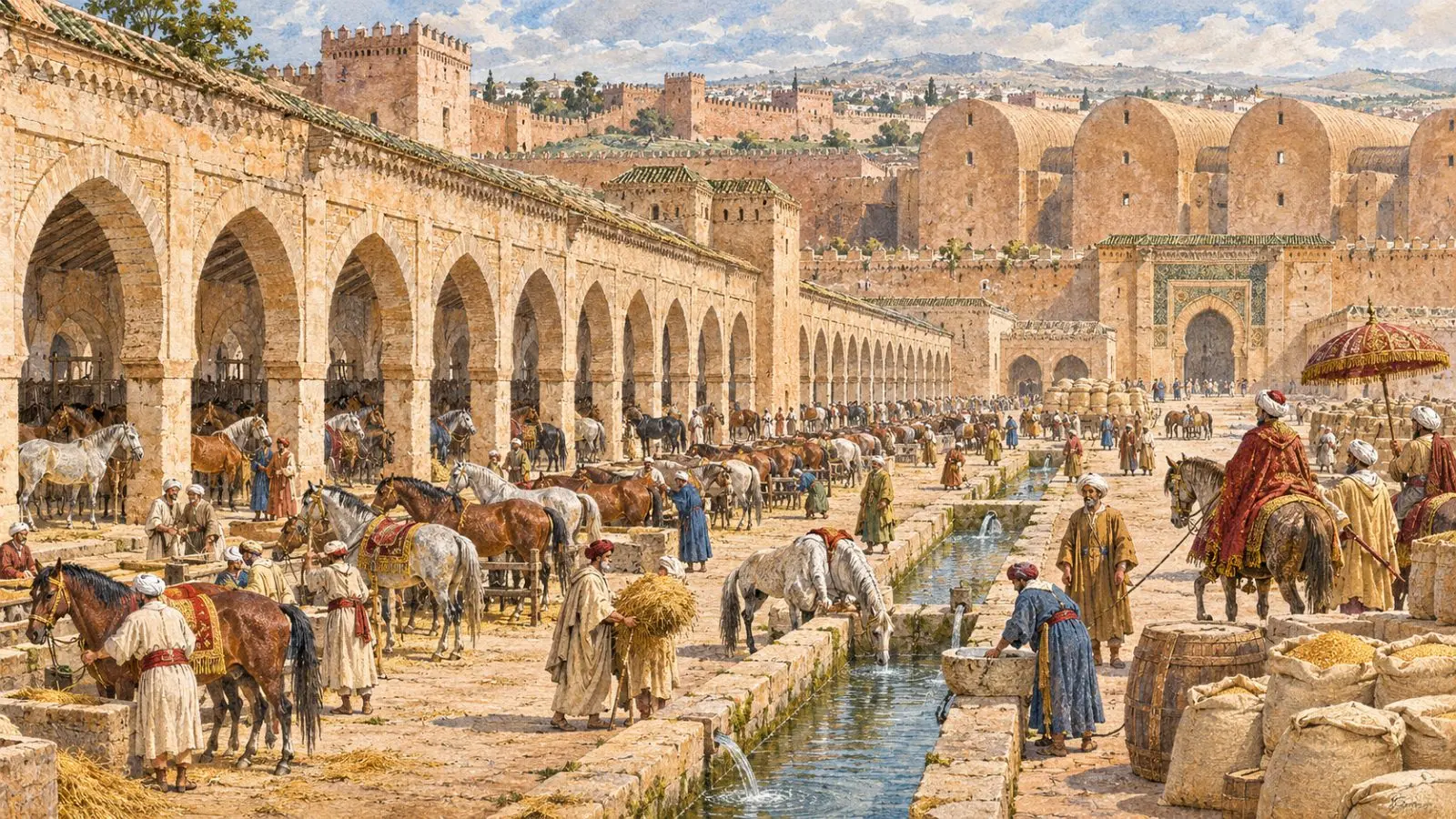
Moulay Ismail's stables
Governor of Meknes under his brother Moulay Rashid, Moulay Ismail became sultan in 1672 and made it his capital. Several reasons explain the choice: he had to reconquer Fes and Marrakech from a rival nephew, the ulama of Fes were hostile to him, and he wanted a new base for his personal guard, the Abid al-Bukhari, recruited from Black slaves from sub-Saharan Africa.
Over his 55-year reign he built a vast palace-city south of the old town. Older buildings were demolished; their rubble gave its name to El Hedim Square, "the rubble". Between 25,000 and 55,000 workers laboured there, paid or captive.
Legends and reality of the imperial city
Accounts by European ambassadors, who came to negotiate the ransom of captives, speak of tens of thousands of Christian slaves locked in huge dungeons. Historians consider these figures exaggerated: Christian captives were probably a few thousand at most, and the underground halls called "prisons" were in fact used to store grain and provisions.
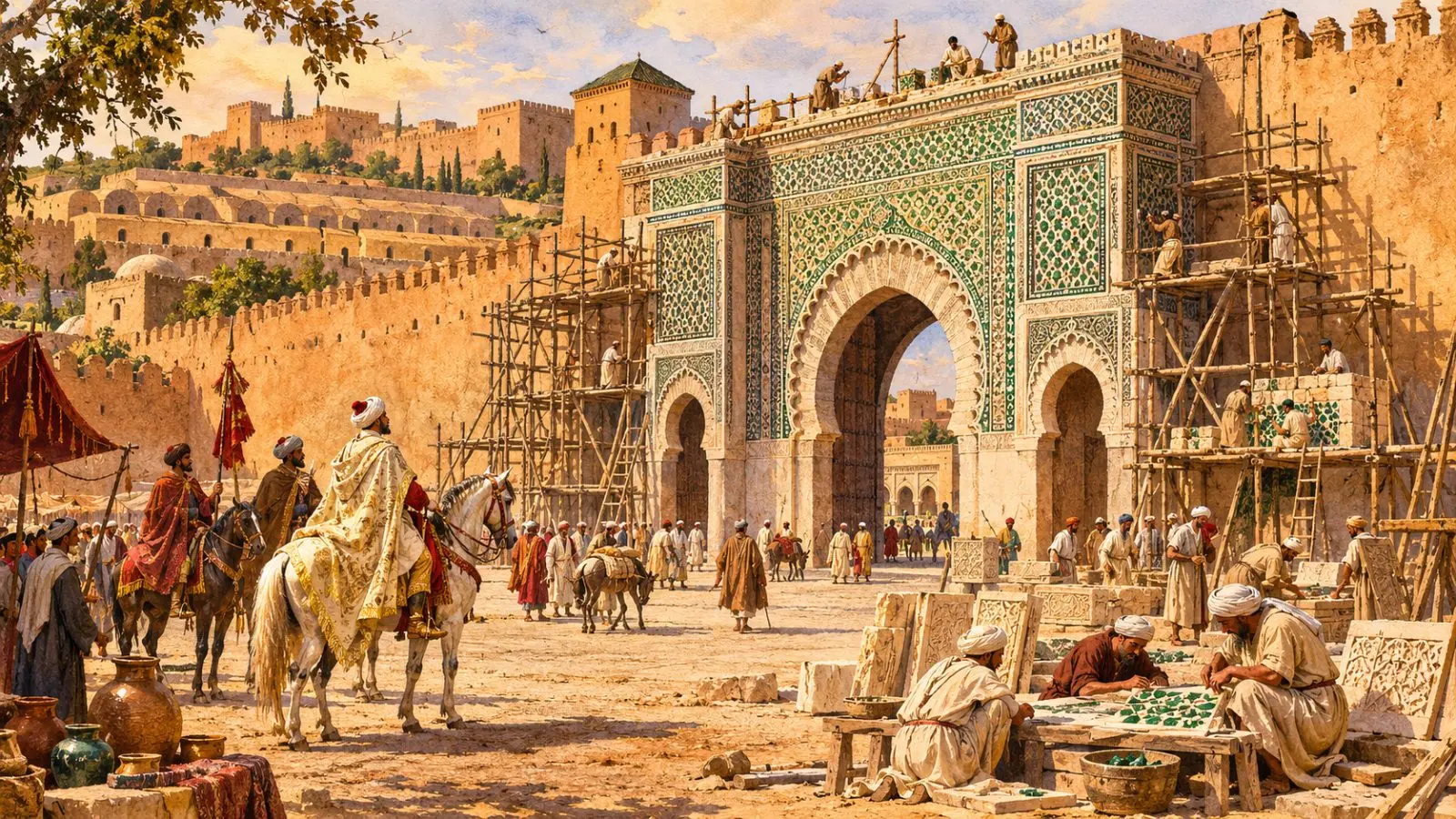
Moulay Ismail moved the city's Jews to a new Mellah near the kasbah, strengthened the walls, opened new gates such as Bab Berdain and Bab Khemis, and built forts for his troops. His wife Khnata bent Bakkar, who played a leading political role, founded the Bab Berdain mosque, completed in 1709. Between 1721 and 1725 he built the Heri al-Mansur and its vast stables. The great Bab Mansour gate was only finished in 1732, by his son Moulay Abdallah.
After the sultan (1727-1912)
When Moulay Ismail died in 1727 his sons fought over the throne and Morocco sank into decades of turmoil. Meknes lost its capital status, and the 1755 earthquake damaged it. Much of the imperial city fell into ruin.
Sultan Sidi Mohammed ben Abdallah (1757-1790) still added the Dar al-Bayda palace, the Er-Roua mosque, Meknes's largest, a dome over the tomb of Sidi Mohammed ben Aissa, founder of the Aissawa brotherhood, and the present minarets of the Great Mosque and Nejjarine mosque.
Garrison, vineyards and resistance
Under the protectorate, from 1912, the French built a new town on the plateau facing the medina and made Meknes a major military centre and road hub. The population grew from 25,000 at the start of the century to over 140,000 by the mid-20th century. Settlers took over large tracts of land and developed vineyards.
In 1937, in the midst of shortages, a plan to divert the river's water to benefit settlers sparked a revolt, bloodily suppressed: thirteen dead. After independence the city kept growing with rural migration. Its medina and imperial city were listed as UNESCO World Heritage in 1996.
— II —
CHAPTER III
Key dates
900–1000
The Amazigh Miknasa tribe settles here and gives the city its name.
1672
Moulay Ismail makes Meknes his capital and surrounds it with 40 km of walls.
1996
The historic city is listed by UNESCO.
— III —
CHAPTER IV
Landmarks
1
Bab Mansour and El Hedim square
Morocco's finest monumental gate, covered in green zellige and marble columns, faces El Hedim square, the lively heart of the medina, with its storytellers and olive stalls.
2
Heri es-Souani and the Agdal basin
Moulay Ismail's granaries and stables: vast vaulted halls with thick walls that kept the grain cool. Right next door, the Agdal basin was the reservoir that watered the royal gardens.
3
The Mausoleum of Moulay Ismail
The sultan's tomb, with its successive courtyards, fountains and stucco and zellige decoration. It is one of the few shrines in Morocco where non-Muslims may enter part of the building.
4
Volubilis and Moulay Idriss
30 km away, the Roman ruins of Volubilis and their mosaics, then, on the next hill, Moulay Idriss Zerhoun, the holy town where the founder of Morocco's first dynasty is buried.
— IV —
CHAPTER V
People
MMoulay Ismaïl1645–1727The second Alaouite sultan, he reigned from 1672 to 1727 and made Meknes his imperial capital.
KKhnata bent Bakkar†1754Wife of Moulay Ismail and mother of Moulay Abdallah, a scholar and adviser, one of the most influential women in Moroccan history.
SSidi Mohammed ben Aïssa1465–1526The “Shaykh al-Kamil”, founder of the Aissawa Sufi brotherhood; his mausoleum is in Meknes.
— V —
CHAPTER VI
Culture and traditions
The Aissawa moussem
Every year, around the Mawlid, Aissawa brotherhoods from all over Morocco converge on the mausoleum of the Shaykh al-Kamil. Shawms, drums and trance chants fill the town for several days.
Horses and tbourida
Heir to the royal stables, the Meknes region is still horse country. The region's moussems are home to some of the best tbourida troupes, the charge of riders who fire their rifles together.
Meknès is Morocco's wine capital — the surrounding Beni M'tir plateau produces the country's best vintages (consumed primarily for export). The city is famous for its olive oil production and its embroidery tradition. The moussem (pilgrimage festival) of Moulay Ismail at the mausoleum is one of Morocco's most atmospheric religious events.
— VI —
CHAPTER VII
The people
The Meknassis
Meknes is a city of traders, soldiers and Saiss farmers. Its people are known as modest and attached to their town, less turned towards tourists than those of Fes or Marrakech. The city takes its name from the Amazigh Meknassa tribe.
Between Fes and the Middle Atlas
Meknes darija is close to that of Fes but more rural; in the surroundings you hear the Tamazight of Middle Atlas tribes.
— VII —
CHAPTER VIII
At the table
Meknes olivesGreen, purple, black, with preserved lemon or harissa: the stalls of El Hedim square remind you that the town has been named for its olive trees for a thousand years.
01Meknes is nicknamed "Morocco's Versailles": Moulay Ismail was Louis XIV's contemporary and asked for his daughter's hand.
02The imperial city's walls run for about 40 km.
03The Meknes region produces most Moroccan wine and large quantities of olives.
— IX —
Frequently asked questions about Meknes
How many days do you need in Meknes?
Allow 1–2 days to see Meknes without rushing. That is the length we use in our itineraries.
When is the best time to visit Meknes?
The best months for Meknes are March, April, May and October.
How much does a day in Meknes cost?
Per person per day, accommodation included: about $30 on a budget, $75 mid-range and $180 for a luxury stay.
How do you get to Meknes?
Train from Fes (45 min), Casablanca (3h), Rabat (2h). CTM buses from all major cities. No airport — use Fes as the air hub.
What is there to see in Meknes?
The must-sees of Meknes: Bab Mansour, Moulay Ismail Mausoleum, Heri es-Souani and Place el-Hedim.
What should you eat in Meknes?
To taste in Meknes: Mrouzia, Rfissa, Khobz and Moroccan mint tea.
Where should you stay in Meknes?
The best areas to stay: Medina and Ville Nouvelle.
Is Meknes safe?
Yes, Meknes welcomes many travellers every year. The precautions are those of any tourist destination: watch your belongings in crowds, politely turn down unofficial guides, agree on a taxi fare before getting in.