AA Mauretanian town and then the most important Roman city this far south, Volubilis has kept its arches, columns and mosaics among the olive trees. Idris I was proclaimed here in 788. The site has been on the UNESCO list since 1997.
The site, a naturally protected spur, was occupied from the Neolithic, but the town was born in the Mauretanian period and grew mainly in the 2nd century BC. Punic traders from Carthage were active in the region from the 4th century: four Punic or Neo-Punic inscriptions have been found on site, as well as inscriptions in Libyan, the ancient Amazigh script, still undeciphered.
The town was part of the Berber kingdom of Mauretania, an ally of Rome. Under King Juba II, raised in Rome and married in 19 BC to Cleopatra Selene, daughter of Antony and Cleopatra, Volubilis was a prosperous town of about ten hectares, ringed by a mud-brick wall.
Loyal to Rome, a Roman municipium (40-44)
Roman Volubilis
In 40 Emperor Caligula had Ptolemy, son of Juba II and last king of Mauretania, assassinated. His freedman Aedemon raised the country against Rome. Volubilis sided with Rome and raised a militia that helped crush the revolt, at the cost of destruction.
The notable Marcus Valerius Severus pleaded the town's case with Emperor Claudius. In reward, Volubilis became a Roman municipium in 44: all its free inhabitants received Roman citizenship and tax advantages for ten years. Mauretania, annexed in late 42 or early 43, became the province of Mauretania Tingitana, with Tingis (Tangier) as its capital.
The golden age of olive oil (2nd-3rd century)
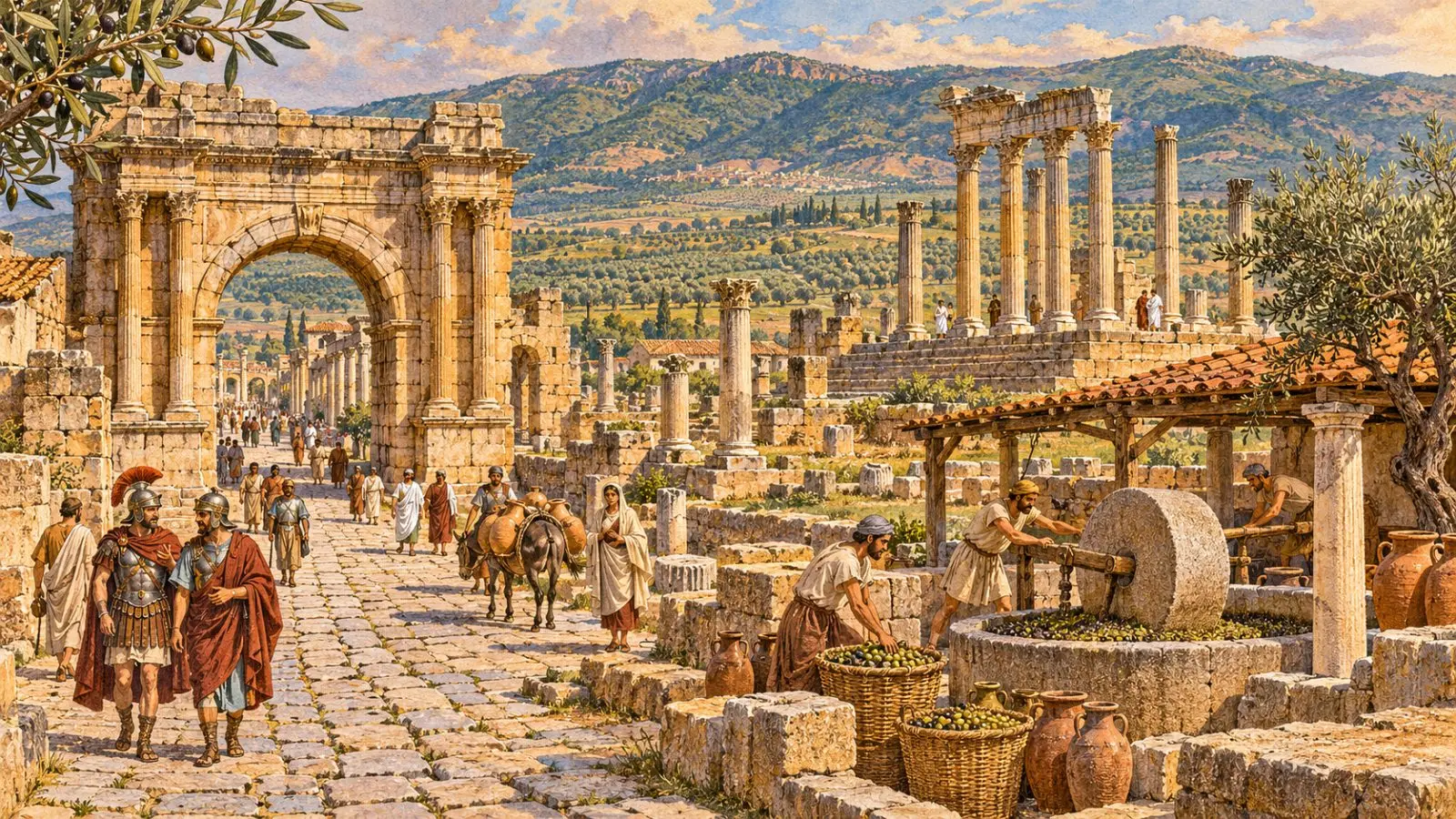
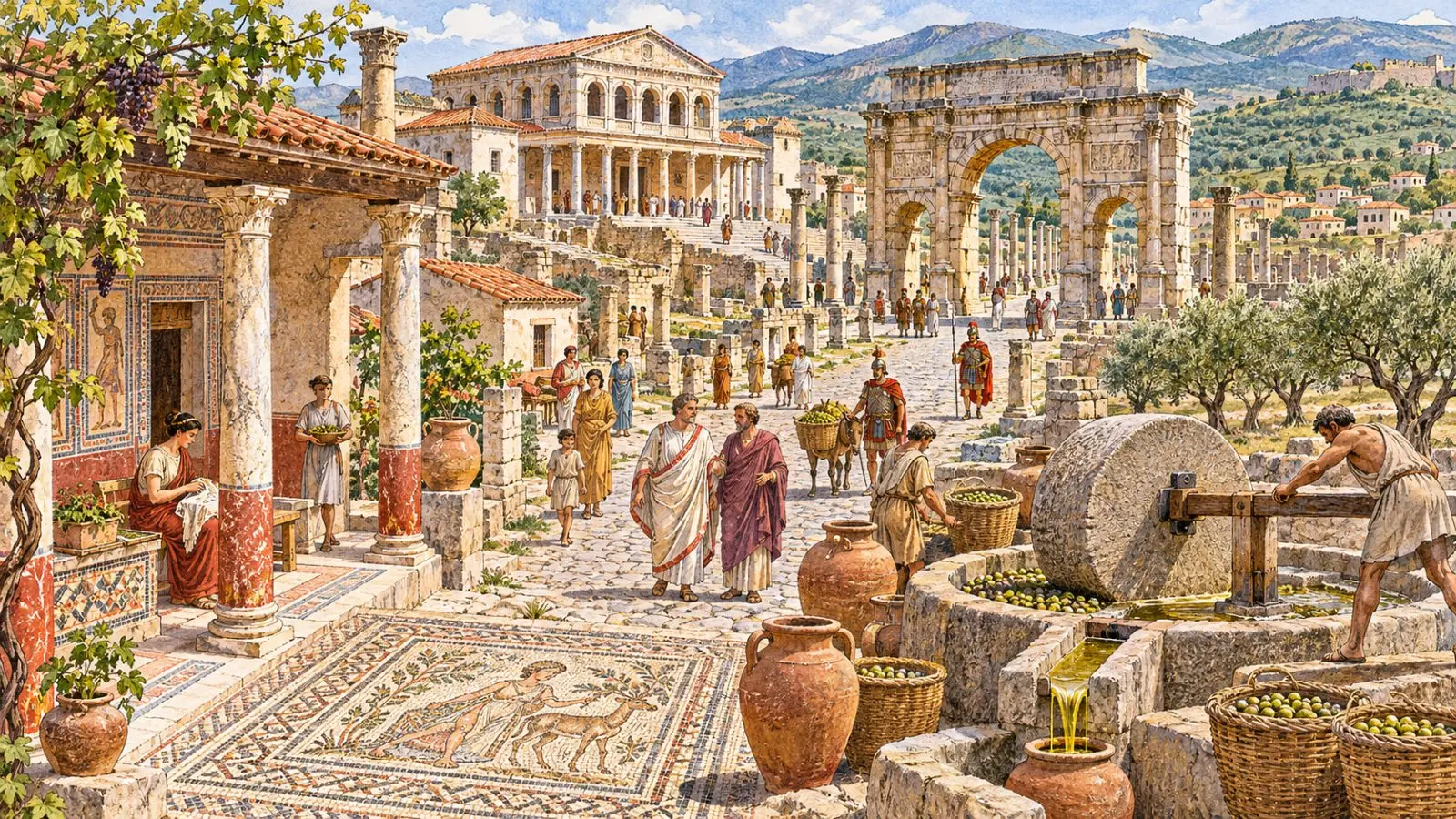
The town grew rich from the olive groves of its hinterland and the oil trade. Its elites, organised on the Roman model with decurions, duumvirs and aediles, built rich houses paved with mosaics and with private baths. The town gained a forum, four public baths, a capitol and an aqueduct bringing water from the nearby mountain.
In 168-169 a wall with eight gates and some forty towers enclosed 42 hectares. A portico lined the decumanus maximus up to the triumphal arch, raised in honour of Emperor Caracalla, who had granted the province relief from tax arrears. In the early 3rd century, under the Severans, Volubilis was at its peak.
The Baquates and Rome's departure (around 285)
Berber tribes lived around the town, among them the Baquates. A series of peace altars, from 140 to 280, records the treaties concluded between Roman governors and their princes, increasingly treated as equals.
Around 285, after the crisis of the 3rd century, Rome evacuated the town and the whole region south of the Loukkos, falling back on Tangier. The inhabitants, Romanised but Berber in origin, stayed. The town shrank towards the river, the aqueduct was no longer maintained, and Latin remained in use until the 7th century. In the late 6th century a new wall was built with reused stone.
Walili, the town of Idris I (7th-9th century)
The Arab conquest reached the region in 681. In the late 8th century Volubilis, now Walili, was still one of Morocco's main towns. It was there that Idris I, a descendant of the Prophet who had taken refuge in the Maghreb, was welcomed in 788 by the Amazigh Awraba tribe and proclaimed imam: the birth of the first Moroccan dynasty.
His son Idris II moved his capital to Fes in 809, and Walili declined. By the 9th century, when Arab authors mention it, the site was already largely abandoned; the holy town of Moulay Idriss Zerhoun, where Idris I lies, grew 5 km away.
Reused stone and rediscovery
For centuries the ruins served as a quarry: Moulay Ismail had marble columns taken for his buildings in Meknes, and the 1755 earthquake toppled many of the monuments still standing.
Archaeological excavations began in the early 20th century under the French protectorate and revealed the mosaics still in place in the houses. The site was listed as UNESCO World Heritage in 1997; its finest bronzes are shown at the Rabat museum.
— II —
CHAPTER III
Key dates
25 BC
Volubilis is a major town of King Juba II's Mauretania.
285
Rome withdraws from the region; the town lives on.
788
Idris I is proclaimed here, founding the first Moroccan dynasty.
1997
The site is listed by UNESCO.
— III —
CHAPTER IV
Landmarks
1
The Arch of Caracalla and the decumanus
The triumphal arch opens onto the main street lined with grand houses up to the Tangier gate.
2
The mosaics
Still in place: Orpheus and the animals, the labours of Hercules, Bacchus, Diana bathing.
3
The basilica and the Capitol
The civic heart of the town, with columns where storks nest in spring.
— IV —
CHAPTER V
People
JJuba II−48–23Scholar-king of Mauretania, husband of Cleopatra Selene, daughter of Cleopatra and Mark Antony.
IIdriss Ier†791Proclaimed imam at Walili in 788: the first ruler of Muslim Morocco.
— V —
CHAPTER VI
Culture and traditions
Visiting at the right time
The site has almost no shade: come at opening time or late afternoon, and hire an official guide at the entrance to read the mosaics.
Volubilis has no living traditions — it's an archaeological site. The nearby village of Moulay Idriss (3km) is Morocco's holiest city, built around the tomb of Idris I (founder of Morocco). Non-Muslims were banned from staying overnight in Moulay Idriss until 2005.
— VI —
CHAPTER VII
The people
Who lived in Volubilis
In the 3rd century the town may have had 20,000 inhabitants: Romanised Berbers, settlers, oil and wheat merchants. After Rome left it stayed inhabited, with Christians and Jews, until Idris I arrived and was welcomed by the Awraba tribe.
The town's names
The Romans called it Volubilis; Moroccans say Oualili, said to be the Amazigh name for oleander, common in the valley.
— VII —
CHAPTER VIII
At the table
Zerhoun olive oilThe region's mills press olives as in Roman times, whose presses can still be seen on the site.
— VIII —
CHAPTER IX
Did you know?
01The 1755 Lisbon earthquake toppled many of the monuments still standing.
02Moulay Ismail reused Volubilis columns for his palaces in Meknes.
03The site has been a UNESCO World Heritage Site since 1997.
— IX —
Frequently asked questions about Volubilis
How many days do you need in Volubilis?
Allow 1 day to see Volubilis without rushing. That is the length we use in our itineraries.
When is the best time to visit Volubilis?
The best months for Volubilis are March, April, May and October.
How much does a day in Volubilis cost?
Per person per day, accommodation included: about $15 on a budget, $40 mid-range and $100 for a luxury stay.
How do you get to Volubilis?
Grand taxis from Meknès (30 min). No direct CTM bus. Most visitors drive or take an organised tour from Fes or Meknès.
What is there to see in Volubilis?
The must-sees of Volubilis: In situ mosaics, Triumphal Arch of Caracalla, Capitoline Temple and Moulay Idriss village.
What should you eat in Volubilis?
To taste in Volubilis: Khobz, Moroccan mint tea, Oranges with cinnamon and Msemen.
Is Volubilis safe?
Yes, Volubilis welcomes many travellers every year. The precautions are those of any tourist destination: watch your belongings in crowds, politely turn down unofficial guides, agree on a taxi fare before getting in.