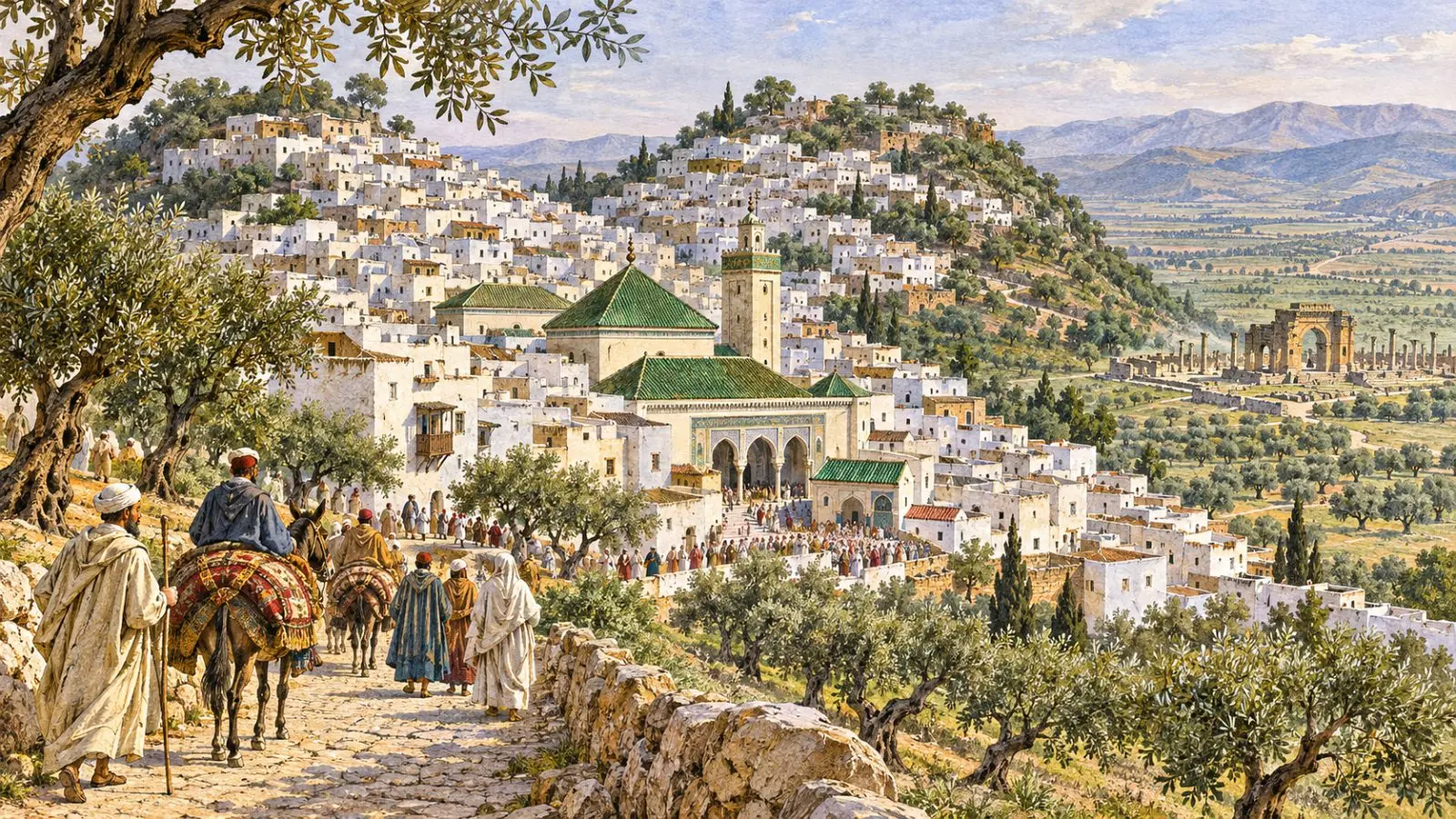
Moulay Idriss Zerhoun and its shrine

THE BOOK OF

Moulay Idriss Zerhoun — All about Moulay Idriss Zerhoun

مولاي إدريس زرهون

History, places, people, culture and food of Moulay Idriss Zerhoun, told by two Moroccans.

10 chapters3 min readBy Yassine and Issam
Things to do in Moulay Idriss Zerhoun
CONTENTS · I
  1. I. At a glance
  2. II. History
  3. III. Key dates
  4. IV. Landmarks
  5. V. People
  6. VI. Culture and traditions
  7. VII. The people
  8. VIII. At the table
  9. IX. Did you know?
  10. X. Frequently asked questions

CHAPTER I

At a glance

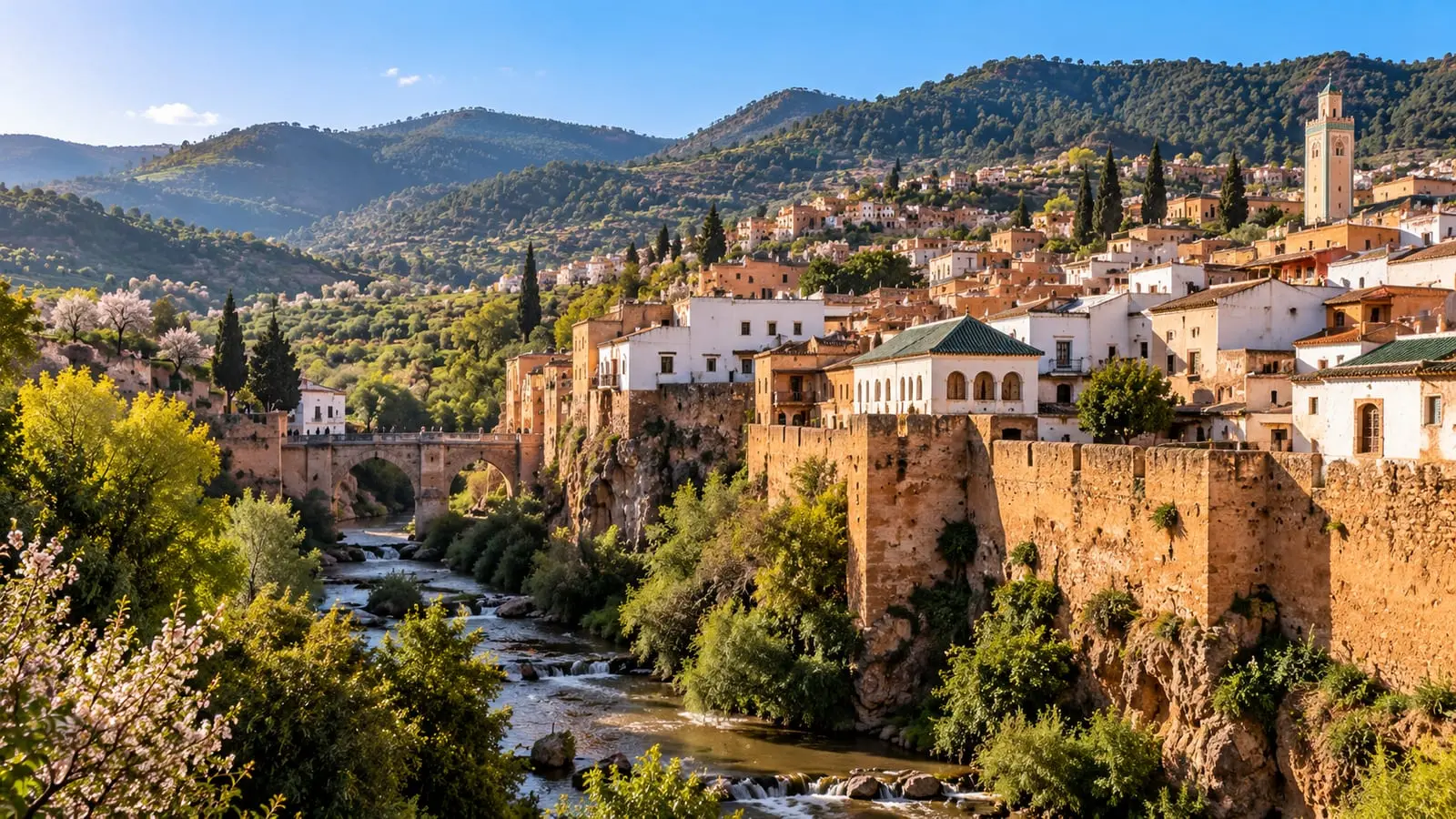
Clinging to two hills of the Zerhoun, facing the ruins of Volubilis, Moulay Idriss holds the tomb of the founder of Morocco's first dynasty. It is the country's holiest town and has been a pilgrimage site for more than a thousand years.

Arabic name
مولاي إدريس زرهون
Other names
Zerhoun
Coordinates
34.0567, -5.5275
Best months
Mar, Apr, May, Sept, Oct

CHAPTER II

History

Idris I and the Awraba (788-791)

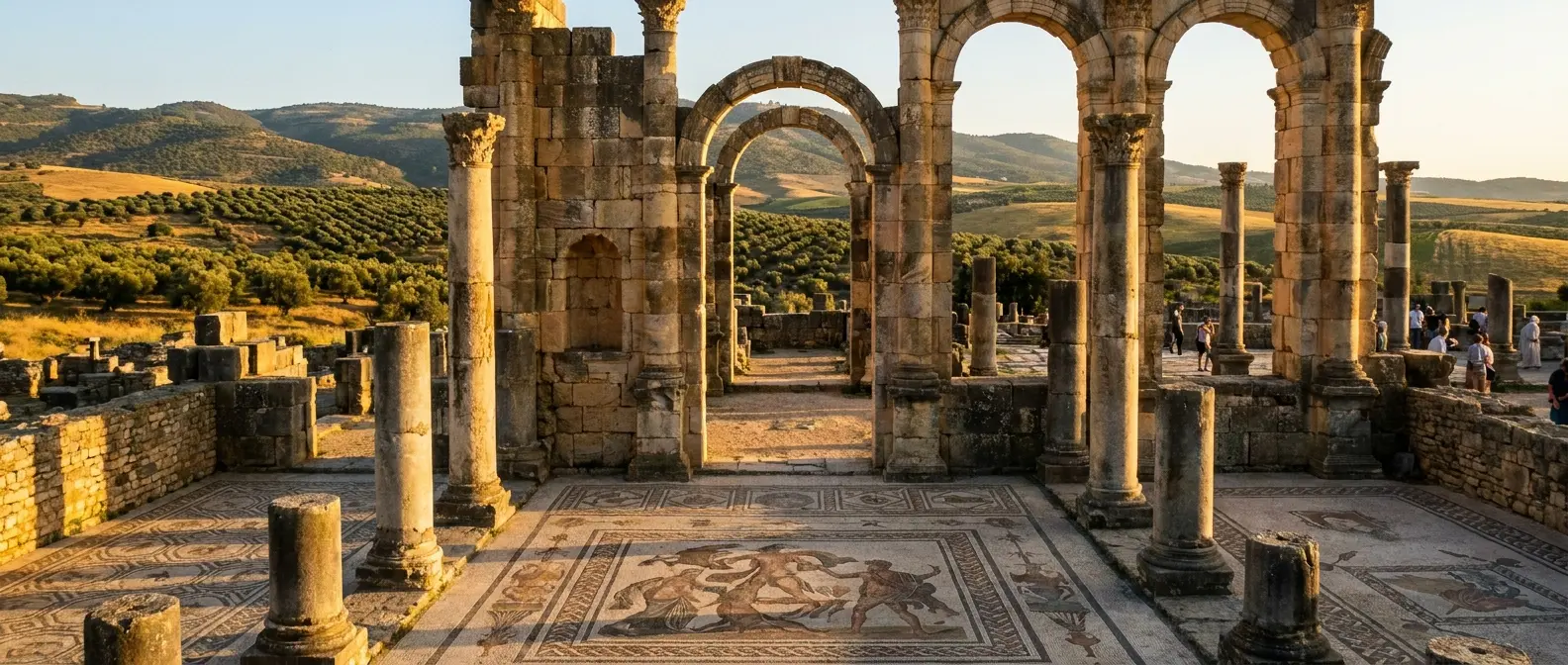
Idris I, a descendant of the Prophet, had to flee Abbasid territory after the Battle of Fakh in 786, where he had backed the defeated Alid rebels. He settled at Walili, the former Roman Volubilis, then inhabited mostly by Berbers. Thanks to his prestige he allied with the local tribes, especially the Awraba, who recognised him as imam around 788-789: he quickly became the leading religious and political figure of the region.

As the Roman site on the plain was considered vulnerable, settlement moved a few kilometres towards the mountains, probably to the site of the present town. Idris I died in 791, possibly poisoned on the orders of Caliph Harun al-Rashid, just before his son Idris II was born.
The tomb forgotten, then found (9th-14th century)

Idris II took power in 803 and founded Fes, some fifty kilometres away, which soon eclipsed his father's town. A mausoleum, probably a simple qubba, sheltered the tomb of Idris I, and the name Walili was gradually replaced by Moulay Idriss.

After the end of the Idrisids the founders' cult declined; the Almoravids, hostile to the veneration of saints, did not encourage it. It revived under the Marinids: the announced rediscovery of Idris I's remains in 1318 caused a sensation, and the annual August moussem took shape at this time.

The Alaouites' shrine (1719 to today)

The sharifian dynasties, the Saadians then the Alaouites, also descended from the Prophet, raised the Idrisids' status further. Moulay Ismail had the old mausoleum demolished and rebuilt on a larger scale between 1719 and 1721; he had the Friday prayer said there. In 1822 Moulay Abderrahmane enlarged the mosque again, and under Sidi Mohammed IV (1859-1873) the Meknes craftsman Ibn Makhlouf added rich tilework. In 1939 the cylindrical minaret covered in green tiles, unique in Morocco, was built.

After independence Mohammed V and Hassan II had the shrine redecorated. A holy town, Moulay Idriss was closed to non-Muslims until 1912, and they could only stay overnight from 2005. It has been on UNESCO's World Heritage tentative list since 1995.

CHAPTER III

Key dates

  1. 789

    Idris I, founder of the first Moroccan dynasty, settles here.

  2. 791

    Idris I dies; his tomb makes the town Morocco's holiest place of pilgrimage.

CHAPTER IV

Landmarks

1

The Mausoleum of Idris I

Green-tiled roofs at the centre of town; non-Muslims see it from the terraces above.

2

The cylindrical minaret

Morocco's only round minaret, covered in green tiles and Quranic verses, built in 1939.

3

The Khiba and Tasga terraces

The two hilltop quarters look over white roofs, olive groves and Volubilis.

CHAPTER V

People

  • Idriss Ier†791Founder of the Idrisid dynasty in 788, father of the Moroccan state.
  • Kenza al-Awrabiya~790Berber wife of Idris I and mother of Idris II, she ensured the dynasty's continuity.

CHAPTER VI

Culture and traditions

The Moulay Idriss moussem

Every year at the end of summer thousands of pilgrims and brotherhoods climb to the mausoleum; it is said that several visits here are worth a pilgrimage.

The annual moussem draws hundreds of thousands of pilgrims from across Morocco and North Africa for a week of religious observances, Sufi rituals, fantasia (horse-charging ceremonies), music and communal feasting. The town's craftsmen specialise in a unique circular minaret design (the only one in Morocco) and in producing the 'boules de Moulay Idriss' — small balls of compacted herbs and rose water used as offerings at the tomb. Local women weave haïk (traditional white full-body wrap) on hand looms.

CHAPTER VII

The people

The Shorfa of Zerhoun

Many residents consider themselves shorfa, descendants of Idris I and so of the Prophet. The town lives from pilgrims, Zerhoun olive groves and small shops around the shrine.

A mountain darija

People speak a darija close to Meknes', punctuated by religious formulas: blessings and invocations run through every conversation.

CHAPTER VIII

At the table

Zerhoun bread and grillsOn the square, kefta grills are eaten with oven bread and olive oil from the hills.

CHAPTER IX

Did you know?

  • Until 2005 non-Muslims were not allowed to spend the night here.
  • Some Moroccans believe five pilgrimages here equal one to Mecca, according to popular belief.
  • Idris I arrived here in 788, fleeing the Abbasids, and founded the first Moroccan dynasty.

Frequently asked questions about Moulay Idriss Zerhoun

How many days do you need in Moulay Idriss Zerhoun?

Allow 1 day to see Moulay Idriss Zerhoun without rushing. That is the length we use in our itineraries.

When is the best time to visit Moulay Idriss Zerhoun?

The best months for Moulay Idriss Zerhoun are March, April, May, September and October.

How much does a day in Moulay Idriss Zerhoun cost?

Per person per day, accommodation included: about $25 on a budget, $60 mid-range and $120 for a luxury stay.

How do you get to Moulay Idriss Zerhoun?

Grand taxis from Meknès (28km, 40 min) and Volubilis (5km). No direct public bus. Most visitors combine with Volubilis on a half-day excursion from Meknès. Driving is most flexible.

What is there to see in Moulay Idriss Zerhoun?

The must-sees of Moulay Idriss Zerhoun: Mausoleum of Idriss I, Circular Minaret, Panorama Terrace (Khiber Quarter) and Volubilis Roman Ruins.

What should you eat in Moulay Idriss Zerhoun?

To taste in Moulay Idriss Zerhoun: Khobz, Moroccan mint tea, Oranges with cinnamon and Msemen.

Where should you stay in Moulay Idriss Zerhoun?

The best areas to stay: Khiber Quarter, Sanctuary Quarter and Tasga Quarter.

Is Moulay Idriss Zerhoun safe?

Yes, Moulay Idriss Zerhoun welcomes many travellers every year. The precautions are those of any tourist destination: watch your belongings in crowds, politely turn down unofficial guides, agree on a taxi fare before getting in.

Is Moulay Idriss Zerhoun good for families?

Yes, Moulay Idriss Zerhoun is easy to visit with children.

Sources

To go further and check what we write.

Other sources

Read next

THE END

Now go and see Moulay Idriss Zerhoun.

By Yassine and Issam · Spotted a mistake? Tell us