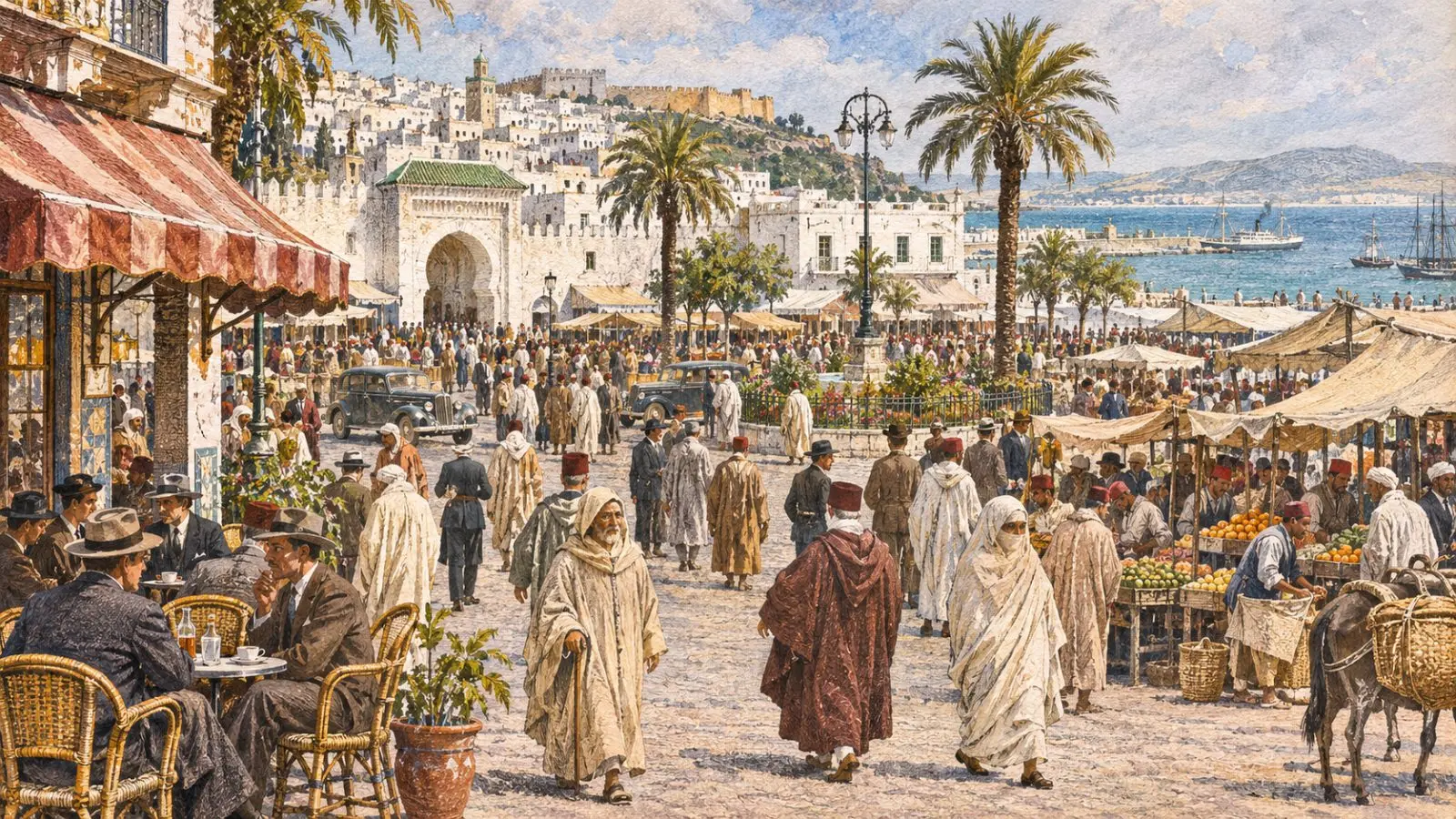
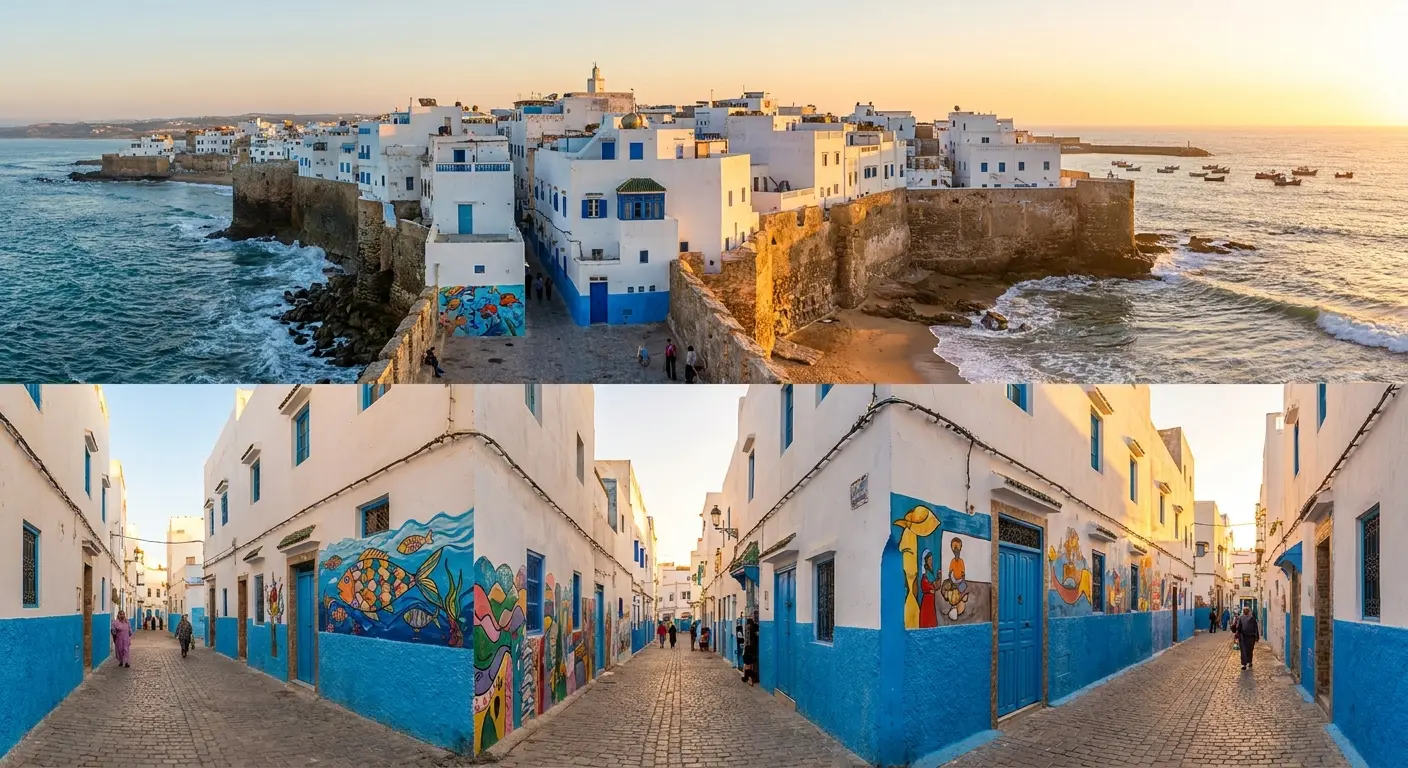
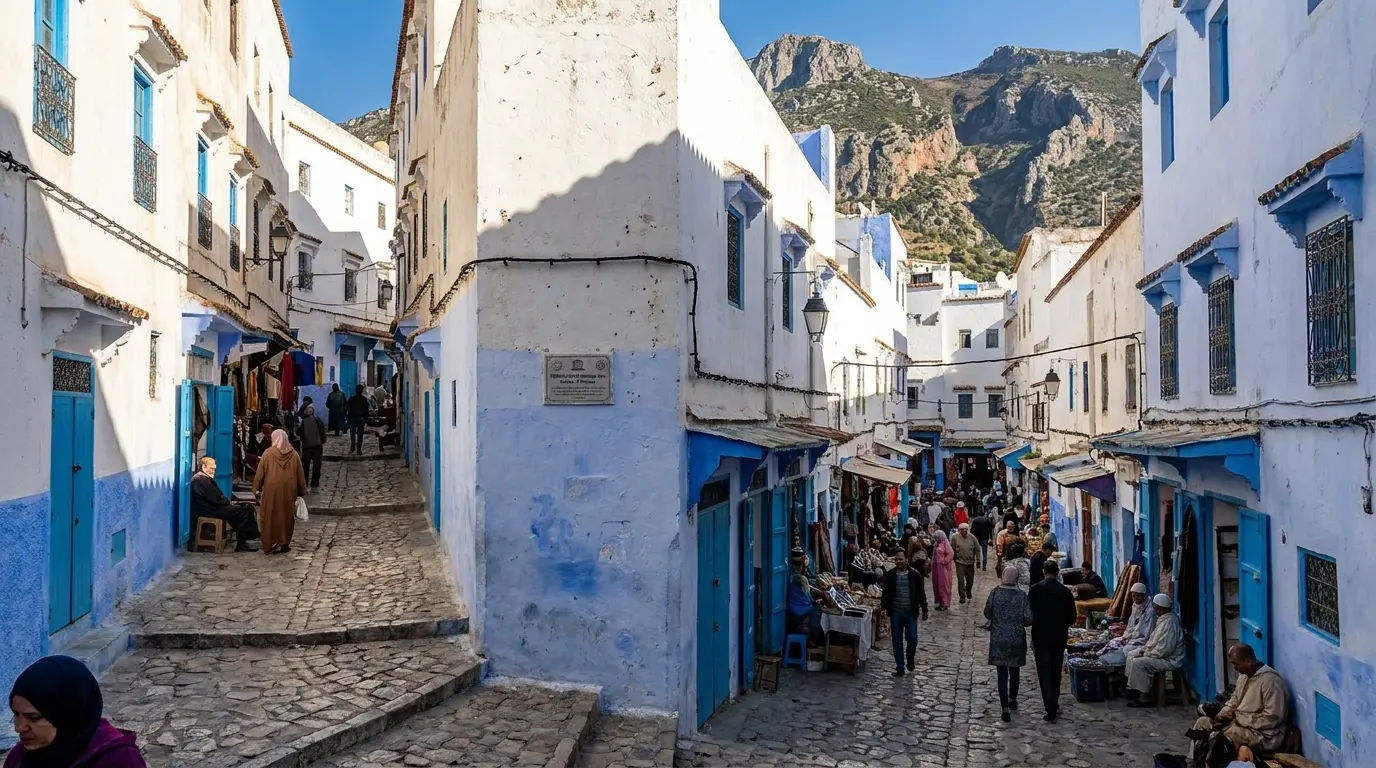
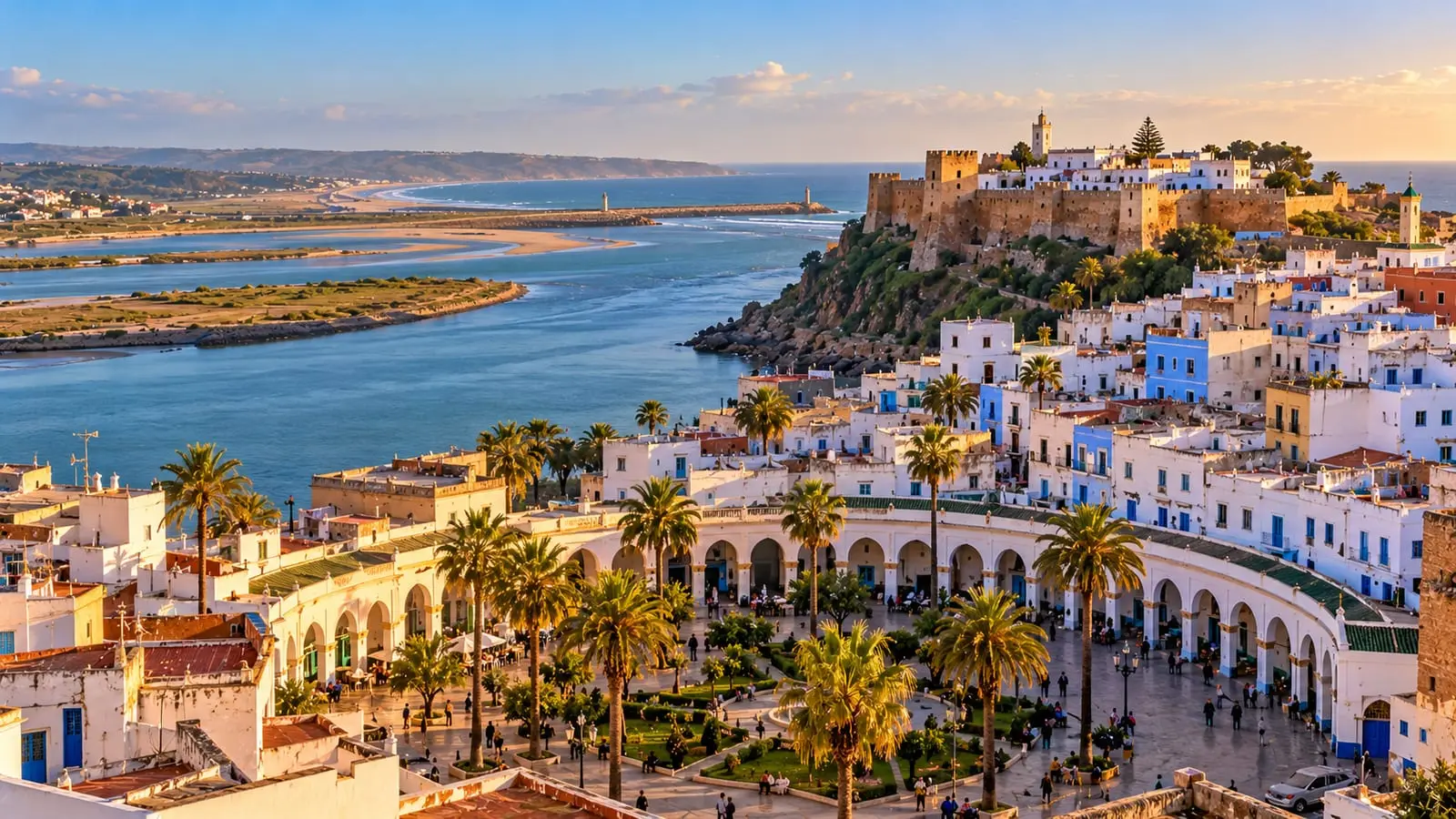
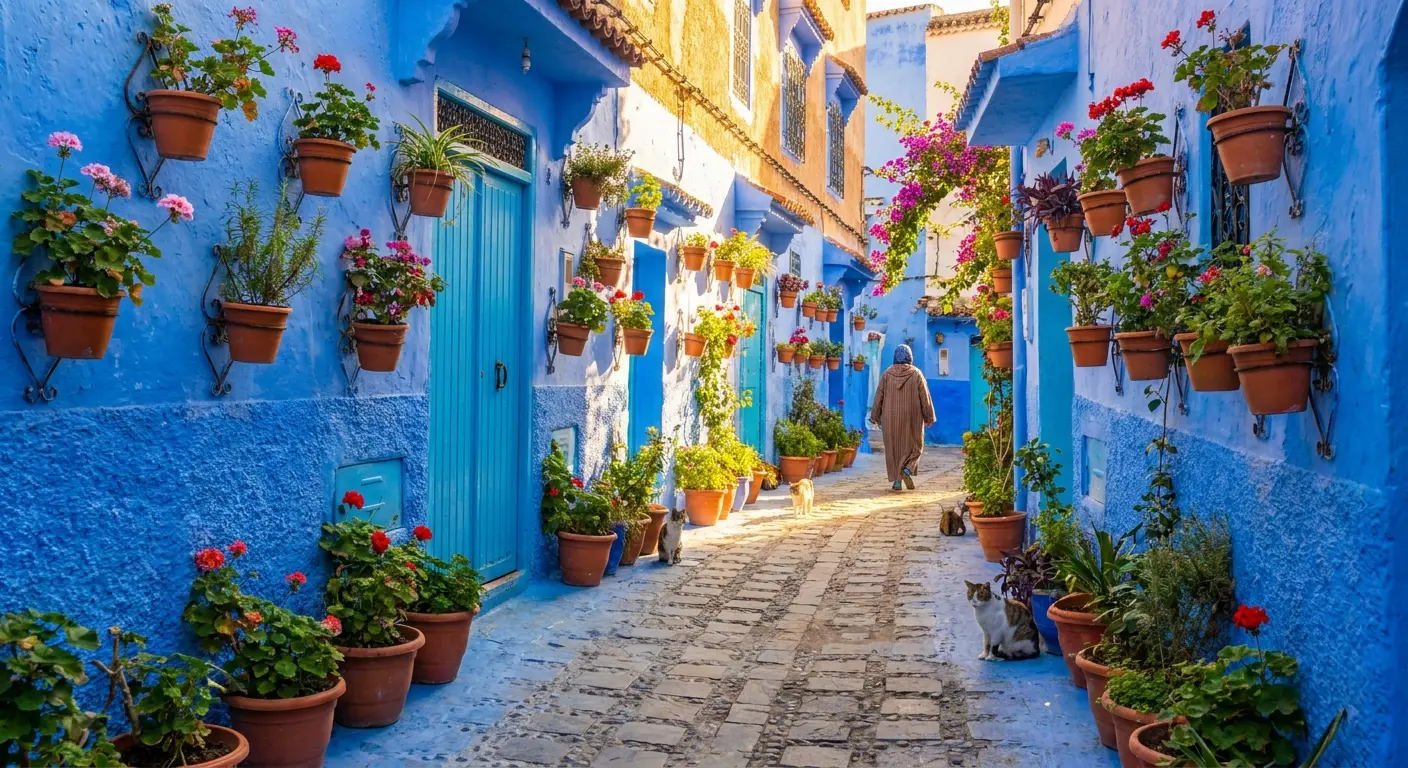
114 km from Europe, Tangier is the gateway to Africa. A Phoenician trading post, Roman capital of Mauretania Tingitana, Portuguese and then English town, from 1923 to 1956 it was an international zone that drew writers, painters and spies from all over the world. Today its Tanger Med port is one of the largest in the Mediterranean.
Tangier was founded as a Phoenician trading post, probably by the 8th century BC. By the 6th century the Berber tombs around it held Punic jewellery, a sign of brisk trade, and Carthage made it an important port in the 5th century. The town long kept its Phoenician traditions: under the Mauretanian kings it struck coins in Punic script.
The Greeks called it Tingis and told its legend: Tinge, widow of the giant Antaeus, bore Hercules a son, Sufax, who founded the town in her honour. Under Emperor Claudius, Tingis became a Roman colony and capital of the province of Mauretania Tingitana. In 298 two Christians, Saints Marcellus and Cassian, were beheaded here during the Great Persecution.
Vandals, Byzantines and the Arab conquest (429-740)
In 429 tens of thousands of Vandals led by Gaiseric crossed from Spain to Africa and occupied Tingis. In 533 the Byzantine general Belisarius retook it for Emperor Justinian, but the administration settled at Septem (Ceuta), easier to defend.
The town fell after a siege led by Musa ibn Nusayr between 707 and 711. It was from Tangier that his lieutenant Tariq ibn Ziyad launched the conquest of Spain in 711. The town became the Umayyads' capital of the far Maghreb, but heavy tributes imposed on the Berbers sparked the great revolt of 740: Maysara al-Matghari took Tangier, and the "Battle of the Nobles", fought near the town, decimated the Arab aristocracy of North Africa.
Between Moroccan dynasties (790-1471)
Idris I passed through Tangier before founding his kingdom and took the town around 790. In the 10th century it was contested between the caliphate of Cordoba and the Fatimids; Cordoba took it in 949. The Almoravids captured it in 1077, then the Almohads in 1147, under whom its port was very active. The Marinids had to besiege it for three months in 1274 to win its submission.
It was in this Marinid Tangier that Ibn Battuta was born in 1304; he left for Mecca at twenty and travelled for nearly thirty years, from China to Mali. In the late 14th century corsairs from Tangier and Salé began harassing ships in the strait.
Portuguese, then English (1471-1684)
English Tangier and the mole (1662-1684)
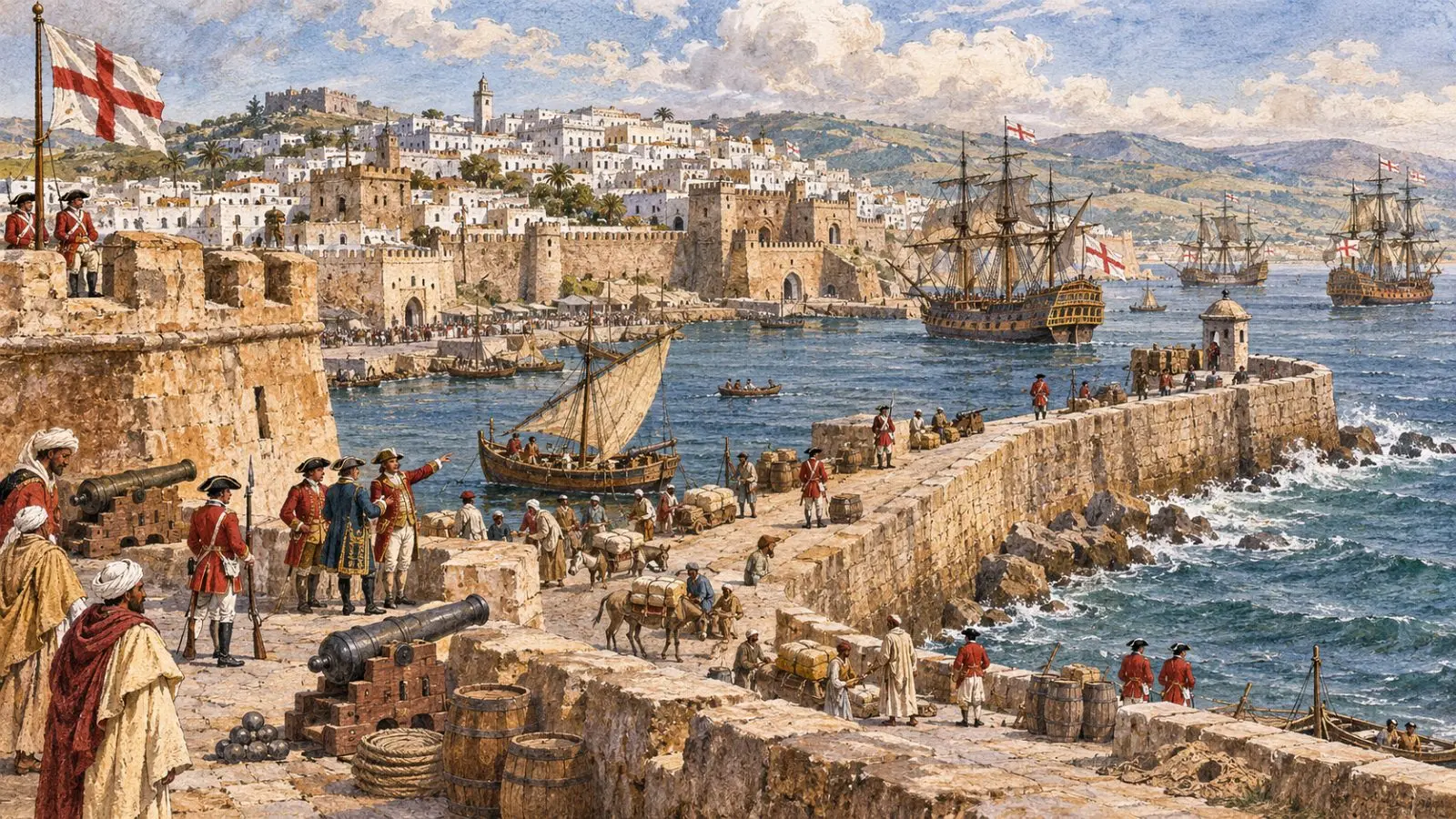
After taking Ceuta in 1415, the Portuguese failed before Tangier in 1437, 1458 and 1464, then occupied it unopposed on 28 August 1471, the garrison having fled on hearing of Asilah's fall. They turned the great mosque into a cathedral. In 1661 the town was given to King Charles II of England as part of Catherine of Braganza's dowry.
The English, constantly attacked by Khadir Ghailan's mujahideen, lost about 470 men in an ambush on 4 May 1664. They built a 438-metre mole to make it a major naval port, at enormous waste. After Moulay Ismail's siege (1678-1680), Parliament gave up: the English spent five months destroying the town and port and left; Morocco retook Tangier on 7 February 1684.
The city of diplomats (18th-19th century)
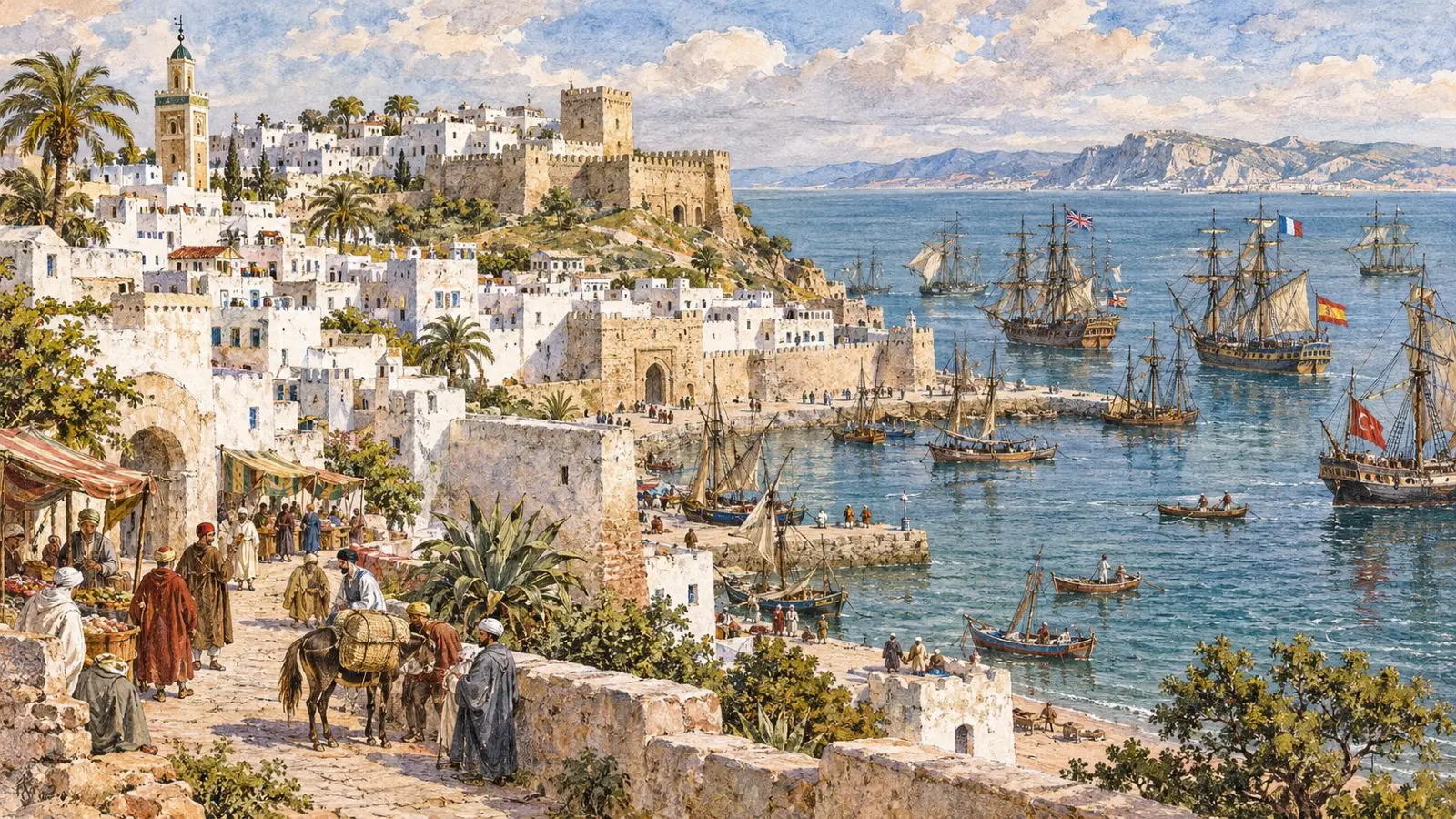
Repopulated by the governors Ali ibn Abdallah and his son Ahmed, Tangier became Morocco's diplomatic seat in the 18th century. The United States opened its first consulate here under George Washington; in 1821 Sultan Moulay Slimane gave them a house, the future American Legation, the first property owned by the US government abroad.
The Prince de Joinville's French fleet bombarded the town on 6 August 1844 during the Franco-Moroccan war. The Italian revolutionary Garibaldi lived here in exile from 1849. In the 1870s every foreign embassy and consulate was in Tangier, which then had about 20,000 inhabitants, 400 of them foreigners.
The Tangier crisis (1905)
In 1905 the German emperor Wilhelm II landed in Tangier and declared himself in favour of Moroccan independence, against French ambitions: the Tangier crisis nearly caused a war. The Algeciras Conference of 1906 ended it, placing the town's police and customs under international control.
That same year, 1905, Sultan Abd al-Aziz had Morocco's first newspaper, Lisan al-Maghrib, founded in Tangier. Before the First World War the town had about 40,000 inhabitants: half Muslim, a quarter Jewish and a quarter European Christians, mostly Spaniards.
The International Zone (1923-1956)
the international zone (1923-1956)
The 1912 Treaty of Fes left Tangier's status undecided. A convention signed in Paris on 18 December 1923 created the Tangier International Zone, run by France, Spain and Britain, joined by Italy from 1928. Over 373 km² the town became a tax haven and a refuge: Spanish republicans and nationalists, Jews fleeing Nazi Germany, Moroccan dissidents. Around 1935 it had about 50,000 inhabitants, 12,000 of them Jewish.
Franco's Spain occupied the town on 14 June 1940, the day Paris fell, until 11 October 1945. On 9 April 1947 Sultan Mohammed ben Youssef gave the Tangier speech there, calling for Morocco's unity and independence. In 1951 the nationalist parties signed the National Front pact in the city.
Moroccan Tangier
Meeting in Rabat in July 1952, the protecting powers agreed to abolish the zone, and Tangier rejoined Morocco with independence in 1956. It then had about 40,000 Muslims, 31,000 Christians and 15,000 Jews.
After decades of neglect, the city was transformed in the 21st century: the Tanger Med port opened in 2007 and became one of the Mediterranean's largest container ports, the Al Boraq high-speed train to Rabat and Casablanca arrived in 2018, and the medina and Tanger Ville port were renovated.
— II —
CHAPTER III
Key dates
400 BC
Tingis is a Phoenician and Carthaginian trading post.
1304
Birth of the traveller Ibn Battuta.
1661–1684
Tangier is English, part of Catherine of Braganza's dowry.
1923–1956
Tangier International Zone.
— III —
CHAPTER IV
Landmarks
1
The kasbah and its museum
At the top of the medina, the Dar el-Makhzen palace, built under Moulay Ismail after the English left, houses the Kasbah Museum with collections from prehistory to the Islamic period. From the square, a view over the strait and the Spanish coast.
2
The Grand Socco and Petit Socco
The Grand Socco (Place du 9 Avril 1947, the date of Mohammed V's independence speech) links the new town to the medina; at its heart, the Petit Socco and its cafés were the meeting place of the international zone's writers.
3
The Caves of Hercules and Cape Spartel
West of the city, where the Atlantic meets the Mediterranean, the Cape Spartel lighthouse (1864) and the Caves of Hercules, whose opening onto the sea is said to draw the map of Africa.
4
Café Hafa
Opened in 1921, this café of terraces hanging on the cliff has served mint tea and bissara facing the strait for a century; the Rolling Stones and Paul Bowles sat here.
5
The American Legation
Given to the United States by the sultan in 1821, it is the first American diplomatic property abroad. Morocco had been one of the first countries to recognise American independence, in 1777.
— IV —
CHAPTER V
People
IIbn Battuta1304–1377Born in Tangier, he travelled for nearly thirty years across Africa, the Middle East, India and China, and dictated the account of his journeys, the Rihla.
TTariq ibn Ziyad670–720Governor of Tangier, he crossed the strait in 711; Gibraltar (Jebel Tariq, “Tariq's mountain”) bears his name.
MMohamed Choukri1935–2003Tangier writer, author of For Bread Alone, an autobiographical account of his destitute childhood, translated into some forty languages.
PPaul Bowles1910–1999American writer and composer, settled in Tangier from 1947 until his death, author of The Sheltering Sky; he also recorded Moroccan traditional music.
HHenri Matisse1869–1954The painter stayed there in 1912 and 1913; Tangier's light changed his palette, from Window at Tangier to The Moroccan Café.
— V —
CHAPTER VI
Culture and traditions
A city of literature
From Choukri to Bowles, from Burroughs to Jean Genet, Tangier inspired a whole literature; the Librairie des Colonnes, open since 1949, keeps its memory.
Music of the north
The Andalusian and tarab tradition, the Jbala music of the nearby mountains, and the Tanjazz festival every autumn.
The Beat Generation literary legacy is deeply felt — cafés where Burroughs and Bowles wrote are still standing. The Thursday antique market in the Grand Socco remains a local ritual. The Amazigh (Berber) Riffian culture is strong in the surrounding region. Tangier's distinct Andalusian-influenced music, called Gharnati, is performed at cultural events.
— VI —
CHAPTER VII
The people
The Tanjawis
Tangier has always been a place of passage: Jbala mountain families, Riffians, Spaniards, English and Sephardic Jews lived here together. Tanjawis have kept an openness and irony they're proud of, and a fierce attachment to their football club, Ittihad Tanger.
A darija full of Spanish
Northern speech borrows heavily from Spanish ("cuchara" for spoon, "semana" for week), and most Tanjawis speak Spanish, often better than French.
Fish from the straitBetween two seas, Tangier eats the catch of the day: grilled sardines, squid, and sea bream from the fishing port.
— VIII —
CHAPTER IX
Did you know?
01Ibn Battuta, the greatest traveller of the Middle Ages, was born in Tangier in 1304.
02From 1923 to 1956 Tangier was an international zone run by several European countries.
03Tanger Med port, opened in 2007, has become one of the Mediterranean's largest container ports.
— IX —
Frequently asked questions about Tangier
How many days do you need in Tangier?
Allow 1–3 days to see Tangier without rushing. That is the length we use in our itineraries.
When is the best time to visit Tangier?
The best months for Tangier are April, May, June, September and October.
How much does a day in Tangier cost?
Per person per day, accommodation included: about $40 on a budget, $90 mid-range and $220 for a luxury stay.
How do you get to Tangier?
Tangier Ibn Battouta Airport (TNG) with European direct flights. Tangier Ville train station connects to Casablanca (5.5h), Fes (5h), Rabat (3h). Ferry to Tarifa, Spain (35 min).
What is there to see in Tangier?
The must-sees of Tangier: Kasbah Museum, Cap Spartel, Caves of Hercules and Grand Socco.
What should you eat in Tangier?
To taste in Tangier: Grilled merguez, Bissara, Sfenj and Maakouda.
Where should you stay in Tangier?
The best areas to stay: Medina, Ville Nouvelle and Malabata.
Is Tangier safe?
Yes, Tangier welcomes many travellers every year. The precautions are those of any tourist destination: watch your belongings in crowds, politely turn down unofficial guides, agree on a taxi fare before getting in.